Deleting a table in Google Docs takes one click once you know where the option is, but it’s easy to end up deleting only the text inside the cells, or leaving an empty table behind. This guide shows how to delete a whole table on a computer and in the mobile apps, how to remove just rows or columns, how to keep the text while removing the table, and how to hide borders instead of deleting.
Quick Answer
Right-click any cell in the table and choose Delete table. The table and everything in it disappear. Press Ctrl + Z (Cmd + Z on Mac) right away if you change your mind.
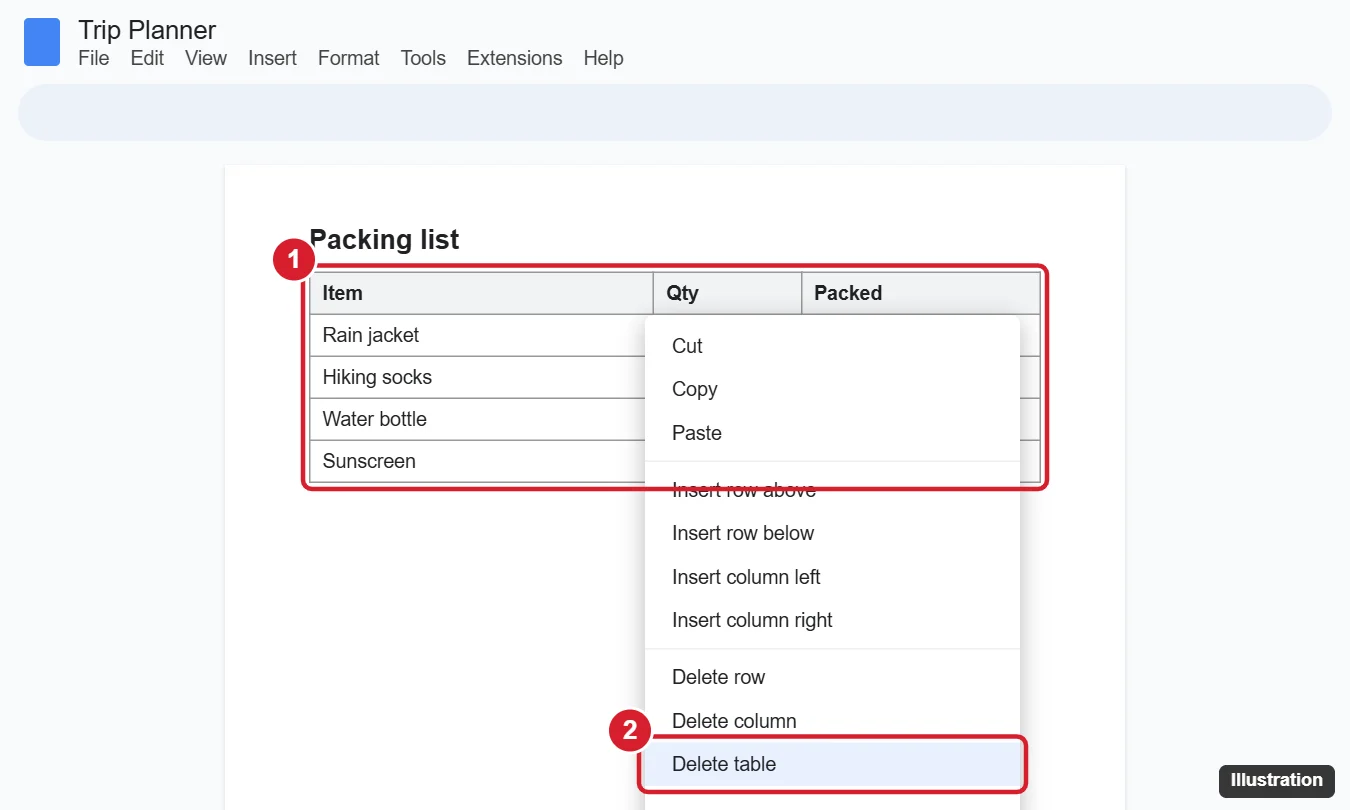
Method 1: Right-Click (Computer)
- Open the document at docs.google.com.
- Right-click inside any cell of the table.
- Choose Delete table.
Method 2: Select and Delete
- Click just above or below the table and drag across it so the whole table, plus a line of text before or after it, is highlighted.
- Press Delete or Backspace.
If you select only the cells, pressing Delete clears the contents but leaves an empty table. Include the surrounding line to remove the table itself.
Method 3: Google Docs Mobile App
Android
- Open the document and tap the pencil icon to edit.
- Tap inside a cell of the table.
- Tap the Format icon (A with lines) and open the Table tab.
- Tap Delete table.
iPhone and iPad
- Tap the pencil icon, then tap inside the table.
- Tap the Format icon and choose the Table tab.
- Tap Delete table.
Menu labels can vary slightly between app versions. You can also press and hold a cell to see table options.
Delete Only Rows or Columns
| To remove | Do this |
|---|---|
| One row | Right-click a cell in the row and choose Delete row |
| One column | Right-click a cell in the column and choose Delete column |
| Several rows or columns | Select cells across them, right-click, and choose Delete rows or Delete columns |
| Just the contents | Select the cells and press Delete |
Remove the Table but Keep the Text
Google Docs has no “convert table to text” command, but this workaround works well:
- Select all the cells in the table and press Ctrl + C to copy.
- Click below the table and press Ctrl + Shift + V (Cmd + Shift + V on Mac) to paste without formatting. Each cell’s text appears on its own line.
- Right-click the original table and choose Delete table.
For tidier results with tab-separated columns, paste into Google Sheets first, then copy from Sheets and paste back as plain text.
Hide Borders Instead of Deleting
If you use a table only for layout, such as placing an image next to text, you can make it invisible:
- Right-click the table and choose Table properties.
- Under Color, set Table border width to 0 pt.
- Close the panel. The layout stays, and the lines don’t print.
Troubleshooting
There’s no Delete table option
You’re probably in Viewing or Suggesting mode, or you have view-only access. Switch to Editing using the mode button at the top right, or ask the owner for edit access.
An empty line or blank page is left behind
Click just after where the table was and press Backspace to remove the extra paragraph.
The table won’t delete because it’s at the very end of the document
Click right after the table, press Enter to create a line, then select from above the table down to that line and press Delete.
Frequently Asked Questions
Can I recover a deleted table?
Press Ctrl + Z immediately, or restore an earlier version with File > Version history > See version history.
Does deleting a table remove the images inside it?
Yes. Everything in the table is deleted, so move any images you want to keep first.
How do I delete a table in Google Slides?
Click the table’s border to select it and press Delete.
Summary
- Right-click any cell and choose Delete table.
- Or select the table plus a surrounding line and press Delete.
- On phones, use Format > Table > Delete table.
- Copy and paste as plain text first to keep the words.
- Set borders to 0 pt to hide a layout table instead.

Kermit Matthews is a freelance writer based in Philadelphia, Pennsylvania with more than a decade of experience writing technology guides. He has a Bachelor’s and Master’s degree in Computer Science and has spent much of his professional career in IT management.
He specializes in writing content about iPhones, Android devices, Microsoft Office, and many other popular applications and devices.