To draw a line through text in Google Docs, select the words and choose Format > Text > Strikethrough. The keyboard shortcut is Alt + Shift + 5 on Windows or ChromeOS and Command + Shift + X on Mac. Apply the same command again to remove the line.
Strikethrough keeps the words readable while marking them as completed, replaced, or no longer needed. For example, you could show an old price beside its replacement: $40 $30. It changes the text’s formatting; it does not delete the words.
This guide covers Google Docs in a computer browser and the Google Docs apps for Android, iPhone, and iPad. You need permission to edit the document to change its formatting directly.
How to cross out text in Google Docs on a computer
- Open your document in Google Docs. If it is in Viewing mode, switch to Editing when your access allows it.
- Select the text. Drag across the words, or double-click a single word. Make sure the highlight covers only what you want to cross out.
- Click Format in the menu bar above the document.
- Open Text, then click Strikethrough. A line appears through the selected characters.
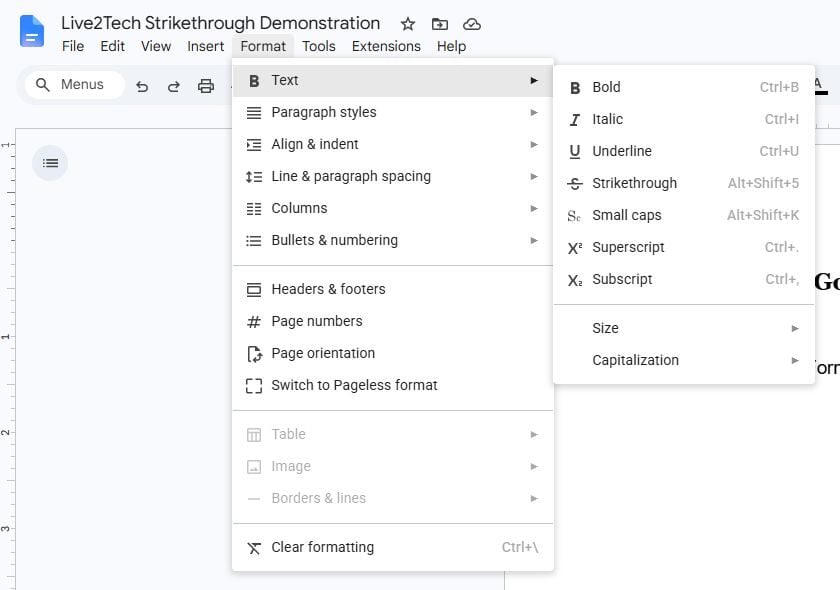
You can select a phrase, several paragraphs, a heading, or text inside a table. The line belongs to the characters, so you do not need to position a drawing over them. Use strikethrough for crossing out words; a separate horizontal rule or drawing is a different kind of object.
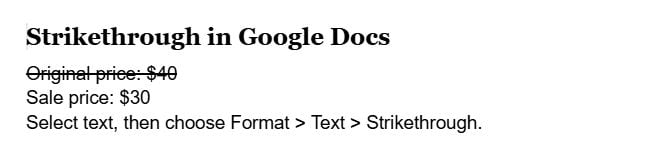
Use the strikethrough keyboard shortcut
Select the text first, then press the keys together. Choose the shortcut for your computer’s operating system.
| Computer | Shortcut |
|---|---|
| Windows or ChromeOS | Alt + Shift + 5 |
| Mac | Command + Shift + X |
Google lists these in its Google Docs keyboard shortcuts. Keyboard layouts can affect availability. If the shortcut does not work, use the Format menu instead.
Another route is the menu search: press Alt + / on Windows or ChromeOS, or Option + / on Mac. Type “strikethrough” and choose the matching command. This is useful when you remember the feature’s name but not its location.
How to add strikethrough on Android
- Open the document in the Google Docs app and tap Edit, shown as a pencil.
- Select the words. Move the selection handles to include the full phrase.
- Tap Format, the A icon, and open the text formatting options.
- Tap Strikethrough, shown as an S with a line through it.
The selected words should now be crossed out. Google’s Android text formatting guide explains the Edit, selection, and Format controls.
How to add strikethrough on iPhone or iPad
- Open the document in the Google Docs app and tap the pencil to edit.
- Double-tap a word, then move the blue markers to select additional text.
- Open the Format controls and choose the Text options if needed.
- Tap the Strikethrough button to cross out the selection.
See Google’s iPhone and iPad formatting instructions if your controls look different. Use the app’s formatting controls when working without a computer keyboard.
How to remove strikethrough without removing other formatting
Select the crossed-out text and choose Format > Text > Strikethrough again, or repeat your computer’s shortcut. In the mobile app, select the text and tap the same strikethrough button again.
Use this toggle when you want to keep the text’s other styling. Clear formatting changes more than strikethrough: it can also remove formatting you wanted to retain, such as bold or a custom text color. On a computer, that command is under Format; its shortcut is Ctrl + backslash on Windows or ChromeOS, or Command + backslash on Mac.
Fix common strikethrough problems
- Nothing changes: Check that the text is selected and the document itself has focus, rather than a search box or browser address bar. Try the menu command to separate a shortcut problem from an editing-access problem.
- The command is unavailable: Check whether you are viewing a shared file without editing permission. Ask the owner for the access needed for your task.
- New words are crossed out too: Turn strikethrough off at the insertion point before continuing, or select the unintended text and toggle it off.
- The line disappears after copying: A plain-text destination cannot keep rich-text formatting. Check the pasted result in the destination app rather than assuming it preserved the line.
Checklists and suggested edits
For a to-do list, use Google Docs’ checklist control. Google offers checklists with or without strikethrough. Choose the style under Format > Bullets & numbering > Checklist; do not assume every checklist crosses out completed items.
For changes that another person must approve, use Suggesting mode. Switch from Editing to Suggesting, then delete the proposed text. Docs displays the suggested deletion crossed out for review. Applying ordinary strikethrough in Editing mode does not create a deletion request someone can accept or reject. Add a comment when the reason for a change needs explanation.
Frequently asked questions
Can I change the line’s color or add a double line?
The strikethrough uses the text’s color. Our guide to changing font color in Google Docs shows how to recolor the selection. The standard Docs strikethrough control offers a single line; there is no separate double-strikethrough choice in the Text menu.
Can I combine it with bold or highlighting?
Yes. Select the same words and apply the additional format you need. Keep the text readable, and explain a change in words when readers might miss its visual formatting.
Will the line appear in a downloaded or printed document?
Check the downloaded file or print preview before sharing it. Use File > Download for a PDF or Word copy, then inspect the crossed-out text in that file. A plain-text copy cannot preserve the formatting.
Does this work in Google Sheets and Slides?
Both have strikethrough. Select cells in Sheets or text inside a Slides text box. Google documents Alt + Shift + 5 on Windows and Command + Shift + X on Mac for Sheets and Slides. Check the application’s own shortcut list when switching between editors.

Kermit Matthews is a freelance writer based in Philadelphia, Pennsylvania with more than a decade of experience writing technology guides. He has a Bachelor’s and Master’s degree in Computer Science and has spent much of his professional career in IT management.
He specializes in writing content about iPhones, Android devices, Microsoft Office, and many other popular applications and devices.