To hide a row or column in Excel 2013, select it by clicking its row number or column letter, right-click, and choose Hide. The keyboard shortcuts are Ctrl + 9 to hide the selected rows and Ctrl + 0 to hide the selected columns. A double line between headers shows where something is hidden. The same steps work in every newer Excel version.
If the lines between cells seem to be gone rather than the rows themselves, work through the causes of missing gridlines instead.
Need room for new data instead of hiding old data? Here is how to insert a blank column in Excel.
Excel can’t hide a single cell, only whole rows and columns. If you want to hide what’s in specific cells, use the custom number format trick further down.
How to Hide Rows or Columns
- Click the row number or column letter. Drag across headers to select several, or hold Ctrl and click to pick ones that aren’t next to each other.
- Right-click any selected header.
- Choose Hide.
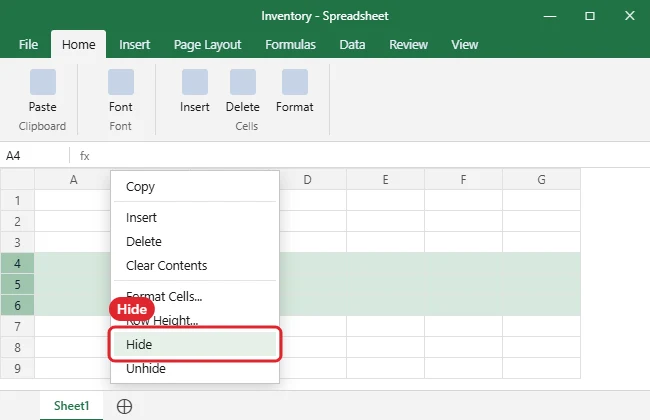
You can also use Home > Format > Hide & Unhide > Hide Rows or Hide Columns. This works even if you’ve only selected a cell in the row or column.
When a whole sheet of helper data should be out of view rather than a few rows, you can hide the entire worksheet from its tab instead.
Keyboard Shortcuts
| Action | Shortcut |
|---|---|
| Hide rows | Ctrl + 9 |
| Hide columns | Ctrl + 0 |
| Unhide rows | Ctrl + Shift + 9 |
| Unhide columns | Ctrl + Shift + 0 (may not work; see Troubleshooting) |
| Hide via ribbon keys | Alt, H, O, U, then R (rows) or C (columns) |
How to Unhide Rows or Columns
- Select the headers on both sides of the hidden ones. For hidden column C, select B through D.
- Right-click the selection and choose Unhide.
To unhide everything, press Ctrl + A (or click the corner box above row 1), then go to Home > Format > Hide & Unhide > Unhide Rows and again for Unhide Columns.
If row 1 or column A is hidden, type A1 in the Name Box to the left of the formula bar, press Enter, then use Home > Format > Hide & Unhide > Unhide Rows (or Columns).
Hide the Contents of Individual Cells
- Select the cells and press Ctrl + 1.
- On the Number tab, choose Custom.
- Type three semicolons (;;;) in the Type box and click OK.
The values disappear from the grid and printouts but stay in the cells and in formulas. You can still see them in the formula bar when the cell is selected. To hide that too, protect the sheet with the cell’s Hidden option turned on (Format Cells > Protection).
Whole sheets can be hidden too, and unhiding a sheet in Excel takes only a right-click on any tab.
Group Instead of Hide
If you’ll hide and show the same rows often, select them and use Data > Group. A plus/minus button appears in the margin so you can collapse and expand them with one click.
Troubleshooting Hidden Rows and Columns
- Ctrl + Shift + 0 doesn’t unhide columns: Windows reserves that combination for switching keyboard input languages. Use right-click > Unhide, or turn off the shortcut in Windows keyboard settings under advanced keyboard, input language hot keys.
- Unhide is grayed out: The sheet is protected. Go to Review > Unprotect Sheet.
- Rows won’t unhide: Their height may be set very small rather than hidden, or a filter is hiding them. Set Row Height to 15, or clear the filter with Data > Clear.
- A column is too narrow to see: See how to set column width in Excel.
Hidden data is still searchable. Learn how to search for a word in Excel, including in hidden cells.
Be careful when a title is centered across several cells in Excel, because hiding its first column hides the whole title.
Other Questions About Hidden Rows and Columns
Do hidden rows print?
No. Hidden rows and columns are left out of printouts.
Are hidden rows included in SUM?
Yes, SUM includes them. Use SUBTOTAL(109, range) or AGGREGATE to add only visible cells.
How do I hide all unused rows below my data?
Click the first empty row number, press Ctrl + Shift + Down Arrow, and press Ctrl + 9.

Kermit Matthews runs Live2Tech from just outside Philadelphia. He is an IT specialist with over 20 years of experience, from a university help desk to small-business IT, IT management and his own consulting practice, and has written tech guides full time since 2020. Steps are checked against the current software on a real device or the maker’s official documentation. More about Kermit.