Google Sheets normally shows the results of your formulas, not the formulas themselves. When you need to audit a spreadsheet, find a mistake, or print a copy that shows how everything is calculated, you can switch the whole sheet to show equations instead. This guide covers the menu option, the keyboard shortcut, the FORMULATEXT function for showing a formula next to its result, and how to hide formulas from other people.
Quick Answer
Click View > Show > Formulas, or press Ctrl + ` (the backtick key, left of 1) on Windows or ChromeOS, or Cmd + ` on a Mac. Every cell with a formula now shows the formula. Repeat the same step to switch back.
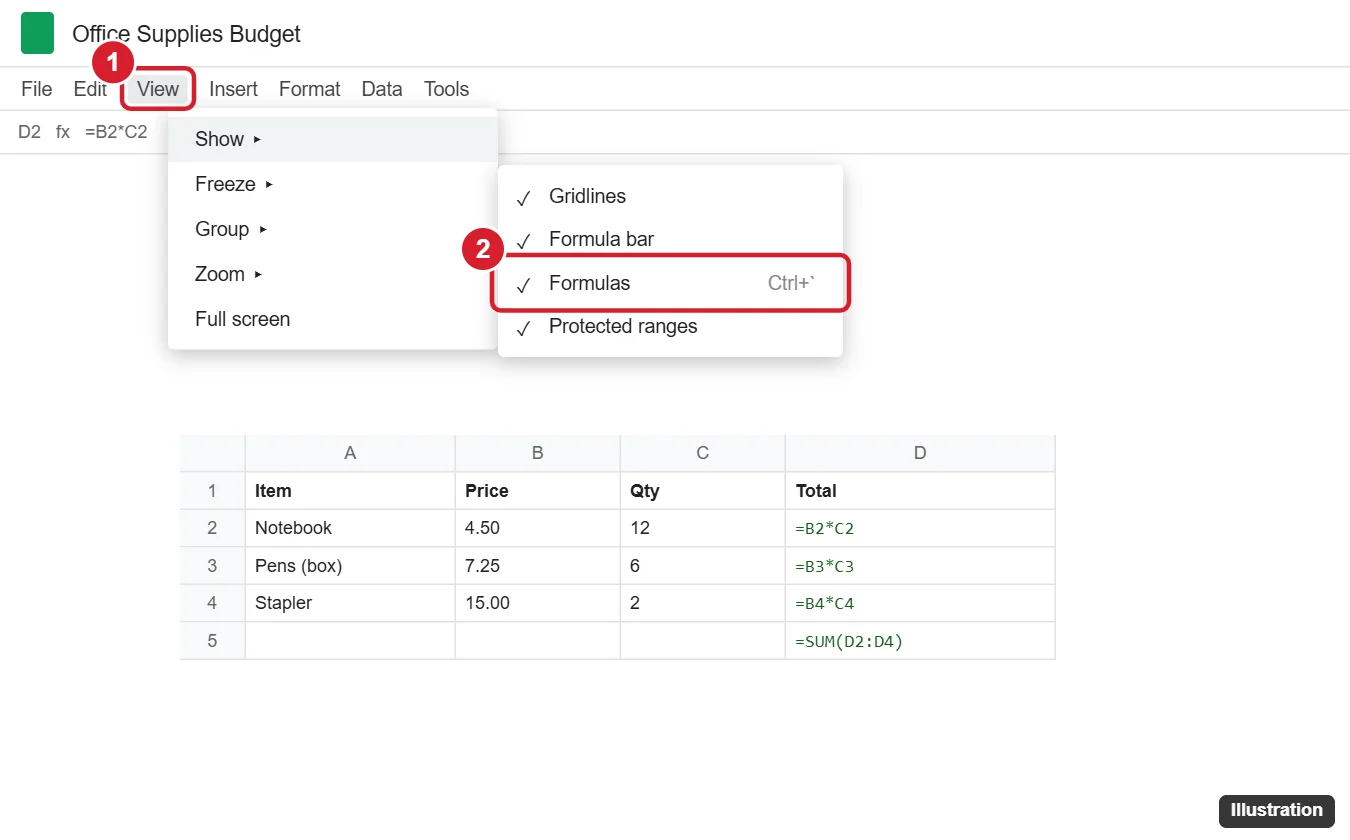
Method 1: View Menu
- Open your spreadsheet in Google Sheets.
- Click View in the menu bar.
- Point to Show and click Formulas. A checkmark appears next to it.
- Columns widen automatically so longer formulas fit.
This setting applies to the current sheet tab in your view only; it doesn’t change what collaborators see.
Method 2: Keyboard Shortcut
- Windows and ChromeOS: Ctrl + `
- Mac: Cmd + `
On some international keyboards the backtick key is in a different place, or the shortcut conflicts with system settings. Use the View menu if the shortcut does nothing.
Method 3: Check One Formula
- Click a cell and look at the formula bar above the grid. If it’s hidden, turn it on with View > Show > Formula bar.
- Double-click the cell (or press F2 / Enter) to edit it in place. Referenced cells are outlined in color, which makes tracing easier. Press Esc to leave without changing anything.
Method 4: Show Formulas Next to Results with FORMULATEXT
To display a formula in another cell while keeping the result visible, use FORMULATEXT:
- Click an empty cell next to the formula, for example E2.
- Type
=FORMULATEXT(D2)and press Enter. - Drag the fill handle down to show formulas for other rows.
This is handy for teaching, documentation, or printing a sheet that shows both answers and methods. If the referenced cell has no formula, FORMULATEXT returns an error; wrap it as =IFERROR(FORMULATEXT(D2),"") to leave those blank.
Print or Download with Formulas Showing
Turn on View > Show > Formulas, then choose File > Print or File > Download > PDF. The output shows the formulas as they appear on screen. Turn the view off afterward.
Hide or Protect Formulas from Others
Google Sheets doesn’t have a true “hide formula” setting. Anyone with edit or view access to a cell can see its formula in the formula bar. Your options:
- Protect ranges: Data > Protect sheets and ranges prevents editing, but formulas stay visible.
- Share results only: copy the range and use Edit > Paste special > Values only in a separate sheet or file you share.
- Use IMPORTRANGE: keep formulas in a private file and pull only results into the shared file.
Troubleshooting
- A cell shows the formula as text even with the view off: the cell is formatted as plain text or the formula starts with a space or apostrophe. Set Format > Number > Automatic and re-enter it starting with =.
- Shortcut doesn’t work: use the View menu, or check that a browser extension isn’t capturing the key.
- Can’t find the Formulas option on mobile: the Sheets app doesn’t have this view. Tap a cell to see its formula in the bar at the bottom, or use a computer.
Frequently Asked Questions
Does showing formulas change my spreadsheet?
No. It only changes how the sheet is displayed on your screen.
Is this the same as in Excel?
Nearly. Excel uses Ctrl + ` too, or Formulas > Show Formulas.
Why are my columns wider after showing formulas?
Sheets widens columns to fit formulas. They return to normal when you turn the view off.
Summary
- Click View > Show > Formulas or press Ctrl/Cmd + `.
- Use the formula bar to check a single cell.
- Use
FORMULATEXTto show a formula beside its result. - Share values only if you don’t want others to see your formulas.

Kermit Matthews is a freelance writer based in Philadelphia, Pennsylvania with more than a decade of experience writing technology guides. He has a Bachelor’s and Master’s degree in Computer Science and has spent much of his professional career in IT management.
He specializes in writing content about iPhones, Android devices, Microsoft Office, and many other popular applications and devices.