Background App Refresh lets iPhone apps fetch new content while you’re not using them, so your email, news, and social feeds are up to date when you open them. It also uses battery and cellular data. On an older iPhone like the iPhone 7, or any iPhone with a worn battery, turning it off, or limiting it to certain apps, can noticeably stretch battery life. This guide shows how to turn it off completely, per app, or only on cellular, and explains what changes when you do.
Quick Answer
Open Settings > General > Background App Refresh. Tap Background App Refresh at the top and choose Off to disable it for all apps, or Wi-Fi to save cellular data. To keep it for some apps only, leave it on and switch off individual apps in the list.
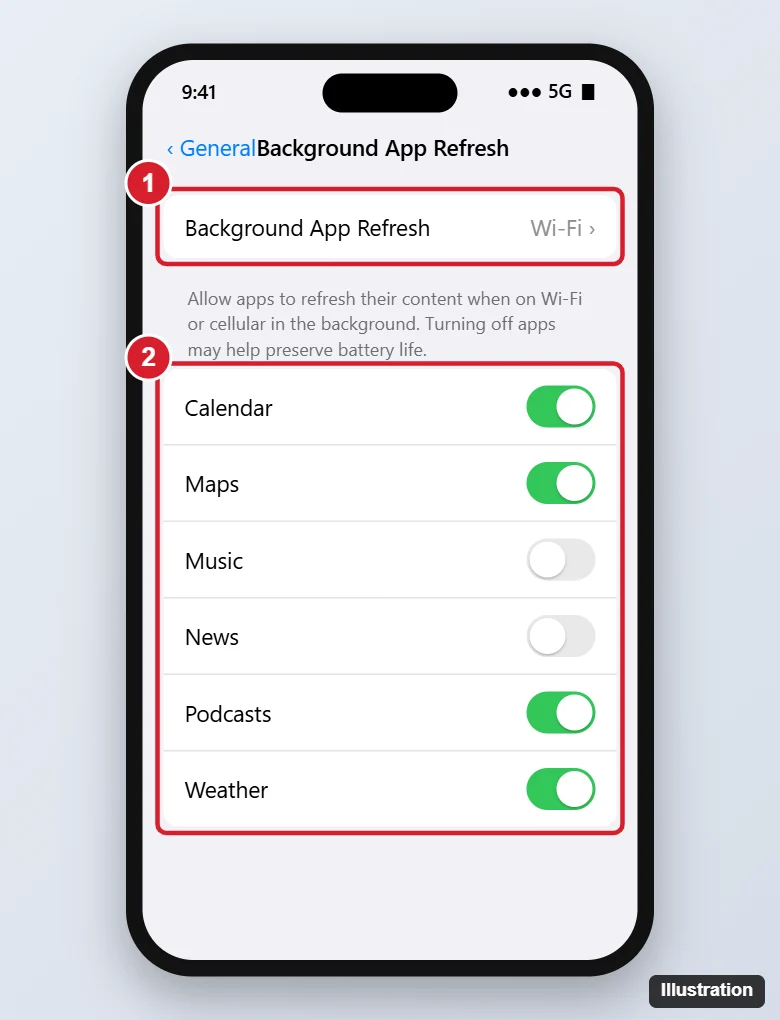
Turn Off Background App Refresh for All Apps
- Open Settings.
- Tap General > Background App Refresh.
- Tap Background App Refresh at the top.
- Choose Off.
The Three Options
| Option | What happens | Best for |
|---|---|---|
| Off | No app refreshes in the background | Maximum battery and data savings |
| Wi-Fi | Apps refresh only on Wi-Fi | Limited cellular data plans |
| Wi-Fi & Cellular Data | Apps refresh on any connection (default) | Always-fresh content |
Turn It Off for Specific Apps
- Go to Settings > General > Background App Refresh.
- Leave the main option on Wi-Fi or Wi-Fi & Cellular Data.
- Turn off the switch for apps that don’t need to refresh, such as games, shopping apps, or news apps you check rarely.
Keep it on for apps where fresh data matters, like navigation, messaging, weather widgets, or fitness sync.
Find the Apps Using the Most Battery
Go to Settings > Battery and scroll to the app list. Tap an app to see its background activity time. Apps with high background activity are good candidates to turn off.
What Changes When It’s Off?
- Notifications still arrive. Push notifications for messages, email, and calls don’t depend on Background App Refresh.
- Apps may take a moment to load new content when you open them.
- Some widgets may update less often.
- Location-based features that rely on background updates may be less timely.
Why the Setting Is Greyed Out
- Low Power Mode temporarily disables Background App Refresh. Turn it off in Settings > Battery to change the setting.
- Screen Time restrictions may lock it: Settings > Screen Time > Content & Privacy Restrictions > Background App Activities.
- A work or school management profile may control it.
Other Ways to Save Battery on an Older iPhone
- Check Settings > Battery > Battery Health. If maximum capacity is under about 80%, a battery replacement makes the biggest difference.
- Lower screen brightness and shorten Auto-Lock.
- Limit Location Services to While Using the App for most apps.
- Use Low Power Mode when you’re away from a charger.
On the watch too? See turning off Background App Refresh on the Apple Watch.
Frequently Asked Questions
Does closing apps in the App Switcher save battery?
Generally no. iOS manages suspended apps efficiently. Force-closing and reopening can use more power.
Will I miss messages if I turn it off?
No. Messages and push notifications still come through.
Is this setting the same on newer iPhones?
Yes. It’s in the same place in current iOS versions.
Summary
- Go to Settings > General > Background App Refresh.
- Choose Off, Wi-Fi, or Wi-Fi & Cellular Data.
- Turn off individual apps that don’t need to refresh.
- Turn off Low Power Mode if the setting is greyed out.

Kermit Matthews is a freelance writer based in Philadelphia, Pennsylvania with more than a decade of experience writing technology guides. He has a Bachelor’s and Master’s degree in Computer Science and has spent much of his professional career in IT management.
He specializes in writing content about iPhones, Android devices, Microsoft Office, and many other popular applications and devices.