If your iPhone screen suddenly slides down halfway, leaving the top half empty, you’ve triggered Reachability. It’s a one-handed feature that brings the top of the screen within reach of your thumb. It’s handy on large iPhones, but easy to activate by accident. This guide shows how to use it on purpose, how to turn it off if the screen keeps moving, and how the gesture differs on iPhones with and without a Home button (including the iPhone 7 and iPhone SE).
Quick Answer
Go to Settings > Accessibility > Touch and switch Reachability off to stop the screen from moving down. To use it, turn it on, then swipe down on the bottom edge of the screen (Face ID iPhones) or lightly double-tap the Home button (iPhones with a Home button).
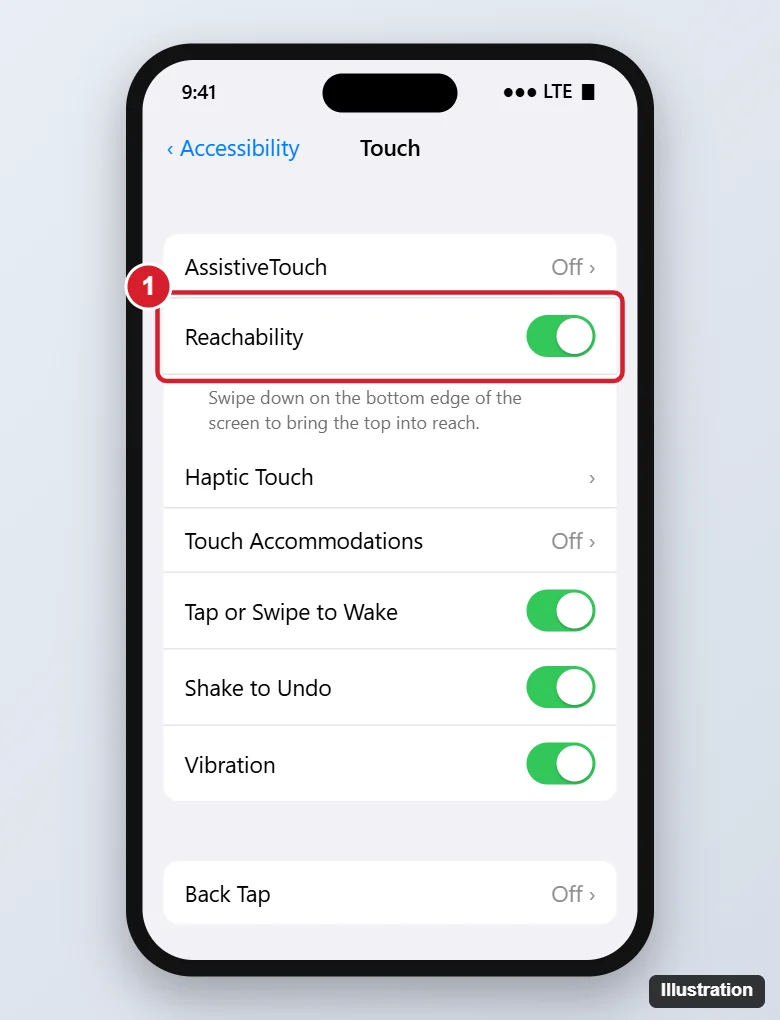
How to Turn Reachability Off (Stop the Screen Moving Down)
- Open Settings.
- Tap Accessibility.
- Tap Touch.
- Switch Reachability off.
On iOS 12 and earlier, the setting is in Settings > General > Accessibility > Reachability.
How to Turn Reachability On
Follow the same steps and switch Reachability on (green).
How to Use Reachability
iPhones With Face ID (iPhone X and Later)
- Place your thumb on the bottom edge of the screen, on or just above the Home indicator bar.
- Swipe down a short distance. The top half of the screen slides down.
iPhones With a Home Button (iPhone SE, iPhone 8 and Earlier)
- Lightly touch the Home button twice (don’t press it).
- The screen slides down.
Double-pressing the Home button opens the App Switcher instead, which is how many people end up in Reachability by accident when they tap too softly.
Return to Normal
Tap the empty top area, swipe up from the bottom, or wait a few seconds. Reachability also ends when you open an app or tap something.
Tips for Using Reachability
- While the screen is lowered, swiping down on the empty top-left area opens Notification Center, and swiping down on the top-right area opens Control Center.
- It works in most apps and on the Home Screen, but not on the Lock Screen or in landscape orientation.
- For a more permanent one-handed setup, try the Back Tap shortcut (Settings > Accessibility > Touch > Back Tap) or AssistiveTouch.
- On iPhones with a Home button, you can also use Settings > Display & Brightness > Display Zoom to change how much fits on screen.
Screen Still Moving or Shifted?
- Screen partly zoomed: this may be Zoom, not Reachability. Double-tap the screen with three fingers, or turn off Settings > Accessibility > Zoom.
- Screen stuck lowered: tap the empty area or press the side button to lock and unlock.
- Keyboard shifted to one side: that’s the one-handed keyboard. Touch and hold the emoji or globe key and choose the centered keyboard.
- Accidental swipes with a case: a thick case lip can trigger the bottom-edge gesture. Turn Reachability off.
Related: How to Turn Off Double Tap on iPhone.
Frequently Asked Questions
Does Reachability work on iPad?
No. It’s only available on iPhone.
Can I make Reachability lower the screen less?
No. The distance is fixed at about half the screen.
Why can’t I find Reachability in General settings?
Since iOS 13, it’s under Accessibility > Touch.
Summary
- Settings > Accessibility > Touch > Reachability.
- Turn it off to stop the screen moving down.
- Or keep it on and swipe down on the bottom edge (or lightly double-tap Home).
- Tap the top area to return to normal.

Kermit Matthews is a freelance writer based in Philadelphia, Pennsylvania with more than a decade of experience writing technology guides. He has a Bachelor’s and Master’s degree in Computer Science and has spent much of his professional career in IT management.
He specializes in writing content about iPhones, Android devices, Microsoft Office, and many other popular applications and devices.