Your iPhone can type Chinese with several input methods: Pinyin (spelling words with Latin letters), handwriting (drawing characters with your finger), stroke, and more, in either Simplified or Traditional characters. Adding a Chinese keyboard takes a minute and doesn’t change your iPhone’s language. This guide covers adding the keyboard on an iPhone 13 (the steps are the same on other models), choosing the right input method, switching keyboards, and removing one you don’t need.
Quick Answer
Open Settings > General > Keyboard > Keyboards > Add New Keyboard. Tap Chinese, Simplified or Chinese, Traditional, check the input methods you want (for example Pinyin – QWERTY and Handwriting), and tap Done. While typing, tap the globe key to switch to it.
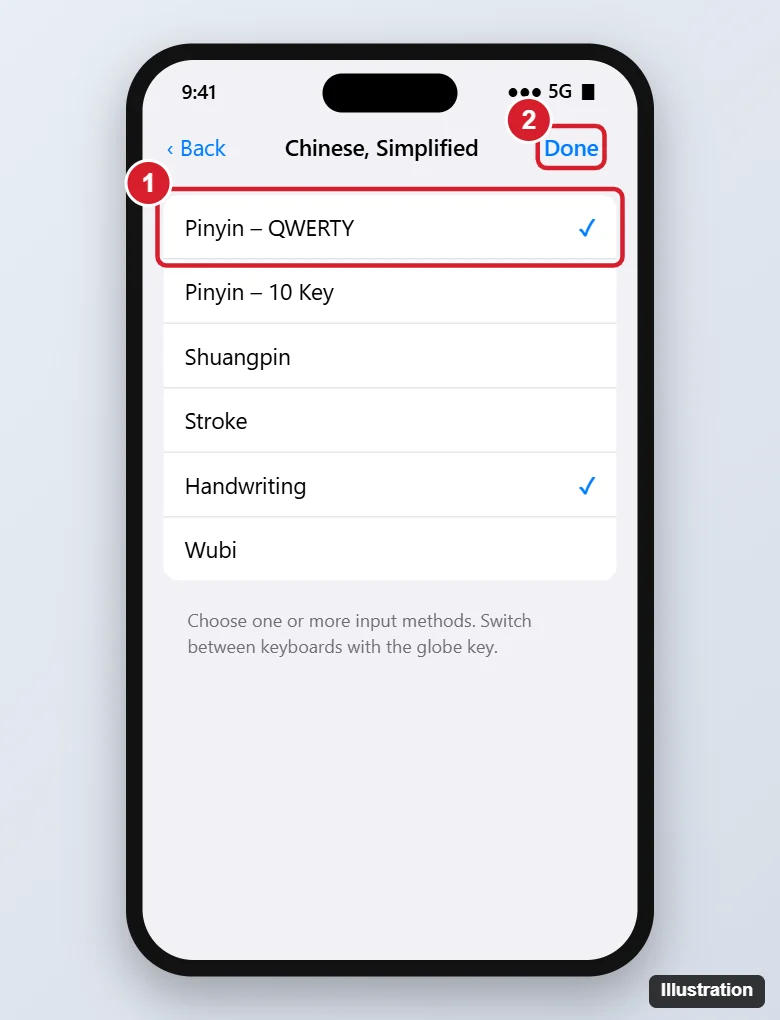
Add a Chinese Keyboard
- Open Settings.
- Tap General > Keyboard > Keyboards.
- Tap Add New Keyboard.
- Choose Chinese, Simplified (used in mainland China and Singapore) or Chinese, Traditional (used in Taiwan, Hong Kong, and Macau). There’s also Cantonese, Traditional.
- Select one or more input methods and tap Done.
Which Input Method Should You Choose?
| Method | How it works | Best for |
|---|---|---|
| Pinyin – QWERTY | Type the Pinyin spelling, then pick characters from suggestions | Most learners and Mandarin speakers |
| Pinyin – 10 Key | Phone-style keypad for Pinyin | One-handed typing |
| Handwriting | Draw characters with your finger | Characters you can write but can’t spell |
| Stroke | Tap the stroke types in order | People who know stroke order |
| Shuangpin / Wubi | Faster, shortcut-based schemes | Experienced typists |
| Zhuyin (Bopomofo), Cangjie, Sucheng | Traditional Chinese input systems | Taiwan and Hong Kong users |
Switch to the Chinese Keyboard
- In any app, tap the globe key (bottom left) to cycle through keyboards.
- Or press and hold the globe key and choose the keyboard from the list.
Typing Tips
- With Pinyin, type the whole word (for example, “nihao”) and pick 你好 from the suggestion bar. Tap the arrow to see more options.
- You don’t need to type tone marks. Suggestions use context.
- Add custom phrases in Settings > General > Keyboard > Text Replacement.
- To reorder keyboards, go to Keyboards > Edit and drag the handles.
Remove a Chinese Keyboard
- Go to Settings > General > Keyboard > Keyboards.
- Tap Edit, tap the red minus next to the keyboard, and tap Delete.
Or swipe left on the keyboard and tap Delete.
Troubleshooting
The globe key is missing
You probably have only one keyboard. Add the Chinese keyboard first. On some models, the globe appears below the keyboard.
Handwriting doesn’t recognize characters
Write larger, in the correct stroke order, and pause briefly between characters.
Suggestions are in the wrong script
You added Traditional instead of Simplified, or the reverse. Add the other keyboard and remove the one you don’t need.
Frequently Asked Questions
Does adding a Chinese keyboard change my iPhone’s language?
No. Your iPhone’s language stays the same. Change it separately in Settings > General > Language & Region if you want.
Is the Chinese keyboard free?
Yes. All the built-in keyboards are free and included with iOS.
Summary
- Go to Settings > General > Keyboard > Keyboards > Add New Keyboard.
- Choose Chinese Simplified or Traditional and pick input methods.
- Tap the globe key to switch while typing.
- Remove keyboards with Edit when you don’t need them.

Kermit Matthews is a freelance writer based in Philadelphia, Pennsylvania with more than a decade of experience writing technology guides. He has a Bachelor’s and Master’s degree in Computer Science and has spent much of his professional career in IT management.
He specializes in writing content about iPhones, Android devices, Microsoft Office, and many other popular applications and devices.