Windows 11 has no single “default search engine” switch. Google is set inside each browser you use: Chrome under Settings > Search engine, Firefox under Settings > Search, and Microsoft Edge under its Address bar and search settings. The search box on the taskbar and in the Start menu is separate; it uses Bing, and on most PCs Windows offers no option to change that. The steps below apply to current versions of Windows 11.
Which search box are you typing in?
Most of the confusion comes from treating every search box on the PC as one setting. Use this table to find the box you care about, then go straight to that section.
| Where you type | Where the setting lives | Can it be Google? |
|---|---|---|
| Chrome’s address bar | Chrome > Settings > Search engine | Yes |
| Firefox’s address bar and search bar | Firefox > Settings > Search | Yes |
| Edge’s address bar | Edge > Settings > Privacy, search, and services | Yes |
| Taskbar or Start menu search | Windows itself | Generally no; some search provider choices exist only in the European Economic Area |
| Links you click in email or other apps | Settings > Apps > Default apps (default browser) | Indirectly: they open in your default browser, which then uses its own search engine |
A practical setup for most people: pick one browser, set Google as its search engine, then make that browser your Windows default. Every web search you start from a browser, and every link you open from another app, then lands on Google.
Chrome: pick Google in Search engine settings
In many countries Chrome already uses Google. Google’s help page notes that in some countries Chrome asks you to choose a search engine instead, so it is worth checking, especially on a new PC or after someone else set the browser up.
- Open Chrome and select More (the three dots at the top right), then Settings.
- Select Search engine in the left column.
- Next to the search engine setting, select Change, choose Google, and confirm the choice.
To test it, type a few words into the address bar and press Enter. The results page address should start with google.com. Google documents the current path on its page about setting your default search engine in Chrome.
The same Search engine page has a link to Manage search engines and site search. That list shows every engine Chrome knows about, lets you add one by hand, and is where you fix things if Google is missing (covered further down).
Firefox: choose Google as the default search engine
- Select the menu button (three lines at the top right) and choose Settings.
- Select Search on the left.
- Open the Default Search Engine drop-down and choose Google.
Firefox saves the change right away; there is no Save button. Mozilla’s article on changing the default search settings in Firefox also warns that extensions can change the default, which matters if Google keeps getting replaced. For more Firefox detail, see setting the default search engine in Firefox.
Edge: switch the address bar from Bing to Google
Edge ships with Bing, and the setting sits a few levels deep. Microsoft lists the current location on its page about changing the default search engine in Microsoft Edge.
- Open Edge and select Settings and more (the three dots at the top right), then Settings.
- Select Privacy, search, and services on the left.
- Select Search and connected services, then Address bar and search.
- In the Search engine used in the address bar menu, choose Google.
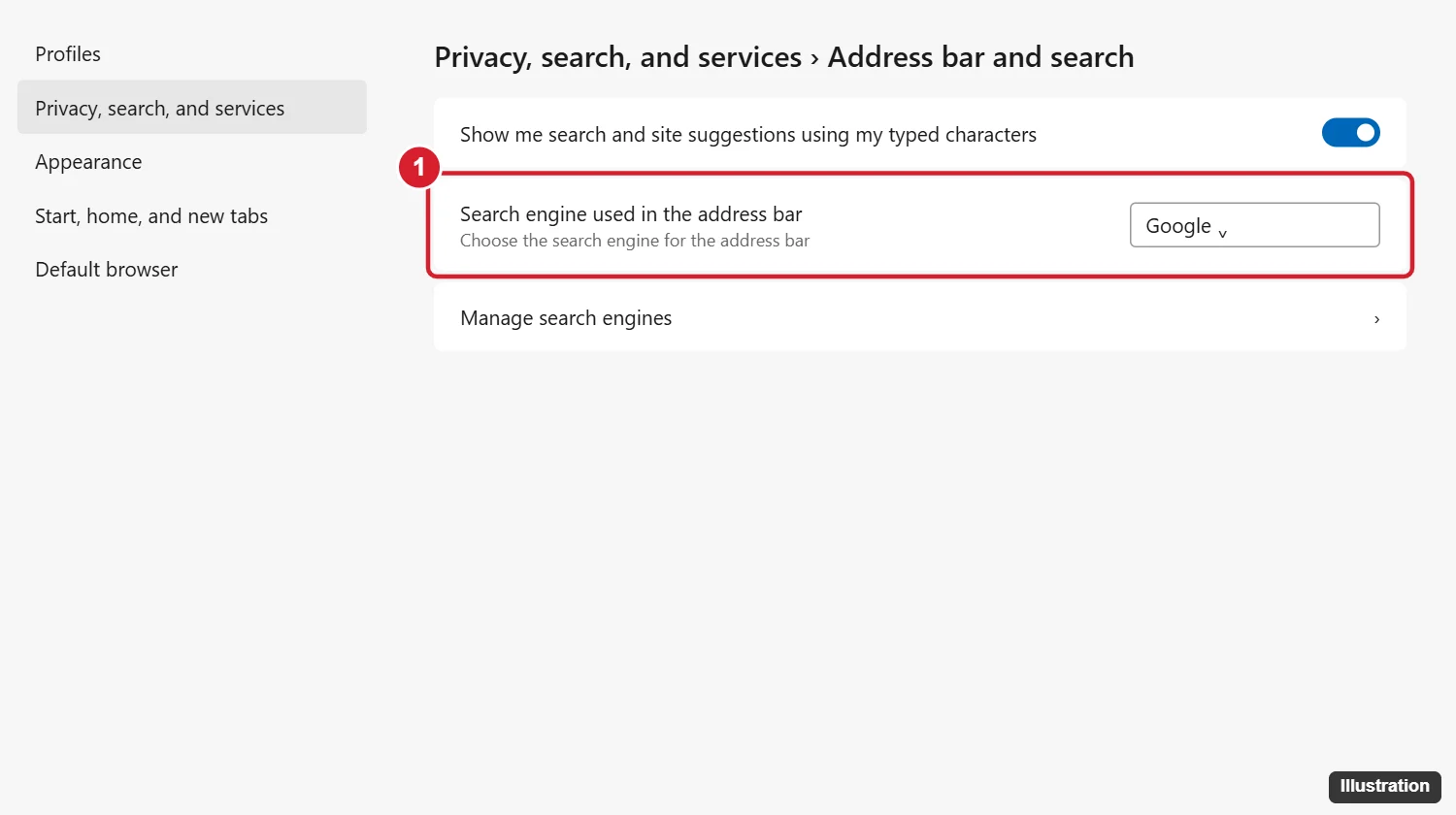
Microsoft points out that keeping Bing gives you some extras inside Edge, such as direct links to Windows apps in search results. Switching to Google removes those, which is a fair trade for most people who just want familiar results. A longer walkthrough of the Edge side, including older Edge layouts, is in changing from Bing to Google in Microsoft Edge.
What the taskbar search box does with web searches
When you type into the taskbar search box or the Start menu and pick a web result, Windows 11 handles that search, not your browser. On PCs outside Europe, Windows doesn’t offer a setting in its Settings app to switch those web results from Bing to Google, and Microsoft’s documentation doesn’t describe one. That is why changing the browser setting doesn’t affect the taskbar box.
The European Economic Area (EEA) is different. Microsoft’s Digital Markets Act update post says that on Windows PCs in the EEA, other apps can provide web search results inside Windows Search, those providers can be reordered in Settings, and the Bing app opens web content in your default browser. If you are in the EEA and a Google app offers itself as a provider, that is where it would show up.
Everywhere else, the simplest workaround is habit: press Ctrl + L in your browser to jump to the address bar and search there. Pinning a browser shortcut that opens Google is another option; see pinning Google to the Windows 11 taskbar.
Default search engine vs default browser
These two settings sound alike and are often mixed up. The default search engine decides which site handles what you type into a browser’s address bar. The default browser decides which browser opens when you click a link in Outlook, Teams, a PDF or any other app. Setting Google in Chrome does nothing if links keep opening in Edge, and the reverse is also true.
To change the default browser in Windows 11:
- Open Settings > Apps > Default apps.
- Under the list of applications, find and select your browser, for example Google Chrome.
- Select Set default next to the option to make it your default browser.
Microsoft’s default apps page documents this route, and Google’s help page on making Chrome your default browser shows the same Settings path. In the EEA, Microsoft says Set default also covers more link and file types and pins the browser to the taskbar unless you clear that option. For the Chrome case with more detail, see setting Chrome as your default browser in Windows 11, and for other browsers, changing the default browser in Windows 11.
Add Google by hand when it’s not listed
Occasionally Google is missing from a browser’s list, usually because someone deleted it, an extension removed it, or a work profile limits the choices.
In Chrome
- Go to Settings > Search engine > Manage search engines and site search.
- Next to Site search, select Add.
- Fill in the three fields: a name (Google), a shortcut (for example google.com), and the URL with
%swhere the search terms go:http://www.google.com/search?q=%s, the example Google gives on its help page. - Select Add, then open the three-dot menu next to the new entry and choose Make default.
Google’s page on managing search engines in Chrome explains these fields and adds one exception: the Gemini entry can’t be edited, deleted or made the default.
In Edge
Edge adds engines it has seen you use. Microsoft’s fix is to run one search with that engine first, for example by going to google.com and searching there. Google then appears in the Search engine used in the address bar menu, and you can select it.
Check every route in two minutes
Once the settings are changed, run a short test so you know which paths now reach Google and which still don’t. It also gives you a baseline if something changes later.
- Address bar test. In each browser you use, open a new window, type a plain phrase such as weather tomorrow into the address bar, and press Enter. The page address should begin with google.com.
- Link test. Click a web link inside an email or a document. It should open in the browser you set as default. If it opens somewhere else, revisit the Default apps steps.
- Taskbar test. Type the same phrase into the taskbar search box and choose a web result. Outside the EEA, expect Bing; that confirms the box is working as Windows designed it, not that your browser change failed.
- Restart test. Close the browser fully, reopen it, and repeat the first test. A setting that resets on restart points to an extension, a policy or sync, covered next.
Changing your mind later is just as easy: go back to the same settings page and pick another engine. Nothing you did here deletes Bing or any other engine from the list.
Why Google keeps getting replaced
If you set Google and a day later your searches go to an unfamiliar site, something is changing the setting. Check these in order.
- Extensions. Look through the extensions or add-ons page of the browser and remove anything you don’t recognize, particularly “search”, “new tab” or “coupon” add-ons. Mozilla notes that Firefox extensions can change your search engine.
- Unwanted software. Google warns that unexpected changes to Chrome’s search engine can be a sign of malware. Run a full scan in Windows Security and uninstall unfamiliar programs from Settings > Apps > Installed apps, especially anything installed around the time the change started.
- A managed work or school PC. Google’s Chrome help says that on some work or school networks, the administrator sets the search engine. If the option is greyed out or a message says your organization manages the browser, ask IT; the policy will keep putting its choice back.
- Browser sync. If you sign in to the same browser on several PCs, another computer with a different setting can sync it back. Fix it on every PC, or check the browser’s sync options.
Picture a home laptop that came with a free PDF tool: within a week Chrome’s searches start going to a site nobody chose. Removing the bundled toolbar extension, uninstalling the PDF tool, and then picking Google again in Search engine settings usually settles it.
Search engine questions
Is the default search engine the same thing as the default browser?
No. The search engine is a setting inside each browser. The default browser is a Windows setting that decides which browser opens links. You usually want both pointed where you prefer.
Do I need a Google account or to sign in for this to work?
The search engine choice is a browser setting, and none of the vendor pages cited here mention a Google account as a requirement. Signing in mainly adds things like search history across devices.
Can Windows search in the taskbar use Google if I live outside Europe?
Not through a setting in Windows that Microsoft documents. The provider choices Microsoft describes apply to the EEA. Search from your browser’s address bar instead.
What does a shortcut keyword in Chrome’s search engine list do?
It lets you search a specific site from the address bar without changing your default. Type the shortcut, press Tab or Space, then your search, and Chrome sends it to that site.
Why is Gemini listed in Chrome’s search engines, and can I make it the default?
Chrome lists it as a built-in entry. Google’s help page says it can’t be edited, deleted or set as the default search engine.
Phones keep their own setting: see making Google the default search engine in Safari, and changing the default search engine to Google for other devices.
With Google set in your browser and that browser set as the Windows default, try a few Google search operators next; searching for PDFs on Google is a useful one to start with.

Kermit Matthews runs Live2Tech from just outside Philadelphia. He started on a university help desk, spent years as the IT person for small businesses, and has been writing tech guides full time since 2020. Each guide is checked on a device he owns, and re-checked when a menu moves. More about Kermit.