If your Firefox searches suddenly open on an engine you never chose, or you just want a different one, the fix is the same menu: Settings > Search > Default search engine. What changes is what you do next, so start with where you search and what you noticed.
The steps cover desktop Firefox on Windows, Mac and Linux, plus Firefox for iPhone, iPad and Android.
Where each Firefox search box gets its engine
Firefox has more than one place to type a search, and they don’t all follow the same rule. Before changing anything, find the row that matches where you search.
| Where you type | Engine it uses | Where to change it |
|---|---|---|
| Address bar (desktop) | The default search engine | Settings > Search > Default search engine |
| Search bar, if you added it to the toolbar | The same default (Mozilla says the setting covers the address bar and the search bar) | Same menu as above |
| Unified Search button or an @ shortcut | Whatever engine you choose for that one search | In the address bar itself, each time |
| Private windows | Mozilla’s search pages don’t describe a separate private-window default | Not documented |
| Firefox for Android | Its own default, set on the phone | Engine icon in the address bar > Search settings |
| Firefox for iPhone and iPad | Its own default, set on the device | Menu button > Settings > Search |
Set the default on a computer
These steps follow Mozilla’s page on how to manage Firefox search settings. They are the same on Windows, Mac and Linux.
- Click the menu button (three horizontal lines) at the top right of the Firefox window and select Settings. On a Mac you can also click Firefox in the menu bar at the top of the screen and choose Settings (some versions say Preferences).
- Select Search in the left pane.
- Open the drop-down menu under Default search engine.
- Choose the engine you want to use for searches you type in the address bar.
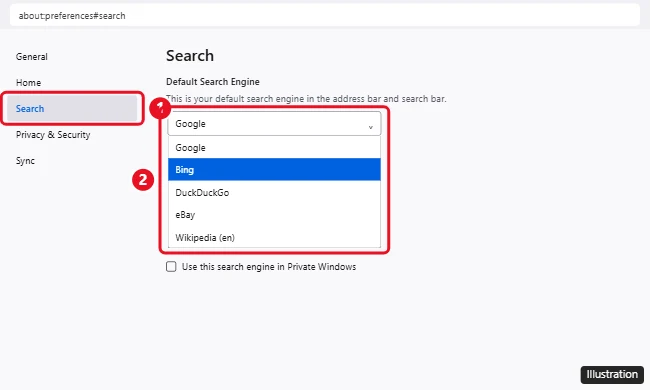
To check the result, open a new tab, type a few words that aren’t a web address, such as weather this weekend, and press Enter. The results page should come from the engine you just picked.
The same Search page has a few related checkboxes. Show search terms in the address bar on results pages keeps your words in the address bar after a search, and Show search suggestions controls the list that drops down as you type. Neither one changes which engine runs the search.
An engine missing from the drop-down is either hidden or not installed yet; both cases are covered under managing the list of engines below.
Use another engine for a single search
If the default is fine and you only want another engine now and then, Mozilla’s page on searching with the address bar describes two ways to do that without touching Settings.
With the Unified Search button:
- Click in the address bar and start typing.
- Click the Unified Search button, which shows the icon of your default search engine at the left end of the address bar.
- Pick another engine from the list. The same list also lets you search your Bookmarks, Tabs or History instead of the web.
With typed shortcuts:
- Type @ followed by an engine’s shortcut, such as @wikipedia, then your search terms.
- Start with * to search bookmarks, % to search open tabs, or ^ to search your history.
You can give any engine a shorter keyword. Mozilla’s steps to assign shortcuts to search engines are: Settings > Search, find the engine under Additional search engines, click its pencil icon, type the keyword and press Enter.
Firefox for Android
Mozilla’s page on how to manage default search engines in Firefox for Android gives this route:
- Tap the search engine icon in the address bar.
- Tap Search settings.
- Tap Default search engine and choose an engine.
To add one, tap Add search engine at the bottom of the same screen, fill in Name and Search string URL (with %s for the search terms), and tap Save. The Search Suggestion API URL field is optional.
Firefox for iPhone and iPad
Mozilla’s page to change the default search engine in Firefox for iOS describes these steps. That page is older than the desktop ones, so labels on your screen may differ slightly.
- Tap the menu button (at the bottom of the screen on iPhone, top right on iPad) and tap Settings.
- Tap Search.
- Tap the name of the current default engine.
- Tap the engine you want; a check mark shows the one in use.
- Go back to Settings and tap Done.
When Firefox changes the default for you
Mozilla’s pages describe two causes for a default that changes on its own: a Firefox update and an extension. Match what you saw to a row, then follow the fix.
| What you noticed | Likely cause | What to do |
|---|---|---|
| A Firefox message saying the search engine changed, right after an update | Mozilla updated the engine list or the default for your region | Keep the new engine or pick another in Settings > Search |
| The default changed soon after you installed an add-on | An extension set a new default | Disable or remove that extension, then pick your engine again |
| An engine you deleted comes back after a restart | Mozilla says this may be a Firefox extension | Find and remove the extension |
After a Firefox update
Mozilla’s page My default search engine changed after updating Firefox explains that Mozilla occasionally updates the list of search engines, or the default engine for certain regions. When that affects you, Firefox shows a notification so you can keep the new default or set a search engine of your choice. Pick your engine again and you’re done.
An extension took over the setting
Some extensions can set a new default search engine. Mozilla’s steps to disable or remove add-ons are:
- Click the menu button and choose Add-ons and themes (some menus say Extensions and themes).
- Select Extensions.
- Turn off the toggle of an extension you don’t recognize or recently installed, or open its three-dot menu and choose Remove.
- Go back to Settings > Search and choose your default again.
If you can’t tell which extension is responsible, starting Firefox with extensions turned off narrows it down; see how to restart Firefox in Troubleshoot Mode.
Start over with Refresh Firefox
When the engine keeps flipping and you can’t find the extension behind it, Refresh Firefox is Mozilla’s reset for add-ons and settings. Mozilla’s page on how to refresh Firefox gives this route:
- Click the menu button and choose Help and Report (the menu item may simply say Help in some versions).
- Choose More troubleshooting information.
- Click the Refresh Firefox button on the right, then confirm with Refresh Firefox.
- When Firefox restarts and lists what it imported, click Finish.
Know what you lose before you click. Mozilla says a refresh keeps bookmarks, browsing and download history, passwords, cookies, web form autofill and your personal dictionary. It removes extensions and themes, website permissions, modified preferences, added search engines and toolbar customizations, among other items. Your old profile data is saved to a folder named Old Firefox Data on your desktop. After the refresh, set your default engine again and re-add any custom engines.
Mozilla’s search pages don’t cover programs installed outside Firefox, so the steps here stay inside the browser.
Manage the list of engines Firefox offers
Mozilla’s page on how to add or remove a search engine lists several routes. Use the first one that fits.
Add an engine from its own website
- Open the search engine’s website in Firefox.
- Right-click the address bar (Control-click on a Mac) and choose Add “[name]”, where [name] is the engine. Some sites also offer it when you right-click their search field and choose Add Search Engine.
- Go back to Settings > Search and select the new engine under Default search engine if you want it as the default.
Add an engine by typing its search address (Firefox 140 and later)
Mozilla says that starting in Firefox version 140 you can add custom search engines in Settings, even ones Firefox does not officially support. Earlier versions don’t offer this in Settings.
- Open Settings > Search and scroll to Additional search engines.
- Click Add search engine.
- Enter a Search engine name.
- In the URL box, enter the engine’s search address with %s where your search terms should go, for example https://search.example.com/?q=%s.
- Add a keyword if you want one, then click Add Engine.
A simple way to find the right address: search for a test word such as firefoxtest on the engine’s website, copy the results page address, and replace the test word with %s.
Add an engine from Firefox add-ons
Some engines are offered as add-ons on addons.mozilla.org, Mozilla’s own add-on site. The Find more search engines link on the Search settings page takes you there. Stick to that site, and keep in mind that an engine added by an add-on can only be removed by disabling or removing that add-on.
Hide a built-in engine or delete one you added
Firefox treats the engines it ships with differently from the ones you add. Mozilla is direct about it: you cannot remove built-in search engines, but you can hide them.
| Type of engine | What you can do | How |
|---|---|---|
| Built into Firefox | Hide it, and show it again later | Turn off its toggle under Additional search engines; turn it back on to restore it |
| Added by you | Delete it | Click its trash can icon under Additional search engines |
| Added by an extension | Remove it with the extension | Disable or remove the add-on |
Older Firefox releases show a Search Shortcuts list instead of Additional search engines. There, you clear an engine’s check mark to hide it, select an engine you added and click Remove, or click Restore Default Search Engines to bring back hidden built-ins. If your screen shows that layout, these are the controls to use.
Firefox search engine answers
Does the search bar use a different engine from the address bar?
No. Mozilla describes the default engine as the one used in both the address bar and the search bar, so one change covers both. The only exception is a one-off search where you pick another engine with the Unified Search button or an @ shortcut.
Can I set a separate engine for private windows?
Mozilla’s search help pages don’t describe a separate default for private windows. The Search settings page does have a Show search suggestions in private windows option, but that controls suggestions, not the engine.
Does changing the search engine change my homepage?
No. The search engine setting on the Search page does not include the homepage, which is set elsewhere in Settings. If you also want a new homepage, the steps to make Google your homepage or make Yahoo your homepage include Firefox alongside other browsers.
Each browser keeps its own search engine. If you want Google everywhere on one computer, see how to make Google the default search engine on Windows 11. Edge users can follow the steps for switching Edge’s search engine to Google, and on a phone, Edge has its own search engine setting on iPhone. For Safari, there are separate steps to change the Safari search engine on iPhone and to change it in Safari on a Mac.
Staying with Firefox, you might also want to open links in a new tab or clear the Firefox cache when pages misbehave. Once your engine is set, run one test search in a new tab to confirm it stuck.

Kermit Matthews runs Live2Tech from just outside Philadelphia. He is an IT specialist with over 20 years of experience, from a university help desk to small-business IT, IT management and his own consulting practice, and has written tech guides full time since 2020. Steps are checked against the current software on a real device or the maker’s official documentation. More about Kermit.