Google Docs can collapse sections under headings. Format your section titles as headings (Heading 1, Heading 2, and so on), then hover over a heading and click the small arrow to its left. Everything under that heading, down to the next heading of the same or higher level, folds up. Click the arrow again to expand it. This works best in pageless format (File > Page setup > Pageless), and depending on your Google account, the arrows may only appear there.
Below are the full steps, how to collapse everything at once, and other ways to organize long documents, such as the outline and document tabs.
Step 1: Turn your section titles into headings
- Click in the line you want to use as a section title.
- Open the style menu in the toolbar (it usually says Normal text) and choose Heading 1, Heading 2, or Heading 3.
- Repeat for every section. Use Heading 1 for main sections and Heading 2 or 3 for subsections.
Keyboard shortcuts: Ctrl + Alt + 1, 2, or 3 on Windows, or Command + Option + 1, 2, or 3 on a Mac.
Step 2: Switch to pageless format (if needed)
- Click File > Page setup.
- Select the Pageless tab at the top and click OK.
Pageless removes page breaks, headers, and footers from view. If you need to print, you can switch back to Pages at any time without losing your content. On some accounts, collapsible headings also work in Pages format.
Step 3: Collapse and expand sections
- Hover your mouse to the left of a heading. A small arrow appears.
- Click the arrow to collapse the section. The arrow points right when the section is collapsed.
- Click it again to expand the section.
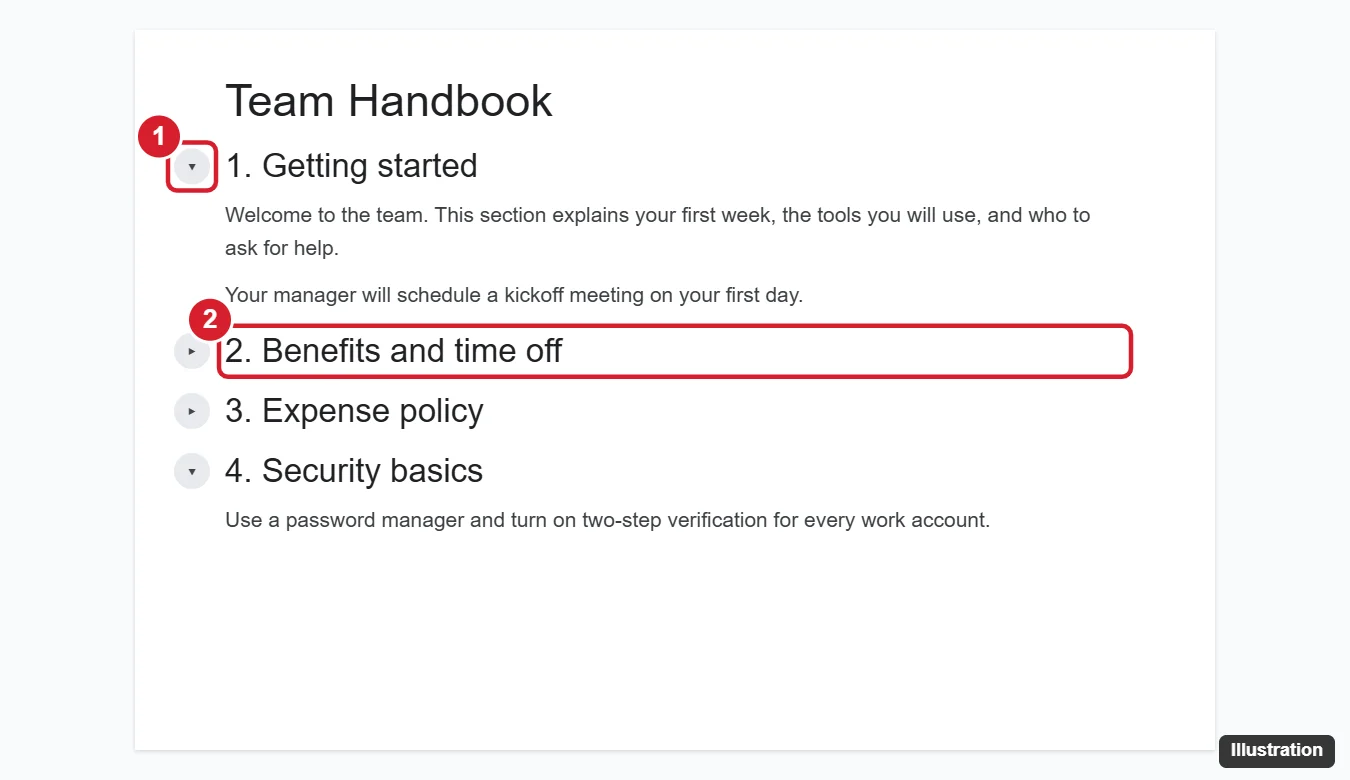
Collapsing a Heading 1 also hides every Heading 2 and Heading 3 inside it.
How to collapse or expand all sections at once
Right-click any heading’s arrow or the heading itself and look for Collapse all headings or Expand all headings. If you don’t see those options, collapse each top-level heading one at a time.
Do collapsed sections stay collapsed for others?
Collapsing is a view setting. Other people who open the document may see sections expanded, and they can collapse or expand them on their own screen without changing yours. Collapsed text still prints, exports, and shows up in search (Ctrl + F).
Other ways to organize a long Google Doc
| Tool | How to use it | Best for |
|---|---|---|
| Document outline | Click the Show outline icon at the top left, or View > Show outline | Jumping between sections |
| Document tabs | Click the + next to Document tabs in the left panel | Splitting a big document into separate pages, like chapters |
| Table of contents | Insert > Table of contents | Clickable links at the top of the document |
| Dropdown chips | Insert > Dropdown | Status labels, not hiding text |
To move sections between document tabs, see how to move content between tabs in Google Docs.
Troubleshooting
- No arrow next to my heading. Make sure the line uses a Heading style, not just bold, larger text. Then try pageless format.
- The arrow collapses too much. A section runs until the next heading of the same or higher level. Use Heading 2 for subsections so a Heading 1 collapse includes them, but a Heading 2 collapse doesn’t hide the next main section.
- It doesn’t work on my phone. Collapsible headings aren’t available in every version of the Google Docs mobile apps. Use a computer, or use the outline to navigate.
Frequently asked questions
Can I collapse text without a heading?
No. Only headings can be collapsed. Add a heading above the text you want to hide.
Can I hide text so it doesn’t print?
No. Google Docs doesn’t have hidden text. Collapsed sections still print. Move private notes to a separate document tab or a comment instead.
Does this work in Microsoft Word too?
Yes. In Word, hover over a heading and click the triangle to its left to collapse the section.

Kermit Matthews is a freelance writer based in Philadelphia, Pennsylvania with more than a decade of experience writing technology guides. He has a Bachelor’s and Master’s degree in Computer Science and has spent much of his professional career in IT management.
He specializes in writing content about iPhones, Android devices, Microsoft Office, and many other popular applications and devices.