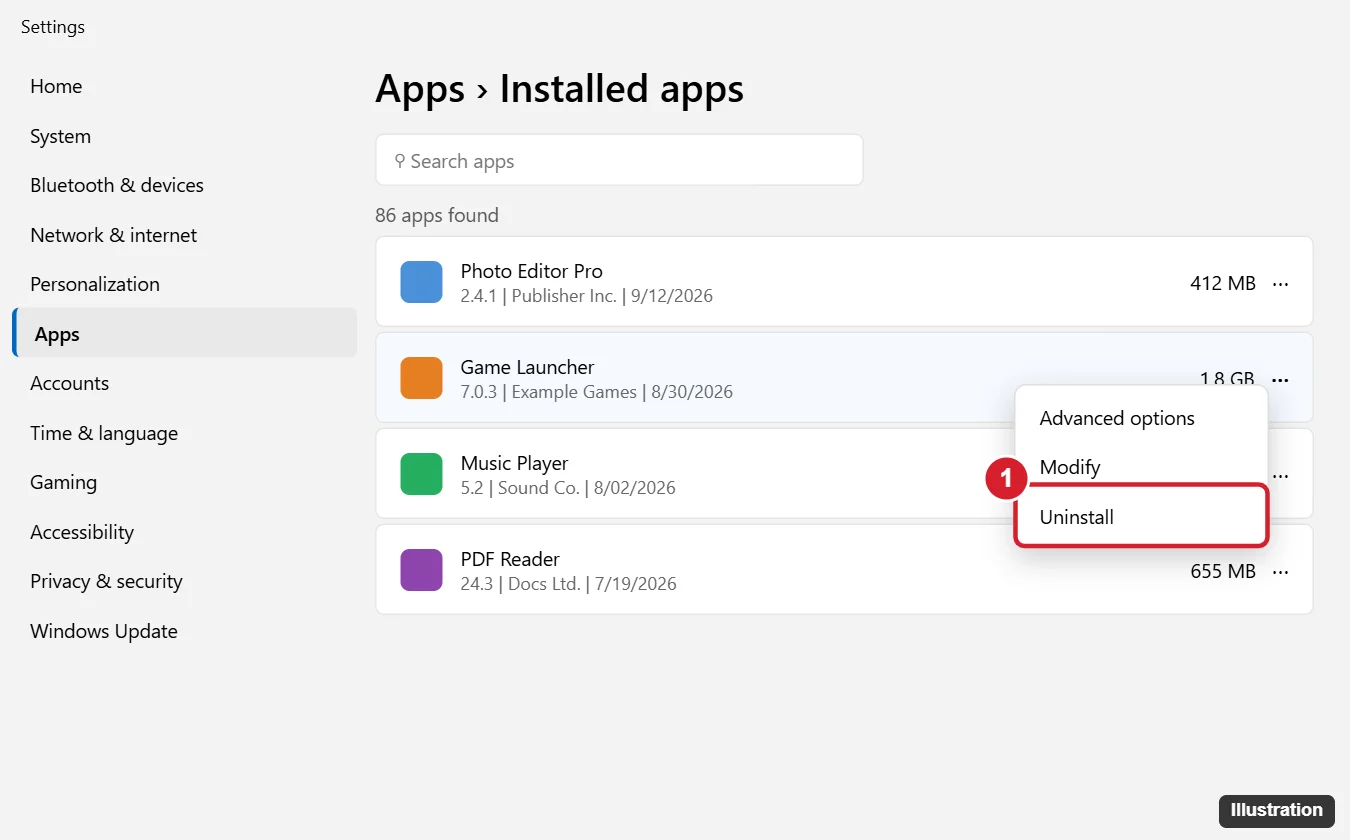
To uninstall an app on Windows 11, open Settings > Apps > Installed apps, click the three dots next to the app, choose Uninstall, and confirm. On Windows 10, go to Settings > Apps > Apps & features, click the app, and choose Uninstall. Or right-click the app in the Start menu and choose Uninstall. Removing apps you no longer use frees up storage, declutters the Start menu, and can speed up your PC by stopping background processes.
Method 1: Settings (Recommended)
Windows 11
- Press Windows + I and go to Apps > Installed apps.
- Search for the app or sort the list by Size to find large apps.
- Click the ⋯ next to the app and choose Uninstall.
- Click Uninstall again to confirm, and follow any uninstaller that opens.
Windows 10
- Go to Settings > Apps > Apps & features.
- Click the app, then Uninstall, and confirm.
Method 2: Start Menu
- Click Start and find the app (in All apps or by typing its name).
- Right-click it and choose Uninstall.
Store apps uninstall immediately after you confirm. Traditional desktop programs open Control Panel’s Programs and Features, where you finish the uninstall.
Copilot is one app that also lives in the keyboard key and Office apps, so removing Copilot from Windows 11 walks through each place it appears.
Method 3: Control Panel
- Press Windows + R, type appwiz.cpl, and press Enter.
- Select the program and click Uninstall (or Uninstall/Change).
Control Panel only lists traditional desktop programs, not Microsoft Store apps.
Method 4: Command Line (winget)
- Right-click Start and open Terminal (or Command Prompt).
- List installed apps:
winget list - Uninstall one by name or ID:
winget uninstall "App Name"
This is handy for removing several apps quickly.
Removing Built-In Windows Apps
- Many preinstalled apps (such as news, games, or trial apps) can be uninstalled in Settings the same way.
- Some core apps can’t be removed from Settings; their Uninstall option is grayed out. Advanced users can remove some with PowerShell (Get-AppxPackage *name* | Remove-AppxPackage), but removing system components can break features, so only do this if you know what the app does.
- Reinstall any built-in app from the Microsoft Store if you change your mind.
When an App Won’t Uninstall
- Close it first: end it in Task Manager (Ctrl + Shift + Esc), including background processes and tray icons.
- Restart the PC and try again.
- Use the app’s own uninstaller in its folder under C:\Program Files (often named uninstall.exe or unins000.exe).
- Run the Program Install and Uninstall troubleshooter from Microsoft’s support site, which fixes broken uninstall entries.
- Security software: antivirus programs often require their vendor’s removal tool.
- Uninstall in Safe Mode if something blocks it during normal startup.
Clean Up Leftovers (Optional)
- Check C:\Program Files, C:\Program Files (x86), and %AppData% for folders the app left behind, and delete them only if you’re sure they belong to the removed app.
- Run Settings > System > Storage > Cleanup recommendations (Windows 11) or Disk Cleanup to clear temporary files.
Not sure what is installed? See how to check installed apps.
Related: Uninstall a program on Windows 11.
Common Questions About Removing Apps
Does uninstalling an app delete my files?
Usually not. Documents you created stay where you saved them. Some apps offer to delete settings or saved data during uninstall.
Game launchers are a special case: uninstalling Steam deletes games in its default library, a point covered at the end of how to download and install Steam.
What’s the difference between uninstalling and deleting the app’s folder?
Uninstalling removes the program properly, including registry entries and shortcuts. Deleting the folder leaves broken leftovers.
Can I uninstall apps without admin rights?
You can remove Store apps installed for your account. Most desktop programs require an administrator.

Kermit Matthews runs Live2Tech from just outside Philadelphia. He is an IT specialist with over 20 years of experience, from a university help desk to small-business IT, IT management and his own consulting practice, and has written tech guides full time since 2020. Steps are checked against the current software on a real device or the maker’s official documentation. More about Kermit.