Daylight saving time changes reach an iPhone on their own as long as the automatic date and time settings stay on. Apple’s own wording is that you can use Date & Time settings to have your device adjust automatically for time zone changes and daylight saving time. If your clock didn’t move when everything else did, a switch was probably turned off, the iPhone couldn’t connect, or something is locking the setting, and each of those has a quick check below.
Did your iPhone clock change?
The fastest way to tell whether your iPhone is set up to follow daylight saving time is to look at the switches, not the clock. If the automatic settings are on, the iPhone takes care of the change; if they’re off, Apple’s automatic adjustment isn’t in play and the clock is yours to check.
Apple ties the automatic change to two things:
- Automatic date and time. With it on, Apple says the iPhone sets the date and time based on your time zone.
- The right time zone. Apple says the time zone is set automatically, but if Location Services is off or you don’t have service, you may need to change it by hand.
If both are in order, your iPhone follows daylight saving time for the time zone it’s set to.
The switches that handle daylight saving time
Current versions of iOS split the old single switch into two. Here’s where to check them:
- Open the Settings app.
- Tap General, then tap Date & Time.
- Make sure Set Time Automatically is on.
- Check that Set Time Zone Automatically, the switch Apple’s guide names for the time zone, is on as well.
Apple’s guide to changing the date and time on iPhone uses both of these names. If you only see one switch called Set Automatically, your iPhone uses the older layout that Apple’s earlier guides describe. Apple’s older guides turn off that one switch to change either the time or the time zone, so leaving it on does the same job.
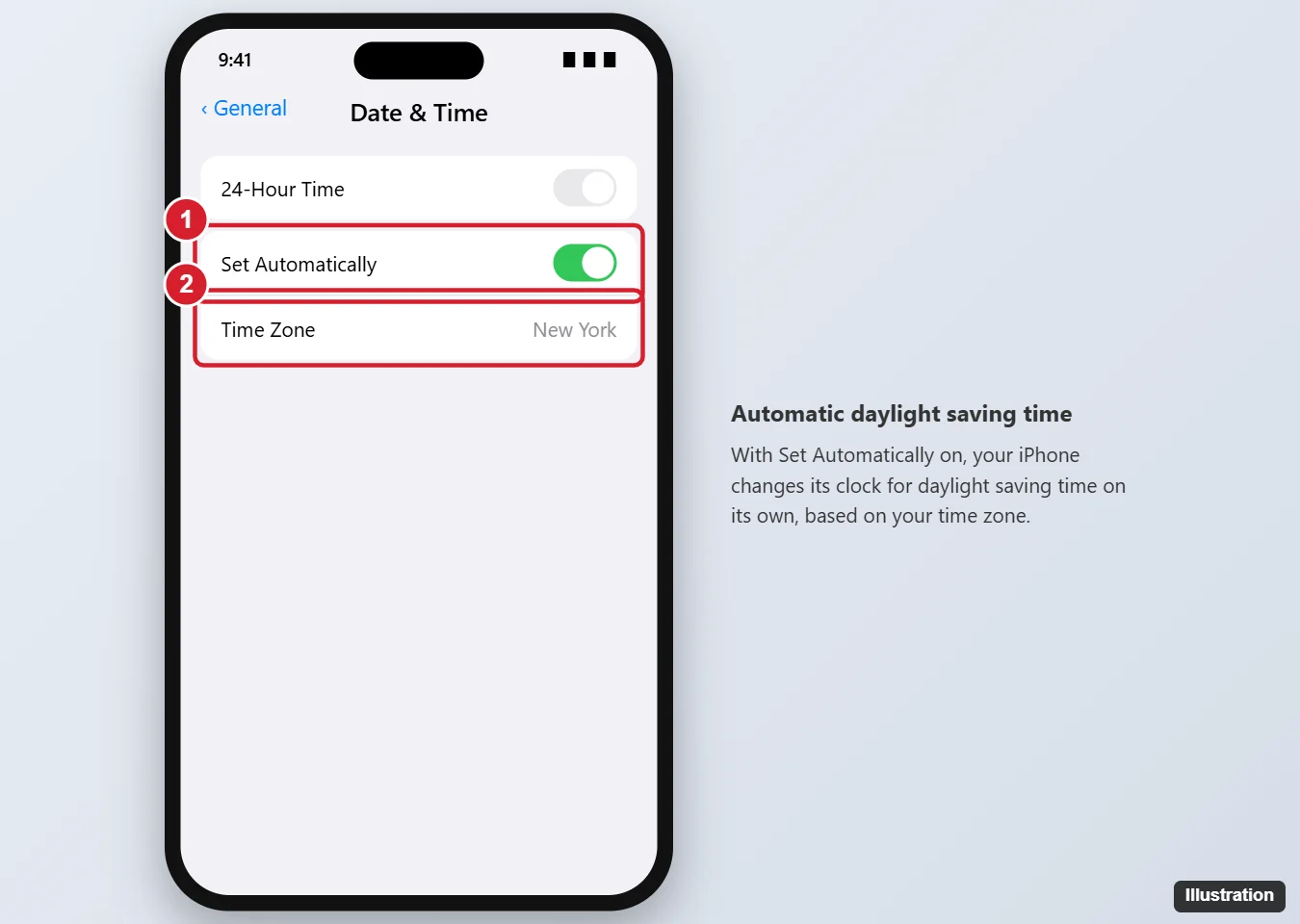
The illustration shows that older single-switch layout. Apple’s current guide names two switches instead: Set Time Automatically and Set Time Zone Automatically.
Location Services and the time zone
An automatic clock is only as good as the time zone behind it. Apple lets the iPhone use its current location to work out the correct time zone, through a setting that sits deep in the privacy menus:
- Open Settings and tap Privacy & Security.
- Tap Location Services.
- Scroll to the bottom and tap System Services.
- Turn on Setting Time Zone.
Apple says this setting allows the device to use its current location to determine the correct time zone. It matters most if you have trimmed Location Services for privacy reasons.
If the clock did not change
Apple’s page on what to do when you can’t change the time or time zone covers a clock that doesn’t adjust for daylight saving time. Work through these in order:
- Install the latest software update. Apple lists keeping the device’s software current among its steps.
- Check the connection. Apple says to make sure the device is connected to the internet.
- Restart when Apple asks. If a message says that updated time zone information is available, Apple says to restart your device and any paired Apple Watch.
- Turn the automatic switches on. Use the steps in the section above, and confirm Setting Time Zone is on in Location Services.
- Look for what’s dimming the switch. Apple says the automatic option might not be available with all carriers or in all countries and regions. If the device has a Screen Time passcode or a corporate profile with device restrictions installed, the setting might be dimmed (grayed out). On a work or school iPhone, ask whoever manages the device.
If none of that helps, Apple suggests changing each setting manually instead of using the automatic switch, and that takes you to the next section.
If you set the clock by hand
Apple ties automatic daylight saving changes to the automatic Date & Time settings, so with them off, plan to check the clock yourself whenever the time changes where you live. To set it manually on a current iPhone:
- Time and date: in Settings > General > Date & Time, turn off Set Time Automatically, then set the date and time.
- Time zone: turn off Set Time Zone Automatically, then tap Time Zone City and search for a city, or tap Set By, tap Time Zone Offset, then tap + or -.
The full walkthrough, including the 12-hour and 24-hour display, is in changing the time and date on iPhone. Apple also warns that changing time settings by hand to change app behavior, such as game timers, isn’t recommended. If you only need to see another city’s time, leave your own clock alone and change the city on a World Clock widget instead.
Daylight saving clock questions
Should I turn the automatic switches off before the change and back on after?
There’s no need. Apple describes the automatic Date & Time settings as the way to have the iPhone adjust for daylight saving time, so leaving them on matches what Apple describes.
If an alarm or appointment surprised you after a clock change, open Settings first and confirm both automatic switches are on and Setting Time Zone is enabled. Then check the alarm itself in setting an alarm on iPhone.

Kermit Matthews runs Live2Tech from just outside Philadelphia. He is an IT specialist with over 20 years of experience, from a university help desk to small-business IT, IT management and his own consulting practice, and has written tech guides full time since 2020. Steps are checked against the current software on a real device or the maker’s official documentation. More about Kermit.