To make an exponent in Microsoft Word, type the number, select it, and click the Superscript button (x²) on the Home tab. Or press Ctrl + Shift + = (the equals sign) before you type the exponent, type it, then press the same shortcut again to go back to normal text. On a Mac, the shortcut is Command + Shift + =.
For math, Word’s equation editor is often better: go to Insert > Equation and type x^2 followed by a space. Here are all the ways to add exponents in Word, including on the web and on a phone.
Ways to type an exponent in Word
| Method | Best for |
|---|---|
| Superscript button or Ctrl + Shift + = | Exponents in regular text, like 106 or m2 |
| Equation editor | Math formulas, fractions, and nested exponents |
| Symbol characters (², ³) | Squared and cubed that stay put when text is copied |
Method 1: Use superscript
With the ribbon button
- Type the base and the exponent next to each other, such as x2.
- Select just the exponent (the 2).
- On the Home tab, in the Font group, click Superscript (x²).
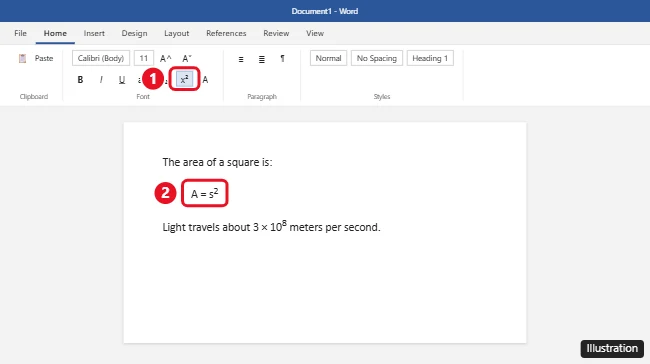
With the keyboard shortcut
- Type the base, like x.
- Press Ctrl + Shift + = (Command + Shift + = on a Mac).
- Type the exponent.
- Press the shortcut again to turn superscript off and keep typing normally.
You can also select existing text and press the shortcut to make it superscript. The subscript shortcut, for chemical formulas like H2O, is Ctrl + = (Command + = on a Mac).
With the Font dialog
Select the exponent, press Ctrl + D, check Superscript under Effects, and click OK.
Method 2: Use the equation editor
- Click where you want the formula.
- Go to Insert > Equation, or press Alt + =.
- Type the base, a caret (^), and the exponent, like x^2, then press the Spacebar. Word turns it into x².
- For a multi-character exponent, wrap it in parentheses: e^(2x), then press Spacebar.
- Click outside the equation box when you’re done.
You can also pick a template from Equation > Script > Superscript and fill in the boxes.
Method 3: Insert a superscript symbol
Squared and cubed have their own characters, which are useful for units like m² and ft³.
- Symbol menu: Go to Insert > Symbol > More Symbols. Set Subset to Latin-1 Supplement and choose ², ³, or ¹.
- Alt codes (with a number pad): Hold Alt and type 0178 for ², 0179 for ³, or 0185 for ¹.
- Unicode and Alt + X: Type 00B2 and press Alt + X to get ². Use 00B3 for ³.
- AutoCorrect: Go to File > Options > Proofing > AutoCorrect Options and add an entry such as ^2 that’s replaced with ².
How to type an exponent in Word on the web or mobile
- Word for the web: Select the text, then on the Home tab click the More font options (three dots) and choose Superscript. Ctrl + Shift + = also works in most browsers.
- Word on iPhone, iPad, or Android: Select the text, tap the Home ribbon (or the A with a pencil icon on a phone), tap Font formatting if shown, and choose Superscript.
How to remove superscript
Select the exponent and click Superscript again, or press Ctrl + Shift + =. To clear all formatting, press Ctrl + Spacebar.
Frequently asked questions
Why did Ctrl + Shift + = zoom in instead?
You may be in a browser that uses that shortcut for zoom, or another app has taken over the shortcut. Use the Superscript button instead.
Why does my exponent move the line spacing?
Superscript can push lines slightly apart. To avoid it, use a symbol character like ², or set exact line spacing in Home > Paragraph settings.
How do I write a negative exponent?
Type the minus sign as part of the superscript, like 10-3. In the equation editor, type 10^(-3) and press Spacebar.
Does Word turn ordinal numbers into superscript automatically?
Yes. Word changes 1st, 2nd, and 3rd to superscript by default. Turn this off in AutoCorrect Options > AutoFormat As You Type > Ordinals (1st) with superscript.

Kermit Matthews is a freelance writer based in Philadelphia, Pennsylvania with more than a decade of experience writing technology guides. He has a Bachelor’s and Master’s degree in Computer Science and has spent much of his professional career in IT management.
He specializes in writing content about iPhones, Android devices, Microsoft Office, and many other popular applications and devices.