If your Windows 10 keyboard suddenly types the wrong symbols, puts @ where " should be, types letters in the wrong places, repeats keys, or ignores key presses, one of a handful of settings has usually changed. This guide walks through every common cause and how to put your keyboard back to normal, starting with the fixes that solve most problems.
Quick Answer
Press Windows key + Spacebar to cycle through keyboard layouts, or open Settings > Time & Language > Language, remove any language or keyboard you did not add, and make sure your normal layout (for example, US under English (United States)) is the only one listed. Then turn off Sticky Keys and Filter Keys in Settings > Ease of Access > Keyboard.
Match the Symptom to the Fix
| What is happening | Likely cause | Fix |
|---|---|---|
| Symbols in the wrong place (@ and " swapped, # becomes £) | UK or other layout active | Method 1 and 2 |
| Letters in the wrong place (Z and Y swapped, A and Q swapped) | German, French, or other regional layout | Method 1 and 2 |
| Letters type as numbers on a laptop | Num Lock on a keyboard with an embedded keypad | Method 4 |
| Keys ignored unless held down, or slow to respond | Filter Keys | Method 3 |
| Shift, Ctrl, or Alt seem stuck on | Sticky Keys | Method 3 |
| Everything types in capitals, or letters overwrite text | Caps Lock or Insert mode | Method 4 |
| Keys repeat or are too slow to repeat | Repeat delay or rate settings | Method 5 |
| Nothing fixes it | Driver or hardware issue | Methods 6 and 7 |
Method 1: Switch Back to Your Normal Layout
Windows lets you have several keyboard layouts installed and switch between them with a shortcut. It is easy to trigger this by accident.
- Press Windows key + Spacebar to cycle through installed layouts. A small panel shows which one is active.
- Left Alt + Shift also switches input languages by default, and Ctrl + Shift may switch layouts within one language.
- Or click the language indicator (such as ENG) in the taskbar notification area and pick the layout you want.
If you see something like ENG UK or ENG INTL when you expected ENG US, that is your problem. Switching fixes it immediately, but it can happen again unless you remove the extra layout.
Method 2: Remove Extra Languages and Keyboards
This is the permanent fix for wrong-symbol and wrong-letter problems.
- Press Windows key + I to open Settings.
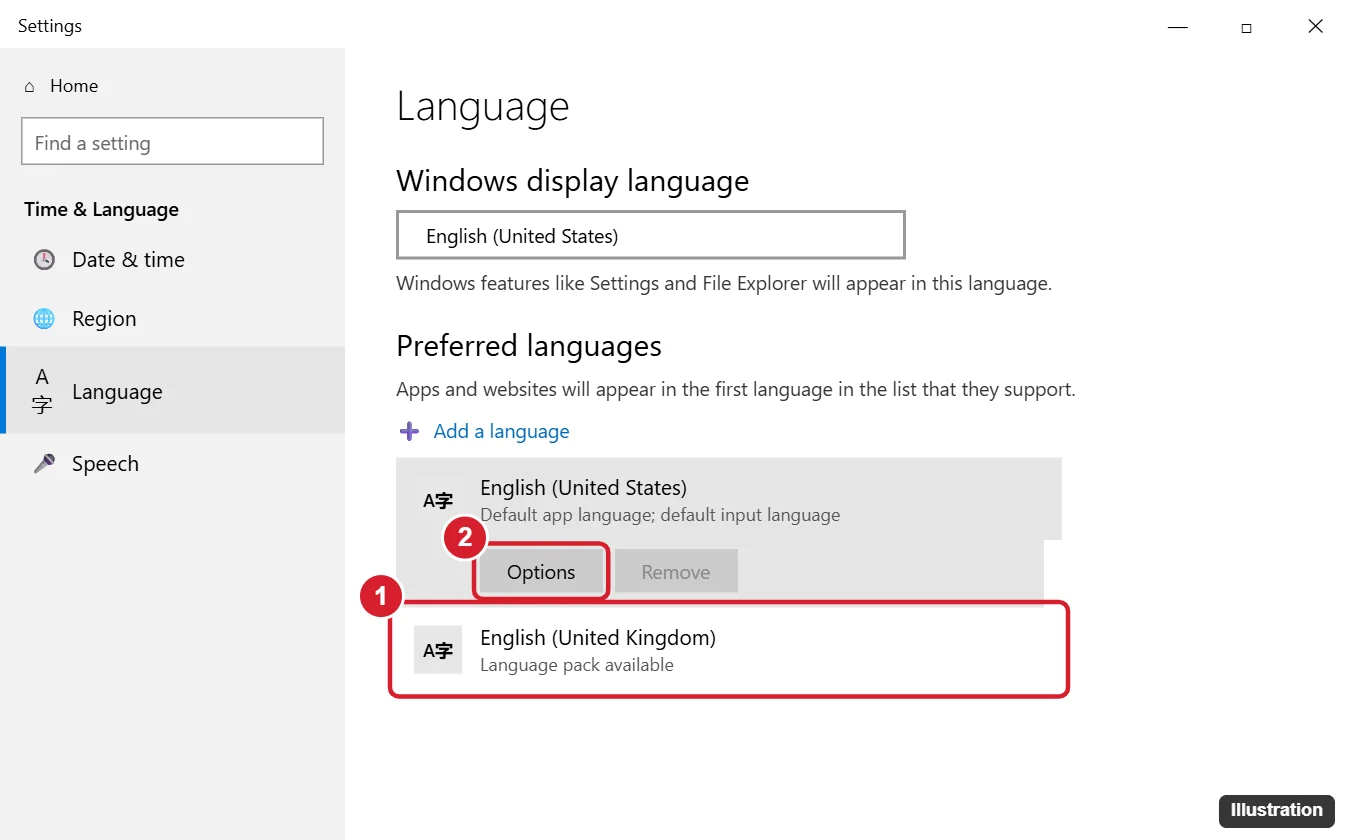
- Go to Time & Language > Language.
- Under Preferred languages, click any language you do not use and click Remove.
- Click your main language (for example, English (United States)) and click Options.
- Under Keyboards, make sure your normal layout is listed (for example, US QWERTY). If it is missing, click Add a keyboard and add it.
- Click any keyboard you do not want (such as United States-International or United Kingdom) and click Remove.
Tip: the United States-International layout is a common culprit. It turns the apostrophe and quote keys into "dead keys" for accents, so nothing appears until you type the next character. Removing it restores normal behavior.
Also check the Region page and make sure your country is correct, because Windows may add a matching layout when the region changes.
Stop Windows From Switching Layouts on Its Own
- In Settings, go to Devices > Typing > Advanced keyboard settings.
- Under Override for default input method, select your normal layout.
- Uncheck Let me use a different input method for each app window if layouts seem to change between apps.
- To change or turn off the switching shortcut, click Input language hot keys, select Between input languages, click Change Key Sequence, and choose Not Assigned for both options.
Method 3: Turn Off Sticky Keys, Filter Keys, and Toggle Keys
These accessibility features are helpful for some people, but they are easy to turn on by accident. Pressing Shift five times can prompt for Sticky Keys, and holding right Shift for eight seconds can turn on Filter Keys.
- Open Settings > Ease of Access > Keyboard.
- Turn off Use Sticky Keys.
- Turn off Use Toggle Keys if you do not want a tone when pressing Caps Lock, Num Lock, or Scroll Lock.
- Turn off Use Filter Keys.
- To prevent accidental activation, uncheck the shortcut options under each feature (such as Allow the shortcut key to start Sticky Keys).
While you are there, check that Use the On-Screen Keyboard is off unless you want it.
Method 4: Check the Lock Keys
- Num Lock: on smaller laptops, keys like U, I, O, J, K, L, and M can double as a number pad. If letters type as numbers, press Num Lock (often Fn + Num Lk or Fn + F11, depending on the laptop).
- Caps Lock: press it once if everything is in capitals. If Shift reverses the case, Caps Lock is on.
- Insert: if typing overwrites the text after the cursor, press Insert (sometimes Fn + Ins) to switch back to insert mode.
- Fn Lock: if the top row triggers volume and brightness instead of F1 to F12 (or the reverse), your laptop's Fn Lock is toggled. Many laptops use Fn + Esc, but it varies by manufacturer.
Method 5: Reset Repeat Delay and Rate
- Press Windows key + R, type control keyboard, and press Enter.
- On the Speed tab, drag Repeat delay and Repeat rate back toward the middle (the Windows defaults are close to the second-shortest delay and the fastest rate).
- Use the test box to try it, then click OK.
Method 6: Run the Keyboard Troubleshooter and Reinstall the Driver
- Go to Settings > Update & Security > Troubleshoot > Additional troubleshooters.
- Click Keyboard and then Run the troubleshooter.
If that does not help, reinstall the driver:
- Right-click Start and choose Device Manager.
- Expand Keyboards.
- Right-click your keyboard (often Standard PS/2 Keyboard or HID Keyboard Device) and choose Uninstall device.
- Restart your computer. Windows reinstalls the driver automatically.
If you use a keyboard with its own software (for gaming or productivity keyboards), check that software too, since it may have remapped keys or switched profiles.
Method 7: Rule Out Hardware and Other Software
- Try the keyboard on another computer, or try a different keyboard on this one.
- For wireless keyboards, replace the batteries and re-pair or reconnect the receiver.
- Clean around stuck keys with compressed air.
- Check for key-remapping tools you or someone else installed, and close or uninstall them.
- Restart in Safe Mode. If the keyboard behaves normally there, a startup app or driver is likely responsible.
Frequently Asked Questions
Why did my keyboard layout change by itself?
Usually because a shortcut such as Left Alt + Shift or Windows key + Spacebar was pressed accidentally while a second layout was installed. Removing extra layouts prevents it.
How do I type @ if my keyboard is stuck on the UK layout?
On the UK layout, @ is Shift + the apostrophe key. Switching back to the US layout puts it on Shift + 2 again.
Is there a single button to reset all keyboard settings?
No. Windows 10 does not have a one-click keyboard reset, so you reset the layout, accessibility options, and speed settings individually as shown above.
Will removing a language delete anything?
No. It only removes that language's keyboard and display options. You can add it back anytime.
Summary
- Press Windows key + Spacebar to get back to your normal layout.
- Remove extra languages and keyboards in Time & Language > Language.
- Turn off Sticky Keys and Filter Keys in Ease of Access > Keyboard.
- Check Num Lock, Caps Lock, Insert, and Fn Lock.
- Reset repeat speed, then troubleshoot drivers and hardware if needed.

Kermit Matthews is a freelance writer based in Philadelphia, Pennsylvania with more than a decade of experience writing technology guides. He has a Bachelor’s and Master’s degree in Computer Science and has spent much of his professional career in IT management.
He specializes in writing content about iPhones, Android devices, Microsoft Office, and many other popular applications and devices.