Text boxes in Excel 2013 can pick up a fill color from a theme or a copied shape, which can hide the cells behind them. Removing the fill makes the box transparent so only the text and border remain. Office 2013 reached end of support on April 11, 2023, so it no longer receives security updates. The same steps work in newer versions of Excel.
Quick Answer
Click the text box border, open the Format tab under Drawing Tools, click Shape Fill, and choose No Fill.
How to Remove Fill Color From a Text Box in Excel 2013
- Click the edge of the text box so the whole box is selected, not just the text.
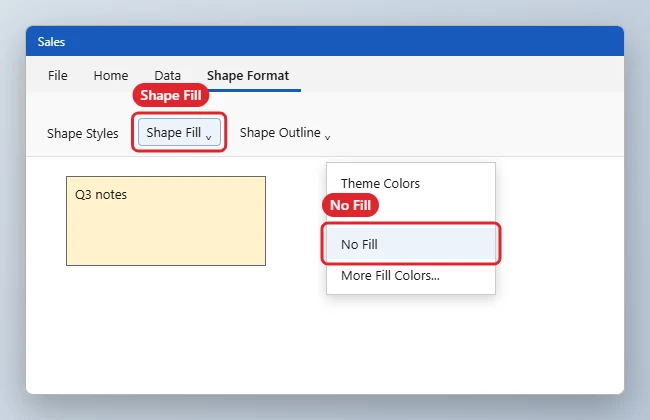
- Open the Format tab under Drawing Tools (called Shape Format in newer versions).
- Click Shape Fill.
- Choose No Fill. The cells behind the box now show through.
- To also remove the border, click Shape Outline and choose No Outline.
Text Box Formatting Options
| Option | Effect |
|---|---|
| Shape Fill, No Fill | Transparent background |
| Shape Outline, No Outline | Removes the border |
| Shape Fill, Transparency | Keeps a faint color |
| Shape Styles | Applies a preset look |
To show a live number in the box, see how to display a formula result in a text box.
Troubleshooting
- No Format tab appears: the text box is not selected. Click its border until handles appear around it.
- The box still looks white: the cells behind it may have a white fill. Check the cells with Home, Fill Color.
- To delete the box instead, see how to delete a text box in Excel 2013.
- To color the cells behind it, read how to fill cell color in Excel 2013.
Frequently Asked Questions
Can I change the default fill for new text boxes?
Yes. Format a box the way you like, right-click it, and choose Set as Default Text Box.
Does No Fill affect printing?
Yes, the box prints transparent too.
Can I remove fill from many boxes at once?
Hold Ctrl, click each box, then apply No Fill once.
Summary
- Select the text box border.
- Open the Format tab.
- Choose Shape Fill, No Fill.
- Remove the outline too if needed.

Kermit Matthews is a freelance writer based in Philadelphia, Pennsylvania with more than a decade of experience writing technology guides. He has a Bachelor’s and Master’s degree in Computer Science and has spent much of his professional career in IT management.
He specializes in writing content about iPhones, Android devices, Microsoft Office, and many other popular applications and devices.