You fill a cell with color in Excel 2013 from the paint bucket icon on the Home tab. Highlight the cells, open the menu beside Fill Color, and click a swatch; No Fill in that same menu takes the shading back off. The steps are identical in Excel 2016, 2019, 2021, and Microsoft 365.
Quick Answer
Select cells > Home > Fill Color arrow > choose a color. Use No Fill to clear it.
How to Add a Fill Color to Cells
- Select the cells. Click a column letter or row number to color a whole column or row.
- Click the Home tab.
- In the Font group, click the small arrow beside the Fill Color paint bucket.
- Hover over colors to preview them, then click the one you want.
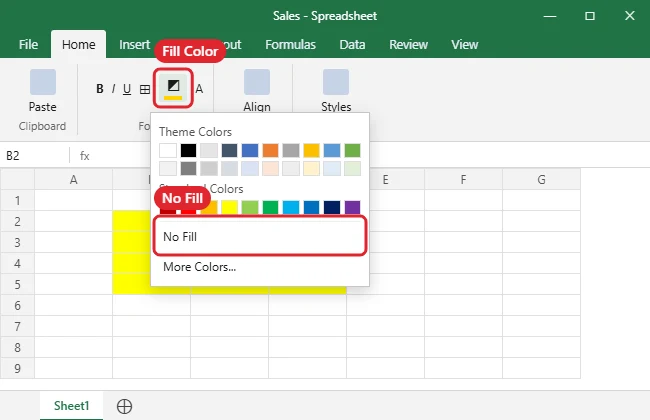
Clicking the bucket itself (not the arrow) applies the last color you used, which is handy when coloring several ranges.
Other Ways to Apply a Fill Color
| Method | How | When to use it |
|---|---|---|
| Keyboard | Press Alt, H, H, then use the arrow keys and Enter | Keyboard-only work |
| Repeat last action | Select new cells and press F4 | Applying the same color again |
| Mini toolbar | Right-click the cells and use the bucket on the mini toolbar | Quick access near the cells |
| Format Cells | Ctrl + 1 > Fill tab | Patterns, custom colors, gradients |
| Format Painter | Click a colored cell, click Format Painter, then click the target cells | Copying a color and other formatting |
Use a Custom Color, Pattern, or Gradient
- Select the cells and press Ctrl + 1.
- Open the Fill tab.
- Choose a color, or click More Colors to enter exact RGB values.
- Use Pattern Color and Pattern Style for stripes or dots, or click Fill Effects for a two-color gradient.
- Click OK.
For more on gradients, see how to use a gradient fill effect in Excel 2013.
Color Cells Automatically Based on Their Values
If you want cells to change color based on what’s in them, use conditional formatting instead of a manual fill:
- Select the range.
- Go to Home > Conditional Formatting > Highlight Cells Rules.
- Choose a rule, such as Greater Than or Text that Contains, enter the value, and pick a format.
Conditional formatting colors update automatically when the data changes, and they display on top of any manual fill.
You can colour worksheet tabs too; see how to change a sheet tab color in Excel 2013.
For shapes and text boxes, read how to remove fill color from a text box in Excel.
To remove all formatting at once, see how to clear cell formatting in Excel 2013.
To place images in cells, see how to insert a picture in a cell.
Troubleshooting
- The color doesn’t change: A conditional formatting rule may be overriding it. Check Home > Conditional Formatting > Manage Rules.
- Fill Color is grayed out: The sheet is protected, or you’re editing a cell. Press Enter or Esc first, or unprotect the sheet under Review.
- The fill doesn’t print: Check File > Print > Page Setup > Sheet, and make sure Black and white isn’t checked.
- Gridlines disappear under colored cells: That’s normal. Add borders if you want lines to show.
Using Excel 2010? The Fill Color button is in the same place; see changing cell shading in Excel 2010.
Frequently Asked Questions
How do I remove fill color from cells?
Select the cells, click the Fill Color arrow, and choose No Fill. To remove all formatting instead, use Home > Clear > Clear Formats.
Can I fill a cell with color using a formula?
Not directly. Formulas return values, not formatting. Use conditional formatting with a formula rule (New Rule > Use a formula to determine which cells to format).
How do I fill every other row with color?
Format the range as a table with Home > Format as Table, which adds banded rows automatically.
Summary
- Select the cells.
- Click Home > Fill Color arrow.
- Pick a color, or No Fill to remove it.
- Use Ctrl + 1 for patterns and gradients, or conditional formatting for automatic colors.

Kermit Matthews is a freelance writer based in Philadelphia, Pennsylvania with more than a decade of experience writing technology guides. He has a Bachelor’s and Master’s degree in Computer Science and has spent much of his professional career in IT management.
He specializes in writing content about iPhones, Android devices, Microsoft Office, and many other popular applications and devices.