To show the ruler in Microsoft Word, open the View tab and check the Ruler box in the Show group. The horizontal ruler appears above the page, and in Print Layout view a vertical ruler appears along the left edge. The same checkbox works in Word 2013, 2016, 2019, 2021, and Microsoft 365.
If the ruler still doesn’t appear, the cause is usually the current view or a vertical-ruler setting in Word Options. Both are covered below.
Quick Answer
Go to View > check Ruler. For the vertical ruler, go to File > Options > Advanced and turn on Show vertical ruler in Print Layout view.
How to Show the Ruler in Word on Windows
- Open your document in Word.
- Click the View tab on the ribbon.
- In the Show group, check Ruler.
- If you only see a horizontal ruler, click Print Layout in the Views group.
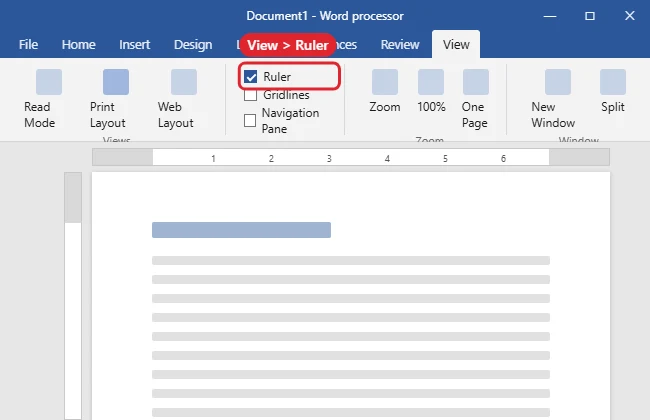
To hide the ruler again, clear the same checkbox. Word remembers the choice for the next documents you open.
Turn On the Vertical Ruler
The vertical ruler only appears in Print Layout view, and it can be switched off separately:
- Click File > Options.
- Select Advanced and scroll to the Display section.
- Check Show vertical ruler in Print Layout view.
- Click OK.
Which Views Show the Ruler
| View | Horizontal ruler | Vertical ruler |
|---|---|---|
| Print Layout | Yes | Yes (if enabled in Options) |
| Draft | Yes | No |
| Web Layout | Yes | No |
| Read Mode | No | No |
| Outline | No | No |
Show the Ruler in Word for Mac and Word for the Web
- Word for Mac: Open the View tab and check Ruler, or choose View > Ruler from the menu bar at the top of the screen.
- Word for the web: Open the View tab and select Ruler. If you don’t see it, make sure you’re in Editing mode rather than Viewing mode, since the browser version shows fewer options while viewing.
What You Can Do With the Ruler
- Set indents: Drag the top triangle for a first-line indent, the bottom triangle for a hanging indent, and the small square to move both.
- Add tab stops: Click the tab selector at the left end of the ruler to pick a tab type, then click the ruler where you want the stop. Our guide to setting multiple tabs in Word walks through it.
- Adjust margins: Drag the edge between the gray and white areas of the ruler.
- Resize table columns: Click inside a table and drag the column markers on the ruler.
The ruler uses inches by default in the US. You can switch Word to centimeters under File > Options > Advanced > Display > Show measurements in units of.
The status bar also shows your document’s length; see where to find the word count in Word.
To center a whole table, see how to align tables in Word.
Working on slides? Here’s how to center a text box in PowerPoint.
Troubleshooting
- There’s no Ruler checkbox on the View tab: The ribbon may be collapsed or simplified. Double-click the View tab to pin the full ribbon, or widen the Word window so the Show group isn’t collapsed into a single button.
- The ruler is checked but not visible: You’re probably in Read Mode or Outline view. Click Print Layout.
- Only the vertical ruler is missing: Turn on the Print Layout option in Word Options, as described above.
- The ruler flickers or disappears: Hovering at the top edge of the page with the ruler hidden briefly shows it in some versions. Checking the Ruler box keeps it on screen.
Frequently Asked Questions
Is there a keyboard shortcut for the ruler in Word?
Word doesn’t have a dedicated shortcut. On Windows you can press Alt, W, then R to toggle the Ruler checkbox from the ribbon.
Why did my ruler disappear after an update?
Updates don’t normally change the setting, but a switch to Read Mode, a collapsed ribbon, or opening the file in the web version can make it look gone. Recheck View > Ruler.
Is the ruler setting saved in the document?
No. It’s a Word setting, so it applies to every document you open on that computer.
Summary
- Open the View tab.
- Check Ruler in the Show group.
- Switch to Print Layout if you need the vertical ruler.
- Turn on the vertical ruler in File > Options > Advanced if it’s still missing.

Kermit Matthews is a freelance writer based in Philadelphia, Pennsylvania with more than a decade of experience writing technology guides. He has a Bachelor’s and Master’s degree in Computer Science and has spent much of his professional career in IT management.
He specializes in writing content about iPhones, Android devices, Microsoft Office, and many other popular applications and devices.