Google Slides lets you add pictures from your computer, the web, Google Drive, Google Photos, a link, or your camera. This guide covers every way to insert an image, plus how to resize, crop, mask it into a shape, set it as a slide background, replace it without losing formatting, and add alt text so everyone can understand it.
Quick Answer
Click the slide, go to Insert > Image, and choose Upload from computer (or another source). Select the picture and click Open or Insert. You can also drag an image file straight onto the slide.
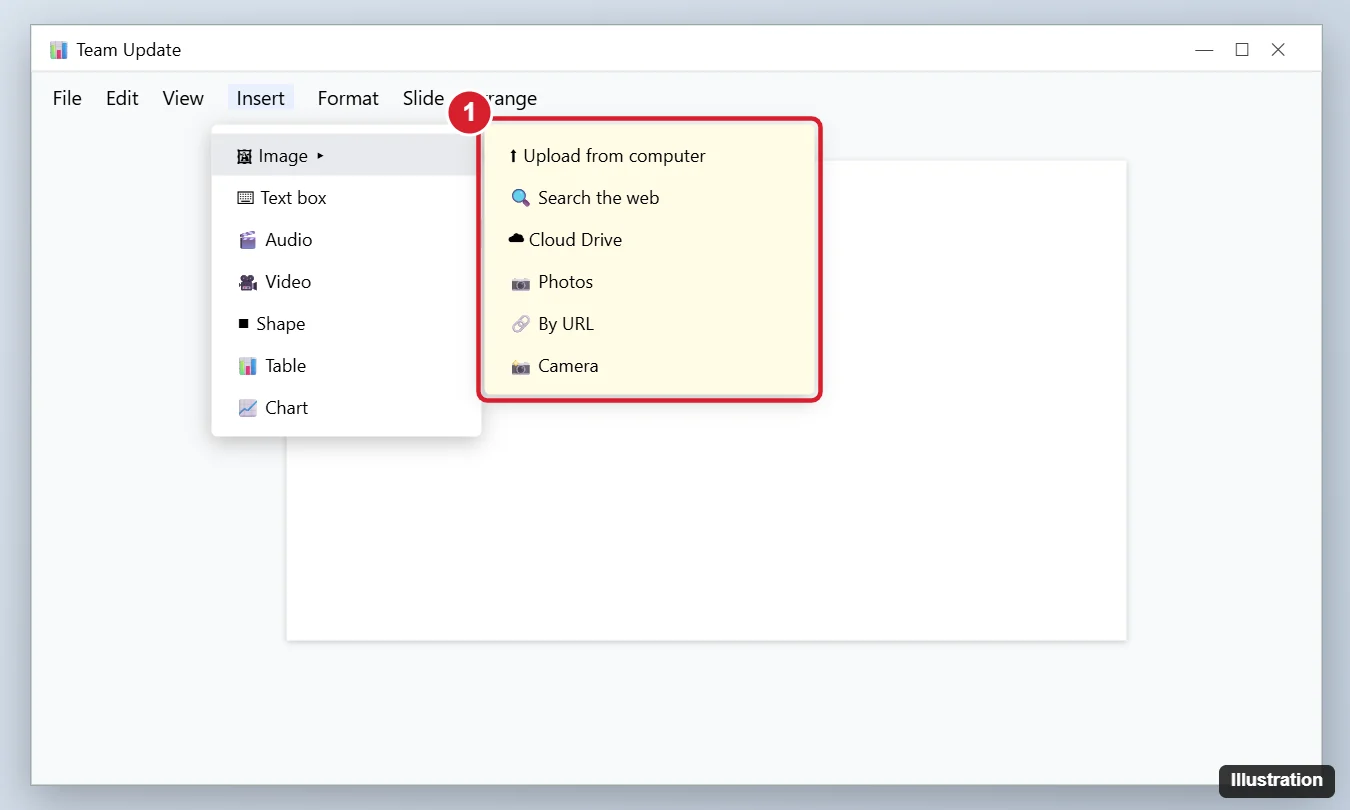
Insert a Picture on a Computer
- Open the presentation and select the slide.
- Click Insert > Image, or the image icon in the toolbar.
- Pick a source:
- Upload from computer: choose a file from your device.
- Search the web: search images from the web; check the license before using them publicly.
- Drive or Photos: pick from your Google account.
- By URL: paste a direct link to an image file.
- Camera: take a photo with your webcam.
- Click Insert, Open or Select.
Other shortcuts: drag an image from File Explorer or Finder onto the slide, or copy an image and press Ctrl + V (Command + V on a Mac).
Supported formats include JPG, PNG, GIF (animated GIFs play in presentation mode), BMP and WebP. Files must be under 50 MB and 25 megapixels.
Insert a Picture on iPhone, iPad or Android
- Open the presentation in the Google Slides app and tap the slide.
- Tap + at the top, then Image.
- Choose From photos, From camera, or From the web (options vary by device).
Resize, Move and Rotate
- Drag a corner handle to resize while keeping proportions. Side handles stretch the image.
- Drag the image to move it; pink guides help align it with other objects.
- Drag the round handle at the top to rotate. Hold Shift to snap to 15-degree steps.
- For exact sizes, click Format options > Size & Rotation.
Crop or Mask Into a Shape
- Crop: double-click the image (or click Crop in the toolbar) and drag the black crop handles. Press Enter to finish.
- Mask: click the arrow next to the crop button and choose a shape, such as a circle, for rounded profile photos. Use Mask image > Aspect ratio for a perfect square or circle.
Adjust and Recolor
Select the image and click Format options to change transparency, brightness and contrast, recolor it, or add a drop shadow or reflection.
Replace an Image and Keep Its Formatting
Right-click the picture, choose Replace image, and pick a new source. The new picture takes the old one’s size, position and crop. More detail: how to replace an image in Google Slides.
Use a Picture as the Slide Background
- Right-click an empty part of the slide and choose Change background, or go to Slide > Change background.
- Click Choose next to Image and pick a picture.
- Click Add to theme to use it on every slide with that layout.
Background images can’t be moved or selected accidentally while you edit.
Add Alt Text
Right-click the image and choose Alt text. Describe what the image shows so screen reader users get the same information.
Troubleshooting
| Problem | Fix |
|---|---|
| Upload fails | Check size (under 50 MB) and format; convert HEIC photos to JPG |
| By URL doesn’t work | Use a direct image link ending in .jpg or .png |
| Image looks blurry | Use a higher-resolution original; avoid stretching small images |
| Can’t select a picture | It may be part of the background or theme; check Slide > Edit theme |
Related: Add emojis in Google Slides.
Frequently Asked Questions
Can I insert several pictures at once?
Yes. Select multiple files in the upload window, or drag several onto the slide.
How do I put text on top of a picture?
Insert a text box over it, or set the picture as the background. See how to add a text box on Google Slides.
Summary
- Insert > Image and choose a source, or drag and drop.
- Resize with corner handles and crop or mask as needed.
- Use Replace image to swap pictures without losing formatting.
- Add alt text for accessibility.

Kermit Matthews is a freelance writer based in Philadelphia, Pennsylvania with more than a decade of experience writing technology guides. He has a Bachelor’s and Master’s degree in Computer Science and has spent much of his professional career in IT management.
He specializes in writing content about iPhones, Android devices, Microsoft Office, and many other popular applications and devices.