To type emojis on Windows, press the Windows key + period (.) or Windows key + semicolon (;) while your cursor is in a text box. The emoji panel pops up. Start typing a word, like “heart” or “laugh,” to search, then click an emoji or press Enter to insert it. This works in almost every app, including Word, Outlook, web browsers, Teams, and Notepad, on both Windows 10 and Windows 11.
How to use the emoji keyboard shortcut
- Click where you want the emoji to go.
- Press Windows + . (period) or Windows + ; (semicolon).
- Type a word to search, or scroll through the categories at the bottom (or top) of the panel.
- Click the emoji, or use the arrow keys and press Enter.
- Press Esc to close the panel.
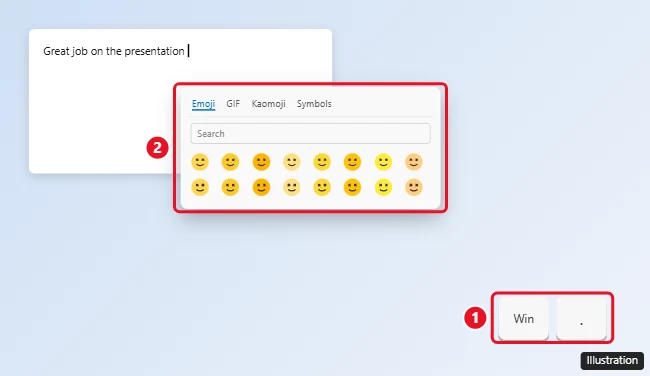
Tip: As soon as the panel opens, you can just keep typing. For example, press Windows + . and type thumbs to jump to the thumbs-up emoji.
More than emojis: GIFs, kaomoji, and symbols
- Kaomoji: Text faces like ¯\_(ツ)_/¯ and (╯°□°)╯︵ ┻━┻.
- Symbols: Currency, math, arrows, Latin and Greek letters, and punctuation like ©, €, °, and →.
- GIFs (Windows 11): Search and insert animated GIFs in apps that support them.
- Clipboard history (Windows 11): The same panel shows items you’ve copied. Turn it on with Windows + V.
Change emoji skin tones
In the emoji panel, click the skin tone button (a colored circle, or the hand icon in the people category) and choose a tone. Windows remembers your choice for supported emojis.
Other ways to add emojis
- Touch keyboard: On a touchscreen or tablet, tap the smiley face key on the on-screen keyboard. On a regular PC, turn on the touch keyboard button in taskbar settings.
- Built-in app pickers: Many apps, like Teams, Outlook, Slack, and Discord, have their own emoji button in the message box.
- Copy and paste: Copy an emoji from a website and paste it with Ctrl + V.
- Alt codes for symbols: Hold Alt and type a number on the numeric keypad, like Alt + 0176 for the degree symbol (°). Alt codes don’t work for modern emojis.
Emoji in specific apps
- Word and Outlook – the emoji panel works; some Outlook versions also have an emoji button in the message ribbon.
- Browsers and chat apps – many sites and apps add their own emoji pickers, but Windows + . works too.
- Colon shortcuts – some apps, like Teams and Slack, convert codes like 🙂 or 🙂 into emojis automatically.
The emoji panel also has a location pin you can use in Word. See how to add a location symbol in Word.
Emoji shortcut not working?
- Click in a text field first. The panel only opens where you can type.
- Check your keyboard language. The panel works best with English and other supported input languages. Switch with Windows + Space and try again.
- Restart the input service. Restart your PC, or restart Windows Explorer in Task Manager.
- Some apps show emojis in black and white. Older apps may not support color emoji fonts, but the emoji is still inserted.
Related: Use emojis on Windows 10.
Frequently asked questions
Is there a Windows emoji shortcut for Mac users?
On a Mac, press Control + Command + Space, or press the Fn or globe key on newer keyboards.
Why do emojis look different in different apps?
Each platform draws emojis its own way. Windows uses Microsoft’s emoji designs, while websites and apps may use their own.
Can I type emojis in Word?
Yes. Use Windows + . in Word, or Insert > Icons for larger graphics.
Does the emoji panel work on Windows 10?
Yes. It’s been part of Windows 10 since 2017. GIF search and clipboard history in the panel were added in Windows 11.
Can I add emojis to file names?
Yes. Rename a file and use the emoji panel; Windows supports emoji in file names.

Kermit Matthews is a freelance writer based in Philadelphia, Pennsylvania with more than a decade of experience writing technology guides. He has a Bachelor’s and Master’s degree in Computer Science and has spent much of his professional career in IT management.
He specializes in writing content about iPhones, Android devices, Microsoft Office, and many other popular applications and devices.