To connect a MacBook Air to a TV with HDMI, plug a USB-C to HDMI adapter (or a USB-C to HDMI cable) into one of your MacBook Air’s Thunderbolt/USB-C ports, connect the HDMI cable to the TV, and switch the TV to that HDMI input. Your Mac detects the TV automatically. To choose whether the TV mirrors your screen or acts as a second display, open System Settings > Displays, select the TV, and change Use as. MacBook Air models don’t have a built-in HDMI port, so you’ll always need an adapter or a USB-C to HDMI cable.
What you need
| MacBook Air model | Port | What to buy |
|---|---|---|
| 2018 and later (Intel and Apple silicon) | Thunderbolt / USB-C | USB-C to HDMI adapter or cable |
| 2011–2017 | Thunderbolt 2 / Mini DisplayPort | Mini DisplayPort to HDMI adapter |
| 2008–2010 | Mini DisplayPort | Mini DisplayPort to HDMI adapter (older models may not send audio over HDMI) |
Apple’s USB-C Digital AV Multiport Adapter works, as do most third-party USB-C hubs with HDMI. For a 4K TV at 60Hz, choose an adapter labeled 4K 60Hz and an HDMI 2.0 or newer cable.
How to connect your MacBook Air to a TV
- Plug the adapter into a USB-C or Thunderbolt port on your MacBook Air.
- Connect an HDMI cable from the adapter to an HDMI port on your TV.
- Turn on the TV and use its remote to select the matching input, like HDMI 2.
- Your Mac’s desktop appears on the TV within a few seconds.
Mirror or extend your screen
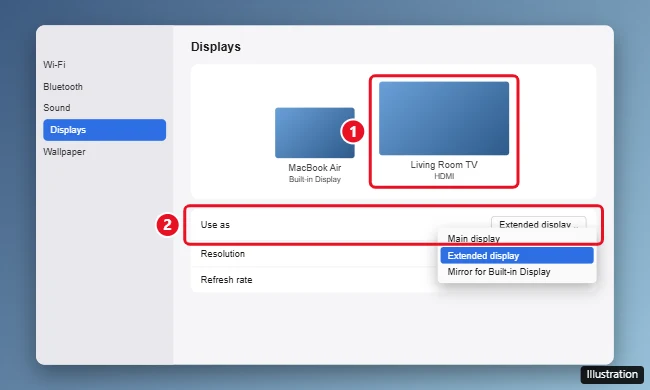
- Open System Settings > Displays (on older macOS, System Preferences > Displays).
- Click the TV at the top of the window.
- Next to Use as, choose Mirror for Built-in Display to show the same thing on both screens, or Extended display to use the TV as a second screen.
- Set Resolution to Default for display for the sharpest picture, or choose a larger text option if things look too small.
A quick way to mirror: click Control Center in the menu bar, click Screen Mirroring (or Display), and pick the TV.
Send sound to the TV speakers
Go to System Settings > Sound > Output and select the TV. You can also Option-click the volume icon in the menu bar and pick the TV. If the TV doesn’t appear, unplug and replug the HDMI cable, or try a different adapter.
Watch with the lid closed
Connect your MacBook Air to power, plug in the TV, and connect a keyboard and mouse (Bluetooth or USB). Then close the lid. The TV becomes your only display. This is called clamshell mode.
How many displays can a MacBook Air use?
- M1 and M2 MacBook Air: One external display.
- M3 MacBook Air: Two external displays, but only with the lid closed.
- M4 MacBook Air and later: Two external displays with the lid open.
Check Apple’s tech specs page for your exact model if you’re not sure.
No wires? Use AirPlay
If you have an Apple TV or a smart TV that supports AirPlay 2 (many Samsung, LG, Sony, and Vizio models), click Control Center > Screen Mirroring and choose the TV. Both devices must be on the same Wi-Fi network.
Troubleshooting
- No picture: Check the TV input, reseat both ends of the cable, and try another HDMI port or cable.
- “No signal” with a hub: Some hubs need power or don’t support video. Try a simple USB-C to HDMI adapter.
- Black borders or cut-off edges: Turn off overscan in the TV’s picture settings (often called Just Scan, Screen Fit, or 1:1 Pixel), or adjust Underscan in Displays if it appears.
- Flickering: Use a higher-quality cable, and choose 60 Hertz under Refresh rate in Displays.
Frequently asked questions
Does my MacBook Air have an HDMI port?
No. No MacBook Air model has a built-in HDMI port. You need a USB-C (or Mini DisplayPort, on older models) to HDMI adapter.
Why doesn’t sound come out of the TV?
Select the TV in System Settings > Sound > Output. Very old MacBook Air models may not send audio over Mini DisplayPort.
Can I use a USB-A to HDMI adapter?
Those need special DisplayLink drivers and work less reliably. A USB-C to HDMI adapter is the better choice.
Can I watch Netflix on the TV this way?
Yes. Streaming services work over HDMI. If a service shows a black screen, update macOS and your browser, or use the TV’s own app.

Kermit Matthews is a freelance writer based in Philadelphia, Pennsylvania with more than a decade of experience writing technology guides. He has a Bachelor’s and Master’s degree in Computer Science and has spent much of his professional career in IT management.
He specializes in writing content about iPhones, Android devices, Microsoft Office, and many other popular applications and devices.