If a box on your Windows 10 PC claims it’s infected or shows a phone number, don’t click it or call: close the browser from Task Manager. For anything else, where the box sits decides the fix. A corner box is a notification, one inside the browser falls to its pop-up blocker, and one that opens with no browser running calls for a Windows Security scan.
A warning is on screen right now
Start here if the box claims your PC is infected, fills the screen or won’t close.
- Don’t click anything inside the box, including its buttons, and don’t call any number it shows. Microsoft’s tech support scam page says its error and warning messages never include phone numbers.
- Press Ctrl + Shift + Esc to open Task Manager.
- Select your browser in the list and end the task. This is general advice rather than a Microsoft step, but it avoids touching the page itself. Microsoft says scam sites may try to disable Task Manager, so if it won’t open, restart the PC.
- When you reopen the browser, don’t restore the previous tabs if it offers to, since that could bring the page back.
- If the box came from outside the browser, go to the scan steps under “Windows that open by themselves” below.
Boxes in the corner of the screen
These are notifications, and they come from one of two places. A website you once allowed usually names the browser and the site. An app notification names the app.
Website notifications in Microsoft Edge
- Select Settings and more > Settings.
- Go to Privacy, search, and services > Site permissions > All sites.
- Select the site, find Notifications and choose Block.
If you’re already on the site, the View site information icon left of the address bar gets you there faster: Permissions for this site > Notifications > Block. Microsoft’s Edge notification page has both routes.
Website notifications in Google Chrome
- Select More > Settings > Privacy and security > Site Settings > Notifications.
- To block a site, select Add next to Not allowed to send notifications and enter its address.
- To quiet the requests themselves, turn on Use quieter messaging. Per Google’s Chrome notification help, you’ll see a bell icon by the address instead of a prompt.
App notifications in Windows
Open Start > Settings > System, then the notifications page. Microsoft’s notifications guide calls it Notifications; on Windows 10 you may see it as Notifications & actions. Under the list of apps and other senders, turn off anything you don’t need. Selecting an app may also give you finer choices, such as banners or sound. There’s more detail on how to turn off notifications in Windows 10.
Security software can send these boxes too. If yours is McAfee, see how to stop McAfee pop-ups.
For a temporary break, not a permanent fix, use the quiet mode. Microsoft now calls it Do not disturb, while Windows 10 may show Focus assist, so here’s how to change Focus Assist settings.
Boxes inside the browser
When a page throws up new windows or redirects you, the browser’s blocker is the control. Set it once per browser.
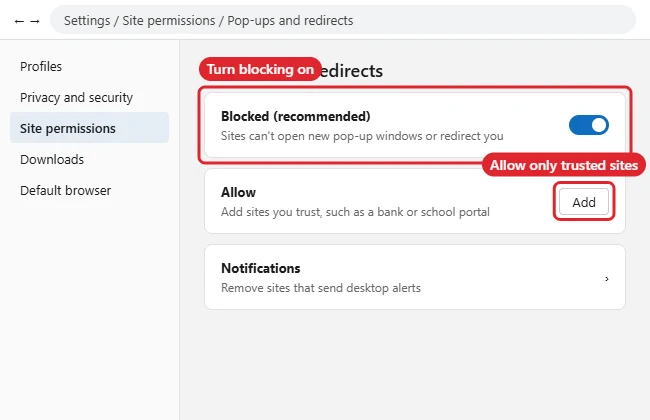
- Microsoft Edge: Go to Settings and more > Settings > Privacy, search, and services > Site permissions > Pop-ups and redirects, then switch on Blocked (recommended). See Microsoft’s Edge pop-up page.
- Google Chrome: Go to More > Settings > Privacy and security > Site Settings > Pop-ups and redirects, then pick the option that doesn’t allow them. Google’s pop-up help covers the details.
- Firefox: Open the menu button, then go to Settings > Privacy & Security > Permissions and data and find the Permissions section. Older versions may show that section directly on the Privacy & Security page. Tick Block pop-up windows, or Block pop-ups and third-party redirects on newer versions. Mozilla’s page explains both labels.
Let one trusted site through
Some sign-in and payment pages need a pop-up to finish. Allow that site only and leave the blocker on.
- Edge: On the Pop-ups and redirects page, go to Allowed to send pop-ups and use redirects > Add site, enter the full address beginning with https://, then select Add.
- Chrome: Click Pop-up blocked in the address bar, click the link for the pop-up, then choose Always allow pop-ups and redirects from that site, and select Done.
Windows that open by themselves
A box appearing with no browser open can be an app sending notifications, so check the Windows list above first. If that’s not it, treat it as possible adware or other malware, and work down this list, stopping when the boxes do.
- Scan: Open Windows Security > Virus & threat protection > Scan options, and run a full scan if that page offers one.
- Run the offline scan: Save your work and close your apps, because the PC will restart. On Scan options, choose Microsoft Defender Antivirus (offline scan), then Scan now. It takes several minutes and runs from outside the normal Windows kernel. Check the results under Protection history. For more on the tool itself, see using Windows Defender.
- Remove what you don’t recognize: Look through your installed apps under Settings > Apps and uninstall anything you didn’t choose. Look up unfamiliar names first, since some belong to your PC’s hardware.
- Check startup items: Open Task Manager, go to the startup list and disable anything you don’t recognize. Disabling is easier to reverse than uninstalling.
Windows’ own tips and promotions
These aren’t malware, just Windows nudging you. Exact wording varies, so go by the function if a label below doesn’t match your screen.
- Tips: On the notifications page in Settings > System, look under additional settings for Get tips and suggestions when using Windows. Windows 10 may word it as “Get tips, tricks, and suggestions as you use Windows.”
- Welcome screen: Clear Show the Windows welcome experience after updates and when signed in to show what’s new and suggested in the same place. Your PC may use shorter wording.
- Start menu: Go to Settings > Personalization > Start and look for a switch about showing suggestions.
- Lock screen: In Settings > Personalization > Lock screen, look for the option about fun facts and tips. It may only appear with certain background choices. You can also disable lock screen notifications separately.
- File Explorer: Older advice points to a folder option called “Show sync provider notifications.” The Microsoft support pages reviewed for this article don’t document it, so if you can’t find it, move on.
If they keep coming back
A blocker that’s on, but still leaking boxes, usually points to the browser itself. Microsoft’s Edge page suggests these steps, and the same ideas apply elsewhere:
- Update the browser. In Edge, that’s Settings and more > Settings > About Microsoft Edge.
- Test your extensions. In Edge, go to Settings and more > Extensions > Manage extension. Turn them all off, then re-enable them one at a time, watching for when the boxes come back.
- Block third-party cookies. Look under Privacy, search, and services > Cookies in Edge.
- Clear the browser’s cache, then visit the page again.
Older Windows? There’s a separate walkthrough to stop pop-ups on Windows 7.
What these settings can’t fix after end of support
Microsoft says Windows 10 reached the end of support on October 14, 2025. Everything above quiets interruptions, but none of it replaces security updates. That page also describes the consumer Extended Security Updates program, so check it for the current dates and terms before relying on it.
Windows 10 pop-up questions
Why do I get pop-ups when no browser is open?
Either an installed app is sending notifications, or adware is running. Check the Windows notification list first, because it’s quick and harmless. Then run the scans above.
Will blocking pop-ups break sign-in or payment pages?
It can, when a page opens its login or payment step in a new window. Allow that one site instead of turning off the blocker.
How do I find which extension is causing pop-ups?
Turn every extension off, then re-enable them one at a time, using the browser normally between each. The boxes returning points to the last one you turned on.
Can I change these on a work PC?
Perhaps not all of them, since your organization may manage some settings. If a control won’t change, or a security alert looks real, ask your IT team before doing anything else.
Next time a box appears, check where it sits first: that one detail tells you which section to use.

Kermit Matthews runs Live2Tech from just outside Philadelphia. He is an IT specialist with over 20 years of experience, from a university help desk to small-business IT, IT management and his own consulting practice, and has written tech guides full time since 2020. Steps are checked against the current software on a real device or the maker’s official documentation. More about Kermit.