Windows 10 has several ways to minimize every open window at once and get straight to your desktop, and just as many ways to bring them all back. This guide covers the keyboard shortcuts, the hidden Show desktop button, the taskbar menu, minimizing all but one window, and minimizing a single window, plus how to turn the Peek preview on or off.
Quick Answer
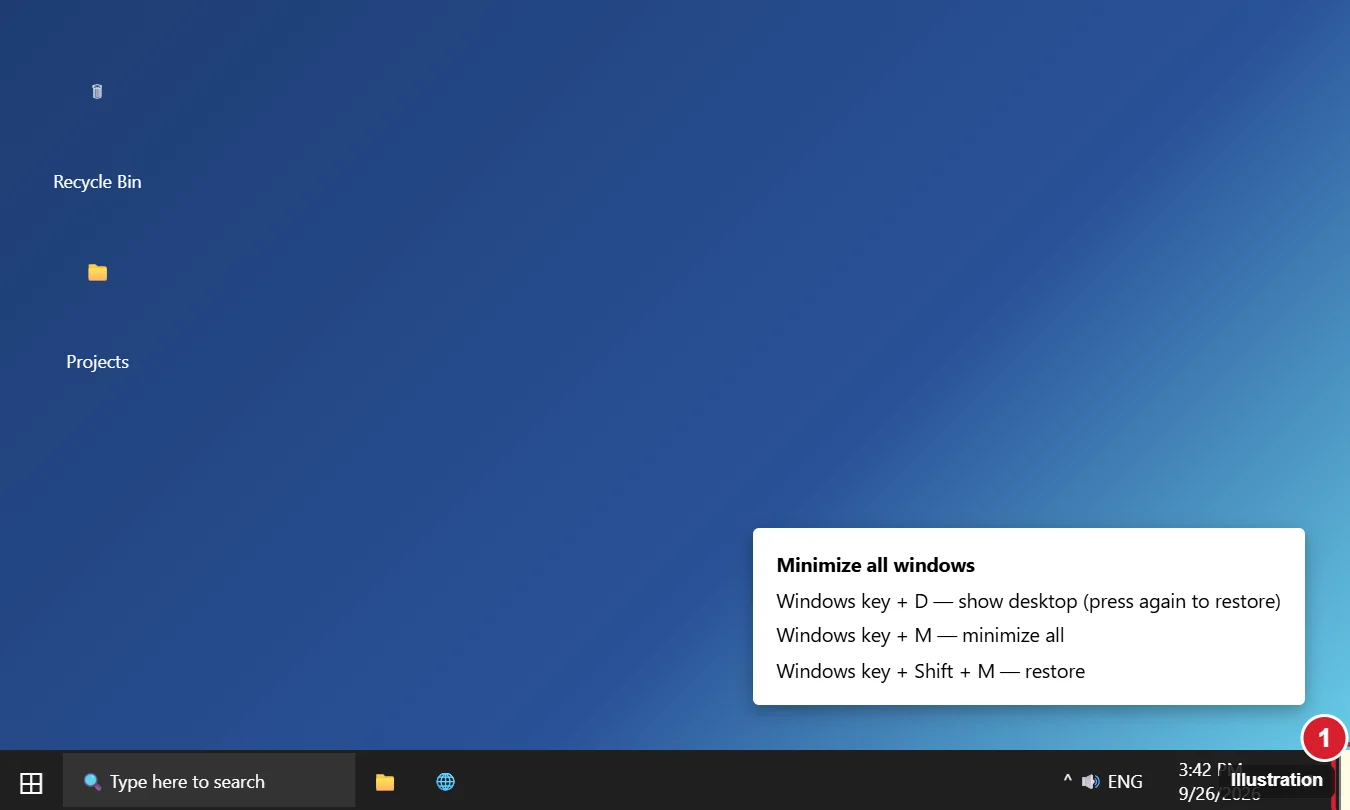
Press Windows key + D to minimize everything and show the desktop. Press it again to restore your windows. Or click the thin Show desktop strip at the far right end of the taskbar.
Keyboard Shortcuts
| Shortcut | What it does |
|---|---|
| Windows + D | Shows the desktop; press again to restore all windows |
| Windows + M | Minimizes all windows |
| Windows + Shift + M | Restores windows minimized with Windows + M |
| Windows + Home | Minimizes all windows except the active one |
| Windows + Down arrow | Restores down, then minimizes the current window |
| Windows + , (comma) | Peeks at the desktop while held |
Windows + D and Windows + M differ in one way: Windows + D also hides windows that can’t be minimized, like some dialogs, and it toggles.
Use the Show Desktop Button
- Move the mouse to the bottom-right corner of the screen, past the clock and notification icon.
- Click the narrow vertical strip. All windows minimize.
- Click it again to bring them back.
To preview the desktop by hovering over the button, right-click it and choose Peek at desktop, or turn on Use Peek to preview the desktop in Settings > Personalization > Taskbar.
Use the Taskbar Menu
Right-click an empty part of the taskbar and choose Show the desktop. Choose Show open windows from the same menu to restore them.
Minimize All but One Window (Aero Shake)
- Press Windows + Home to keep only the active window open.
- Or grab the window’s title bar and shake it quickly. This is on by default in Windows 10. If it doesn’t work, it may be turned off by Group Policy (User Configuration > Administrative Templates > Desktop > Turn off Aero Shake window minimizing mouse gesture).
Minimize a Single Window
- Click the — button at the top right of the window.
- Press Alt + Space, then N.
- Click the app’s taskbar icon while it’s active.
Tablet Mode and Touch
In tablet mode, apps run full screen. Swipe from the left edge or tap Task View to switch apps, or press Windows + D to reach the desktop if tablet mode allows it.
Related: How to Get Out of Full Screen on Windows.
Troubleshooting
- Shortcut does nothing: some full-screen games and remote desktop sessions capture the Windows key. Exit full screen first.
- Show desktop button missing: it’s very thin on Windows 10; hover in the corner, or make sure the taskbar isn’t set to auto-hide on another monitor.
- Windows key disabled: some gaming keyboards have a lock key. See how to turn the Windows key back on.
Related: See all open windows.
Frequently Asked Questions
Does this work on Windows 11?
Yes, the shortcuts are the same. Windows 10 reached end of support on October 14, 2025.
How do I minimize all windows on one monitor only?
Windows doesn’t have a built-in shortcut for that. Use Windows + Home from a window on the monitor you want to keep, or third-party tools.
Summary
- Windows + D toggles the desktop.
- Windows + M minimizes; Windows + Shift + M restores.
- Click the Show desktop strip at the far right of the taskbar.
- Windows + Home keeps only the active window.

Kermit Matthews runs Live2Tech from just outside Philadelphia. He started on a university help desk, spent years as the IT person for small businesses, and has been writing tech guides full time since 2020. Each guide is checked on a device he owns, and re-checked when a menu moves. More about Kermit.