Windows 10 plays sounds for events such as errors, notifications, device connections, and startup. You can change them one at a time, switch to a different sound scheme, or turn most of them off from the Sound dialog. Windows 10 reached end of support on October 14, 2025. Consumer Extended Security Updates (ESU) now run until October 12, 2027.
Quick Answer
Open the classic Sound control panel, go to the Sounds tab, pick a Sound Scheme or select an event and choose a new sound, then click Apply and OK.
How to Change System Sounds in Windows 10
- Open Control Panel, choose Hardware and Sound, then Sound. Typing Change system sounds into the Start search also gets you there.
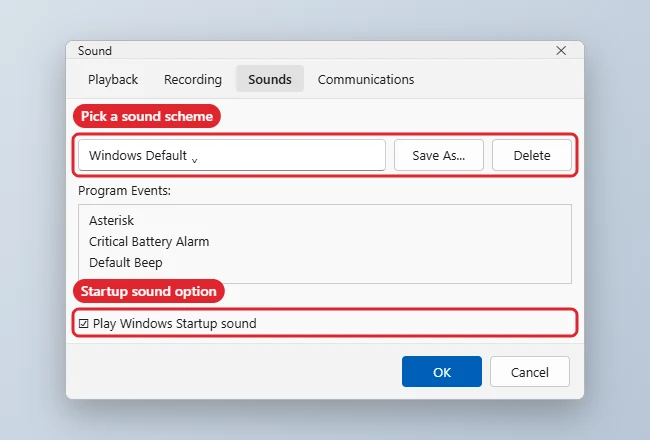
- On the Sounds tab, open the Sound Scheme drop-down and choose Windows Default, No Sounds, or another scheme.
- To change one event, highlight it under Program Events, then pick a replacement in the Sounds list or use Browse to load your own .wav clip.
- Check or clear Play Windows Startup sound if you want to control the sound at startup.
- Click Save As to keep your mix as a named scheme, then click Apply and OK.
Common System Sound Events
| Event | When it plays |
|---|---|
| Default Beep | General alerts and blocked actions |
| Critical Stop | Serious errors |
| Device Connect / Disconnect | Plugging in USB devices |
| Notification | App notifications |
| Windows Logon | Signing in |
Troubleshooting
- The startup sound does not play even when checked: Fast Startup can skip it. Turn off Fast startup in Control Panel, Power Options, Choose what the power buttons do.
- A theme change reset your sounds: themes can include sound schemes, so reselect your saved scheme.
- To change only the notification chime, see how to change the notification sound on Windows 10.
- To stop the Caps Lock pop-up and beep, read how to turn off the Caps Lock notification.
Frequently Asked Questions
How do I turn off all system sounds?
Choose No Sounds in the Sound Scheme drop-down and click Apply.
What file types can I use?
Only .wav files work in the Sound dialog.
Will changing sounds affect games or music?
No. System sounds only cover Windows events; app audio is unaffected.
Summary
- Open the Sound dialog.
- Choose a scheme on the Sounds tab.
- Change individual events if needed.
- Save your scheme and click OK.

Kermit Matthews is a freelance writer based in Philadelphia, Pennsylvania with more than a decade of experience writing technology guides. He has a Bachelor’s and Master’s degree in Computer Science and has spent much of his professional career in IT management.
He specializes in writing content about iPhones, Android devices, Microsoft Office, and many other popular applications and devices.