Every alarm on your iPhone 15 can have its own sound: a built-in tone, a song from your music library, a purchased ringtone, or vibration only. This guide shows how to change the sound for existing and new alarms, set a song as your alarm, change the Sleep | Wake Up alarm, adjust how loud alarms are, pick a vibration pattern, and fix alarms that ring silently.
Quick Answer
Open Clock > Alarms, tap the alarm (or Edit, then the alarm), tap Sound, choose a tone or song, then tap Back and Save.
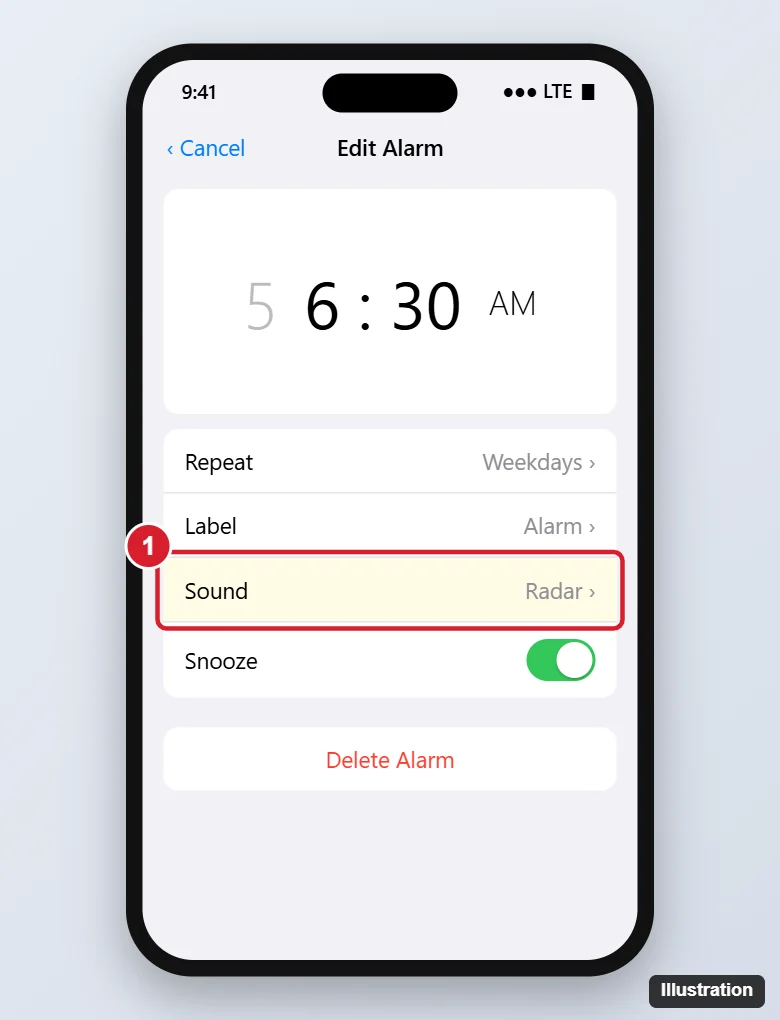
Change the Sound for an Existing Alarm
- Open the Clock app and tap Alarms at the bottom.
- Tap the alarm’s time. (On some iOS versions, tap Edit first, then the alarm.)
- Tap Sound.
- Tap a tone under Ringtones to preview it. Tap Classic at the bottom for older tones.
- Tap Back (or <), then Save.
Each alarm keeps its own sound, so repeat the steps for any other alarms.
Set a Sound for a New Alarm
- In Clock > Alarms, tap +.
- Set the time, then tap Sound and pick a tone.
- Tap Back and Save.
Use a Song as Your Alarm
- Open the alarm and tap Sound.
- Scroll to Songs and tap Pick a song.
- Browse your library and tap a song. It then appears under Songs.
- Tap Back and Save.
Songs from an Apple Music subscription work best when downloaded to your iPhone. If a song can’t play when the alarm goes off, for example because it’s no longer available, the iPhone plays a default tone instead. Songs from other streaming apps can’t be used as alarm sounds.
Buy or Download More Tones
- In the Sound list, tap Tone Store to buy ringtones, which can also be used as alarm sounds.
- If you bought tones before, tap Download All Purchased Tones.
- You can also make a custom tone from your own audio in GarageBand on the iPhone and export it as a ringtone.
Change the Vibration or Use Vibration Only
- In the alarm’s Sound screen, tap Haptics (called Vibration on older iOS) at the top.
- Choose a pattern, Create New Vibration to tap your own, or None.
- For vibration only, go back to the Sound screen and choose None at the bottom of the Ringtones list, while keeping a vibration pattern.
Change the Sleep | Wake Up Alarm Sound
The Sleep | Wake Up alarm is set through your sleep schedule, and its sound is chosen separately.
- In Clock > Alarms, tap Change next to Sleep | Wake Up. (You can also do this in the Health app under Sleep.)
- Scroll to Alarm Options and tap Sounds & Haptics.
- Choose a sound, set the volume slider, and tap Done.
Make the Alarm Louder or Quieter
- Go to Settings > Sounds & Haptics.
- Drag the Ringtone and Alert Volume slider. Alarms use this volume.
- Turn off Change with Buttons if you don’t want the side buttons to lower it by accident.
The Ring/Silent switch or Action button, Silent mode, Focus and Do Not Disturb don’t silence Clock alarms. Some features, like Attention Aware Features on Face ID models, can lower the alarm volume when you look at the phone.
Alarm Not Making a Sound? Try These Fixes
| Problem | Fix |
|---|---|
| Alarm vibrates but no sound | Check that Sound isn’t set to None |
| Alarm is very quiet | Raise Ringtone and Alert Volume in Settings |
| Song alarm plays a default tone | Download the song, or pick one stored on the phone |
| Sound comes from earbuds | Alarms play through connected Bluetooth devices; disconnect them |
| Alarm gets quieter when you look at it | Turn off Settings > Face ID & Passcode > Attention Aware Features |
More help: fixing an iPhone alarm that isn’t working.
Frequently Asked Questions
Can I set a different sound for each alarm?
Yes. Each alarm has its own Sound setting.
Can I use a voice memo as an alarm?
Not directly. Convert it to a ringtone first, for example with GarageBand, then choose it under Ringtones.
Can I rename an alarm?
Yes. Tap Label in the alarm. See how to change an alarm name on iPhone.
Summary
- Clock > Alarms > tap the alarm > Sound.
- Choose a tone, or Pick a song from your library.
- Set Haptics for the vibration pattern.
- Adjust volume in Settings > Sounds & Haptics.

Kermit Matthews is a freelance writer based in Philadelphia, Pennsylvania with more than a decade of experience writing technology guides. He has a Bachelor’s and Master’s degree in Computer Science and has spent much of his professional career in IT management.
He specializes in writing content about iPhones, Android devices, Microsoft Office, and many other popular applications and devices.