The Windows Recovery Environment (WinRE), often called recovery mode, is a separate set of repair tools that runs outside Windows. From it you can run Startup Repair, roll back an update, use System Restore, open Safe Mode, get to the UEFI firmware, or reset the PC. This guide covers every way to get into it on Windows 11, including when Windows won’t start.
Quick Answer
If Windows starts, open Settings > System > Recovery and click Restart now next to Advanced startup. Or hold Shift while you click Power > Restart. If Windows won’t start, turn the PC on and off during startup three times in a row, and Windows opens recovery automatically.
Method 1: From Settings
- Save your work and close apps.
- Press Windows + I to open Settings.
- Go to System > Recovery.
- Next to Advanced startup, click Restart now, then confirm.
- The PC restarts to a blue Choose an option screen.
Method 2: Shift + Restart
- Click Start, then the Power button. (This also works from the power icon on the sign-in screen.)
- Hold down Shift and click Restart. Keep holding Shift until the recovery screen appears.
This is the fastest method, and the sign-in screen version helps if you can’t log in.
Method 3: Command Prompt or Terminal
- Right-click Start and choose Terminal.
- Type this command and press Enter:
shutdown /r /o /f /t 00
/r restarts, /o goes to the advanced boot options, /f closes running apps without warning (save first), and /t 00 does it immediately.
Method 4: When Windows Won’t Start (Automatic Repair)
Windows opens recovery by itself after it fails to start two or three times in a row. You can trigger this deliberately:
- Turn on the PC.
- As soon as the spinning dots or manufacturer logo appear, hold the power button for about 10 seconds until the PC turns off.
- Repeat two more times. On the next start, you should see Preparing Automatic Repair, followed by an Automatic Repair screen.
- Click Advanced options to reach the recovery menu.
Forced shutdowns are safe for this purpose, but don’t do it while an update is installing.
Method 5: Boot From Installation Media
If recovery won’t load at all, use a Windows 11 USB drive created with Microsoft’s Media Creation Tool on another PC.
- Plug in the USB drive and boot from it (use your PC’s boot menu key, often F12, F11, Esc, or F9).
- On the setup screen, choose your language and click Next.
- Click Repair your computer in the bottom-left corner instead of Install.
What You Can Do in Recovery
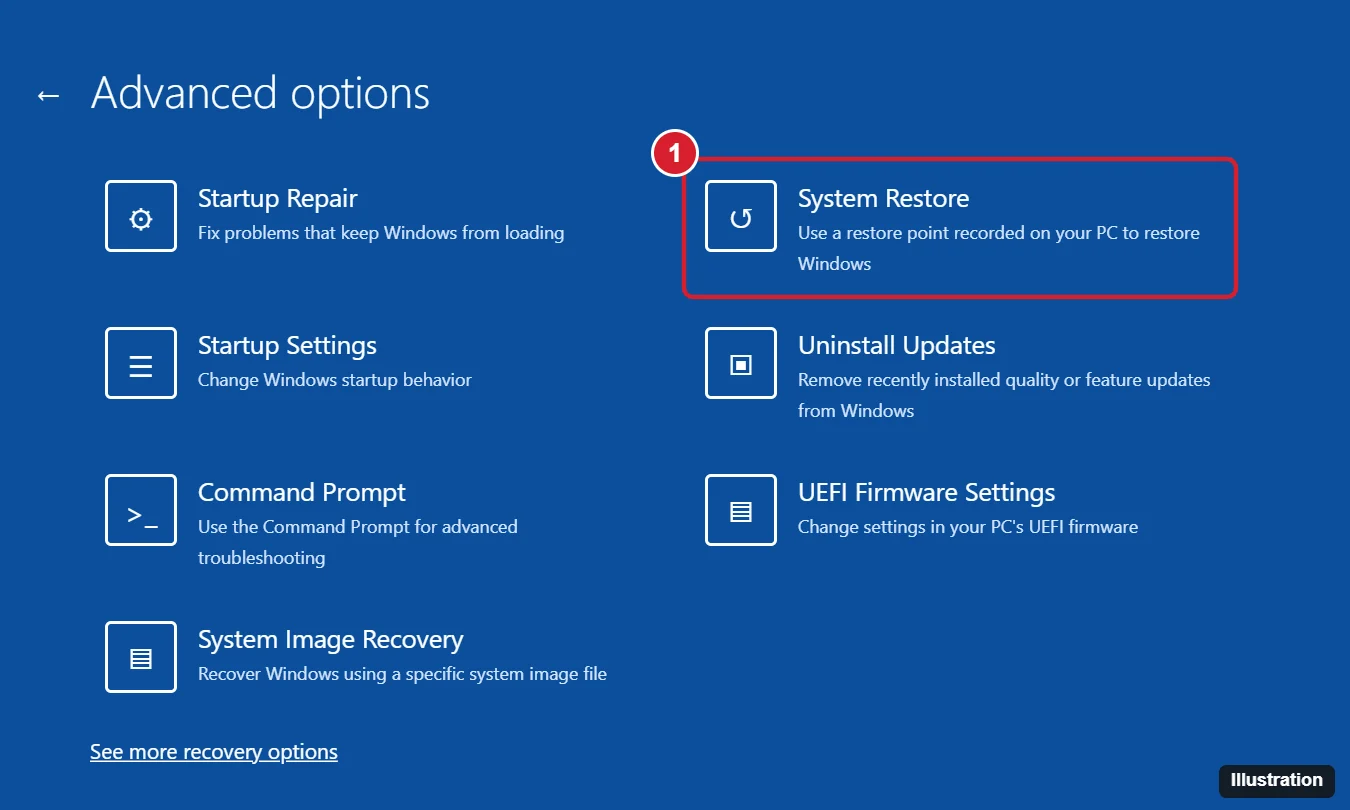
From Choose an option, select Troubleshoot. You’ll see Reset this PC and Advanced options. Advanced options include:
| Option | Use it to |
|---|---|
| Startup Repair | Automatically fix problems that stop Windows from loading. |
| Startup Settings | Restart into Safe Mode (press 4, 5, or 6 after restarting), disable driver signature enforcement, and more. |
| Uninstall Updates | Remove the latest quality update or feature update after a bad update. |
| System Restore | Return system files and settings to an earlier restore point without affecting personal files. |
| Command Prompt | Run commands such as sfc, chkdsk, or bootrec. |
| UEFI Firmware Settings | Restart directly into the BIOS/UEFI. |
| System Image Recovery | Restore from a full system image backup, if you made one. |
Recent Windows 11 versions also add Quick Machine Recovery, which can fetch fixes from Windows Update while in recovery when a widespread boot problem occurs. Availability depends on your version and settings (Settings > System > Recovery).
To leave recovery without changing anything, choose Continue (exit and continue to Windows) or Turn off your PC.
Troubleshooting
- Asked for a BitLocker recovery key: this is normal on encrypted PCs for some options. Find the key in your Microsoft account online (aka.ms/myrecoverykey) or wherever you saved it.
- Recovery environment not found: in an administrator Terminal, run reagentc /info. If it says Disabled, run reagentc /enable. If that fails, use installation media (Method 5).
- Shift + Restart just restarts normally: keep holding Shift until the blue screen appears, or use Settings instead.
- Keyboard or mouse doesn’t work in recovery: try a different USB port, or a wired keyboard.
Related: Run Startup Repair in Windows 11.
Related: Use a recovery drive in Windows 11.
Related: Open Advanced startup options in Windows 10.
Frequently Asked Questions
Is recovery mode the same as Safe Mode?
No. Recovery is a separate environment with repair tools. Safe Mode starts Windows itself with minimal drivers; you reach it from recovery via Startup Settings.
Will entering recovery mode delete my files?
No. Simply opening it changes nothing. Only Reset this PC with “Remove everything” deletes personal files.
Does F8 work on Windows 11?
Usually not. Fast startup makes the F8 window too short. Use Shift + Restart instead.
Summary
- Settings > System > Recovery > Advanced startup > Restart now.
- Or hold Shift and click Restart.
- Or run shutdown /r /o /f /t 00.
- If Windows won’t boot, interrupt startup three times, or use installation media.

Kermit Matthews is a freelance writer based in Philadelphia, Pennsylvania with more than a decade of experience writing technology guides. He has a Bachelor’s and Master’s degree in Computer Science and has spent much of his professional career in IT management.
He specializes in writing content about iPhones, Android devices, Microsoft Office, and many other popular applications and devices.