Word doesn’t have a single “copy header” button, but there are four reliable ways to reuse a header or footer: copy and paste its contents, save it to the Header or Footer gallery for reuse in any document, carry it over between sections with Link to Previous, or build it into a template. This guide covers each method, including how to keep logos, page numbers and fields working after you copy them.
Quick Answer
Double-click the header in the source document, press Ctrl + A then Ctrl + C. Double-click the header in the destination document and press Ctrl + V. Repeat for the footer.
Method 1: Copy and Paste the Contents
- Open the source document and double-click the header area (the top margin) to edit it.
- Press Ctrl + A to select everything in the header, then Ctrl + C. Ctrl + A selects only header content while you’re editing the header.
- Open the destination document, double-click its header, and press Ctrl + V.
- Choose Keep Source Formatting from the paste options if the fonts change.
- Repeat for the footer, then double-click the body or click Close Header and Footer.
Page numbers and date fields copy as fields and update automatically. Logos copy with the header.
Method 2: Save to the Header or Footer Gallery
This makes your header available from the Insert tab in every document.
- Double-click the header and select its contents.
- Go to Insert > Header and click Save Selection to Header Gallery.
- Give it a name, keep Gallery set to Headers, choose Building Blocks.dotx under Save in, and click OK.
- In any document, go to Insert > Header and pick your saved header from the top of the list.
Do the same for footers with Insert > Footer > Save Selection to Footer Gallery. When closing Word, click Save if asked about saving changes to building blocks.
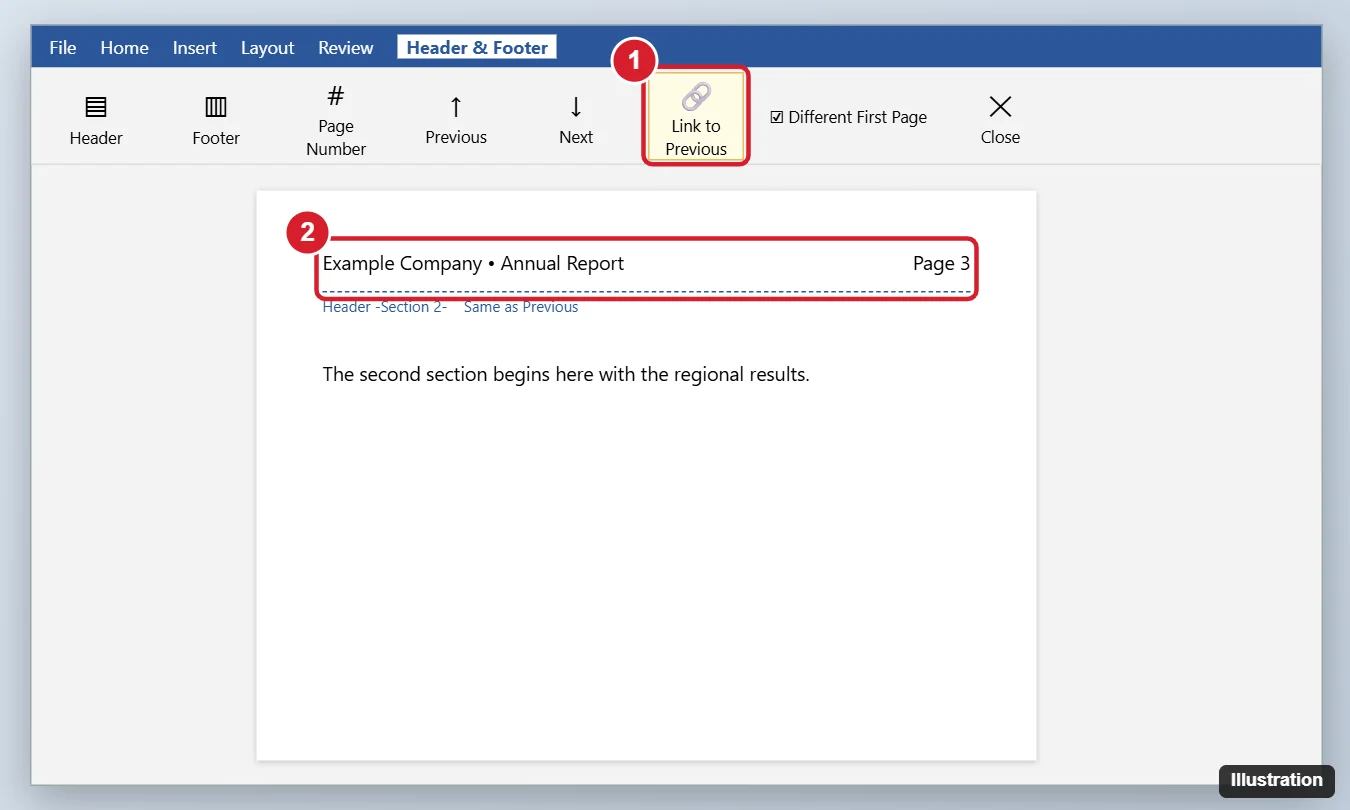
Method 3: Copy Between Sections With Link to Previous
In documents with section breaks, each section can have its own header.
- To make a section use the same header as the one before, double-click its header and turn on Link to Previous on the Header & Footer tab. The label “Same as Previous” appears.
- To give it a different header, turn Link to Previous off, then edit.
- Check Different First Page and Different Odd & Even Pages; each creates separate headers that need their own content.
More on sections: how to link sections in Word.
Method 4: Build It Into a Template
- Create a document with the header and footer you want.
- Go to File > Save As and choose Word Template (*.dotx).
- Start new documents from it with File > New > Personal.
Copy a Whole Section Including Its Header
Copying text that includes a section break carries that section’s header and footer with it. Turn on Home > Show/Hide ¶, select the content through the section break, copy, and paste into the other document.
Troubleshooting
| Problem | Fix |
|---|---|
| Header pasted into the body | Double-click the header area before pasting |
| Header appears on some pages only | Check Different First Page, odd/even settings and section links |
| Page numbers show {PAGE} | Press Alt + F9 to toggle field codes off |
| Logo moves after pasting | Set the picture’s layout to In Line with Text or fix its position |
Frequently Asked Questions
Can I copy headers in Word for the web?
Yes, copy and paste works. The Header Gallery and templates require the desktop app.
How do I copy headers from Word to Google Docs?
Copy the header contents and paste into Google Docs’ header area (Insert > Headers & footers). Fields like page numbers need to be reinserted.
Summary
- Double-click the header, Ctrl + A, Ctrl + C, then paste into the other header.
- Save headers to the gallery to reuse them in any document.
- Use Link to Previous to share headers between sections.
- Save a template for documents that always need the same header.

Kermit Matthews is a freelance writer based in Philadelphia, Pennsylvania with more than a decade of experience writing technology guides. He has a Bachelor’s and Master’s degree in Computer Science and has spent much of his professional career in IT management.
He specializes in writing content about iPhones, Android devices, Microsoft Office, and many other popular applications and devices.