If someone has seen you type your iPhone 14 passcode, or you shared it once and now regret it, change it today: go to Settings > Face ID & Passcode, type your current code, then choose Change Passcode. In that situation, two follow-ups matter. If Stolen Device Protection is on, do it somewhere familiar, such as home, to skip a one-hour wait. Afterward, tap Expire Previous Passcode Now so the old code stops working as a backup.
Your passcode also protects the list of saved passwords on the iPhone, so keep it private.
Change it in six taps
The iPhone 14 can run iOS 27, and Apple still releases iOS 26 updates for it. The steps are the same on both.
- Open Settings and tap Face ID & Passcode.
- Enter your current passcode to open the screen.
- Scroll down and tap Change Passcode.
- If asked, enter your current passcode again.
- On the new passcode screen, tap Passcode Options if you want something other than six digits, and pick a type.
- Type the new passcode, then type it again to confirm.
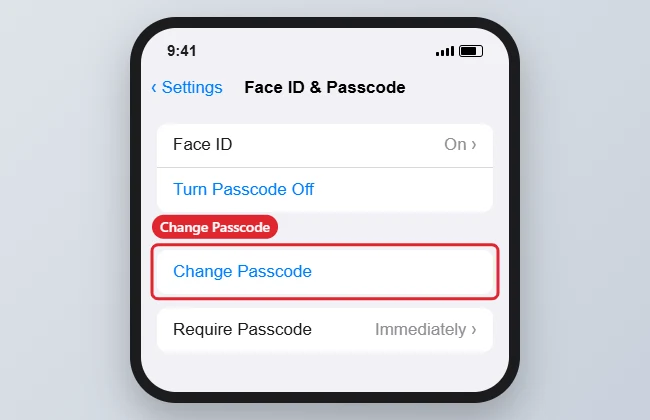
Changing the code should not affect your Face ID setup. On an iPhone that uses Touch ID instead of Face ID, such as iPhone SE, the same steps start at Touch ID & Passcode.
Four passcode types compared
Apple’s iPhone User Guide page on setting a passcode says the most secure choices are a custom alphanumeric code and a custom numeric code. Here is how the options under Passcode Options compare.
| Type | What you enter | Choose it when | Trade-off |
|---|---|---|---|
| Custom Alphanumeric Code | Letters and numbers on the full keyboard | Someone may have seen your old code, or you rely on Face ID nearly all the time | Slowest to type on the full keyboard |
| Custom Numeric Code | Digits only, in a length you choose | You want more strength but still prefer the number pad | A long code takes a moment longer each time |
| 6-Digit Numeric Code | Six digits (the default) | You want a balance of speed and strength | Easier to read over a shoulder than a longer code |
| 4-Digit Numeric Code | Four digits | Rarely the right pick | The easiest to guess or memorize by watching |
If people near you have seen your current code, a different length also helps, since an observer may only have caught the rhythm of your taps. For a closer look at the keyboard option, see using letters instead of numbers in an iPhone passcode. If the phone has no passcode at all yet, adding a passcode to an iPhone starts from the Turn Passcode On button instead.
Whatever type you choose, skip birthdays, repeated digits like 111111, simple runs like 123456, and any PIN that people already know, such as a bank card PIN.
Cut off the old passcode
For 72 hours after a change, your previous passcode can be used once to get into the iPhone and reset the passcode, in case you forget the new one. Apple’s support article Use a passcode with your iPhone, iPad, or iPod touch describes this window and the control that ends it.
That safety net is handy when you chose a new code. It is a risk when the reason for the change is that someone else knows the old one. To close it:
- Go to Settings > Face ID & Passcode and enter the new passcode.
- Find Expire Previous Passcode Now and tap it.
- If a confirmation appears, confirm it. From then on, only the new passcode works.
Apple lists this option for iOS 17 and later, so it is available on any iPhone 14 with current software. Only expire the old code once you are confident you will remember the new one.
At home or away: how Stolen Device Protection changes the steps
Stolen Device Protection treats a passcode change as a sensitive action. Apple’s Stolen Device Protection article explains the rule, and the effect depends on where the iPhone is.
| Where you are | What happens |
|---|---|
| A familiar location, such as home or work | The change works as described above, unless Require Security Delay is set to Always, in which case the delay applies here too. |
| Somewhere unfamiliar | You confirm with Face ID, wait through a one-hour security delay, then use Face ID again before you can change the passcode. |
The delay can end early if the iPhone arrives at a familiar location. It is there so that a thief who watched you type your code cannot quickly change it and shut you out. To check whether the feature is on, or to adjust it, see turning on Stolen Device Protection on an iPhone.
Why the iPhone still asks for the passcode after Face ID
A new passcode will come up more than you might expect for the first few days. Apple’s user guide lists the times the iPhone always wants the passcode, even with Face ID set up:
- After you turn it on or restart it.
- When you have not gotten into it for more than 48 hours.
- When the passcode has not been used in the last 6.5 days and Face ID has not been used in the last 4 hours.
- After it receives a remote lock command.
- After five failed Face ID attempts.
- After you start Emergency SOS or view Medical ID.
These prompts are a good chance to practice the new code, and a short note kept somewhere private for the first few days can help too.
Settings on the same screen worth a second look
While you are on Face ID & Passcode, review the options that work alongside the code:
- Require Passcode sets how soon the passcode is needed after the screen locks. Apple notes you can’t change it while Face ID or Apple Pay is in use, so on most iPhone 14 setups it stays at Immediately.
- Allow Access When Locked controls what someone can reach from the Lock Screen without the code. If another person knows your old passcode, turning a few of these off is sensible.
- Erase Data, at the bottom of the screen, erases the iPhone after 10 failed passcode attempts. Read the Erase Data setting explained before you turn it on or off.
Two related protections live elsewhere. For apps you want behind Face ID even when the phone is open, see locking an app on iPhone. A Screen Time passcode is a separate code from the one you just changed, and turning off restrictions on an iPhone shows where it is managed.
If the change will not go through
- A security delay timer appears. Stolen Device Protection is on and you are away from a familiar place. Wait for the hour to pass, or make the change when you are home.
- Too many wrong entries. Entering the wrong passcode several times in a row locks you out for a while, and the iPhone may show a message that it is disabled. Wait for the timer, then type the current code carefully.
- You forgot the new code. Within 72 hours, and only if you did not expire the old one, the previous passcode can reset it. After that, Apple’s user guide says the way back is to erase the iPhone using a computer or recovery mode, then restore from a backup.
If the shortest option is what you want, see how to use a 4-digit passcode on iPhone and what that choice gives up.
Passcode change questions
Will changing my passcode erase anything?
No. Changing the code doesn’t erase your apps, photos or settings; only the code you type changes.
Can I use Face ID with no passcode at all?
No. Face ID needs a passcode as a fallback, which is why the passcode screen keeps appearing in the cases listed above.
Why does my Settings app say Touch ID & Passcode?
That label appears on iPhone models that use Touch ID, such as iPhone SE. The iPhone 14 uses Face ID, so on it the item is called Face ID & Passcode.
Once the new code is set and the old one expired, try a restart and enter the new passcode to be sure it sticks.
If Face ID keeps failing and you end up typing the passcode every time, work through Apple’s checks for Face ID not working on iPhone.
This unlock code is separate from the Screen Time code that guards parental limits, described in what a Restrictions passcode is on iPhone.

Kermit Matthews runs Live2Tech from just outside Philadelphia. He is an IT specialist with over 20 years of experience, from a university help desk to small-business IT, IT management and his own consulting practice, and has written tech guides full time since 2020. Steps are checked against the current software on a real device or the maker’s official documentation. More about Kermit.