To copy and paste a word 100 times in Word, type the word with a space after it, then select everything, copy and paste. Each round doubles the count, so seven rounds give you 128 copies and you trim the extra 28. If Excel is already open, the formula =REPT("word ",100) builds all 100 copies in one cell that you can paste into Word. Both routes work in current Microsoft 365 versions of Word and Excel.
Pick a route by how exact the count has to be
Every route below ends with the same text in Word. They differ in how many key presses it takes and how easy it is to land on exactly 100.
| Route | Where it runs | Lands on exactly 100? | Best for |
|---|---|---|---|
| Doubling (select, copy, paste) | Word, or any text box | Overshoots to 128; trim 28 | Quick filler text, any app |
| Ten copies, then Ctrl + V once and F4 eight times | Word | Yes, if you count the presses | An exact 100 without trimming |
| Excel REPT formula | Excel, then paste into Word | Yes, the formula sets the number | Any count, such as 250 or 1,000 |
| Holding Ctrl + V | Word, or any text box | Rarely | Rough bulk text only |
The Ctrl + C and Ctrl + V basics themselves (and the right-click and touch versions) are covered in how to copy and paste on Windows.
Double the word inside Word
Doubling needs nothing but the keyboard, and it works the same way in a notes app, an email or a chat box.
- Open a blank Word document so nothing else gets selected along with your word.
- Type the word followed by one space, for example hello and a space. The space keeps the copies from running together.
- Press Ctrl + A to select everything, then Ctrl + C to copy it.
- Press the End key (or Ctrl + End) to move to the end of the text, then press Ctrl + V. You now have 2 copies.
- Repeat steps 3 and 4. The count goes 2, 4, 8, 16, 32, 64, 128.
- After the seventh paste you have 128 copies. To get back to 100, hold Shift and select from the end of the text backward until the word count in the status bar shows 28 for the selection, then press Delete.
The selection count in step 6 comes from Word’s status bar, which shows the words in a selection as well as the whole document. If you skip a round or paste twice by accident, the doubling sequence breaks, so check the count in the status bar before deleting anything.
Paste the same block again with F4 or Ctrl + Y
Word has a Repeat command that copies your last simple action. Microsoft’s undo, redo or repeat page uses this exact case as its example: to repeat something simple, such as a paste operation, press Ctrl + Y or F4, or select Repeat on the Quick Access Toolbar. That turns 100 copies into a short counting job:
- Type the word and a space ten times, or double it to 8 copies and type two more by hand. Check that the status bar reads 10 words.
- Press Ctrl + A, then Ctrl + C to copy the ten copies.
- Press Ctrl + End and then Ctrl + V once. You now have 20.
- Press F4 eight more times, counting out loud. Each press adds another ten, so you finish at 100.
On many laptops the F keys control brightness or volume first. Microsoft’s advice is to press the F-Lock or Fn key, then F4, or simply use Ctrl + Y. If Word can’t repeat the last thing you did, the command changes to Can’t Repeat; paste once more with Ctrl + V and carry on. The full Repeat command, including what it can and can’t repeat, is in how to repeat an action in Word.
Why holding Ctrl + V is hard to stop at 100
Holding the paste keys usually pastes over and over. The catch is speed: the copies arrive faster than you can count, so you usually overshoot by dozens. If a rough amount is fine, hold the keys until you pass 100, then trim with the status bar the same way as in the doubling steps. For an exact count, the F4 route above is more reliable.
Save the word block as a Quick Part for next time
If you need the same 100 copies again next week, store them once. Microsoft’s Quick Parts and AutoText page describes the route for Word for Windows:
- Select the 100 copies.
- On the Insert tab, in the Text group, choose Quick Parts > Save Selection to Quick Part Gallery.
- In the Create New Building Block box, give it a name such as “hello x100” and select OK.
- Later, place the cursor where you want the text, select Quick Parts and pick the entry from the gallery.
More uses of the gallery are in how to use Quick Parts in Word. If what you need repeated is a whole page rather than a word, duplicating a page in Word covers the page-sized options.
Let Excel do the counting with REPT
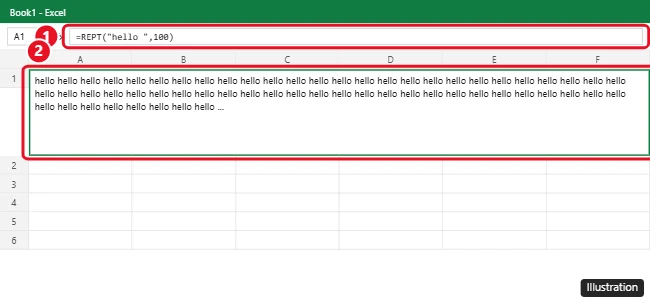
REPT is an Excel function that repeats text a given number of times. Its form is REPT(text, number_times), and Microsoft’s REPT function page gives =REPT("*-", 3), which returns *-*-*-, as its example. Swap in your word and 100:
- Open Excel and select an empty cell, such as A1.
- Type
=REPT("hello ",100), replacing hello with your word. Keep the space before the closing quotation mark, or the copies run together as one long string. - Press Enter. The cell shows the word 100 times.
- With the cell selected, press Ctrl + C, then switch to Word and paste (see the next section for keeping the result as plain text).
A few details from Microsoft’s page change how you write the formula:
- Separators: whatever sits inside the quotation marks is repeated, so
=REPT("hello, ",100)gives commas between the words. - Phrases: put the whole phrase in the quotation marks, such as
=REPT("see you soon ",100). - Size limit: the result can’t be longer than 32,767 characters, or REPT returns #VALUE! instead of text. A six-letter word plus a space is 7 characters, so 100 copies is only 700 characters; the limit matters for long sentences or counts in the thousands.
- Odd numbers: a decimal count is truncated (100.9 becomes 100), and a count of 0 returns empty text.
Paste the result into Word as plain text
A cell copied from Excel can bring its formatting with it. Microsoft’s paste formatting page explains the fix: press Ctrl + V, then select the Paste Options button that appears, or press Ctrl to open it, and choose Keep Text Only (T), which drops all formatting and pastes just the words.
If the button never shows up, Microsoft lists the switch at File > Options > Advanced, under Cut, copy, and paste: Show Paste Options button when content is pasted. The same section sets a default paste style, so you can make Keep Text Only the norm. If pasting does nothing at all, the problem is usually Windows rather than Word; see copy and paste not working in Windows 11.
Confirm you have exactly 100
Word keeps a live count in the status bar at the bottom of the window. Microsoft’s show word count page puts it simply: check the status bar, and for a partial count, select the words you want to count. Click the count to see characters, paragraphs and lines too.
- If the document holds only your repeated word, the status bar should read 100 words.
- For a phrase, multiply: 100 copies of a three-word phrase read 300 words.
- If the repeated text sits inside a longer document, select it first so the status bar counts the selection on its own.
- A missing space makes two copies count as one word, so a total of 99 or lower often means one space was lost. Search for the doubled word to find the join.
One last check before you paste the text somewhere else: repeated text is fine for practice files, typing drills and layout placeholders, but don’t use it to spam people, chats or forms. Many message boxes and form fields also cap their length and may cut the text off.
Repeated text answers
Does doubling work on a Mac or a phone?
Yes. On a Mac, use Command in place of Ctrl for select all, copy and paste. In Word for Mac, Microsoft puts the count under Tools > Word Count; other Mac apps are covered in how to check word count on a Mac. On a phone, the same select all, copy and paste doubling works in a notes app; you just tap the menu commands instead of pressing keys.
Why does my REPT cell show #VALUE!?
The repeated text would be longer than 32,767 characters. Lower the count, shorten the text, or split it across two cells and paste them one after the other.
Why did F4 add the wrong thing?
F4 repeats your most recent action, not the clipboard. If you typed, deleted or changed formatting after the last paste, F4 repeats that instead. Press Ctrl + Z to undo it, paste once with Ctrl + V, then go back to F4.
Can I put each copy on its own line?
The simplest way is in Word: type the word and press Enter instead of adding a space, then double or repeat as above. Each copy lands on its own line, and the status bar still counts one word per line.

Kermit Matthews runs Live2Tech from just outside Philadelphia. He is an IT specialist with over 20 years of experience, from a university help desk to small-business IT, IT management and his own consulting practice, and has written tech guides full time since 2020. Steps are checked against the current software on a real device or the maker’s official documentation. More about Kermit.