Microsoft Family Safety is tied to your Microsoft account, not to a setting on the PC. That means you turn it off online, not in Windows. The family organizer (the adult who manages the family group) signs in at account.microsoft.com/family and either turns off individual controls such as screen time and content filters, or removes the person with Remove from family group. An adult organizer who wants out completely can choose Leave family group.
If you’re an adult and Windows 11 still acts as though you have parental controls, there’s also an official fix from Microsoft for that. This guide covers every option for organizers and adults, what each one changes, and what to check if limits hang around afterward.
Quick Answer
- Sign in at account.microsoft.com/family with the family organizer’s Microsoft account.
- To relax controls but keep the family group, open the member’s card and turn off screen time limits, content filters or activity reporting.
- To remove someone completely, select the menu next to their name, choose Remove from family group, and confirm with Remove.
- To leave the group yourself as an organizer, choose Leave family group next to your name.
- Restart the Windows 11 PC so the change takes effect. Adults who are still restricted can run Microsoft’s Family Safety refresh task (see the troubleshooting section).
In This Guide
- Before you start: roles, accounts and what “off” means
- Method 1: Turn off individual Family Safety features
- Method 2: Remove a member from the family group
- Method 3: Leave or delete the family group
- Where Family Safety appears in Windows 11
- Which option should you use?
- Troubleshooting
- Frequently Asked Questions
Before You Start: Roles, Accounts and What “Off” Means
This guide reflects Microsoft Support documentation as of September 2026 and applies to Windows 11 PCs signed in with a Microsoft account, along with Xbox, Microsoft Edge and the Microsoft Family Safety app on Android and iPhone.
A family group is a set of Microsoft accounts linked together. It has two roles:
- Organizer: an adult who manages the group. Microsoft describes organizers as the administrators who can add and remove members, manage limits and permissions, and view activity for members with reporting turned on.
- Member: anyone else in the group, of any age. Members can ask for more screen time or purchase approval but can’t change their own safety settings.
What you need:
- The organizer’s Microsoft account email and password.
- A web browser. The Microsoft Family Safety app also works for turning features on and off.
- For child accounts: in many countries, children under a certain age need a parent to manage their account. Microsoft calls this parental consent. The age depends on where you live (for example, 13 in the United States), and Microsoft publishes the full list of statutory age limits by country or region.
This guide is for parents and organizers managing their own family group, and for adults who were added to a family group. If you’re a younger member, talk to the organizer. Only they can change these settings.
Also note that the Family Safety app no longer offers location sharing or drive safety. Microsoft ended those features on November 29, 2024, and now focuses on digital safety tools: screen time, content filters, activity reports and spending controls.
Method 1: Turn Off Individual Family Safety Features
Choose this if you want to keep someone in your family group, for example to share a Microsoft 365 Family subscription, but no longer want certain limits on them. Only an organizer can do this.
Turn off screen time limits
- Go to account.microsoft.com/family and sign in with the organizer account.
- Select the family member’s tile.
- Open the platform tab you want to change: Windows, Xbox or Mobile.
- Select the three-dot menu and choose Turn limits off.
Expected result: screen time limits no longer apply on that platform. Repeat for each tab where limits are set.
In the Family Safety app, tap the member’s tile, open the Windows or Xbox section, tap the three-dot menu and choose Turn limits off. To bring limits back later, choose Turn limits on. If you just want to see how much time is being used before deciding, read how to see screen time on Windows.
Turn off web and search filters
- On the member’s page, open the Edge tab. In the app, tap Content filters.
- Turn off Filter inappropriate websites and searches.
- If it’s on, also turn off Only use allowed websites.
Expected result: Microsoft Edge and Bing stop filtering results for that person.
Why this matters: Family Safety web filters only work in Microsoft Edge. While filtering is on, other browsers are blocked on the member’s Windows device. Turning filters off removes that reason for blocking. Microsoft explains more in Filter websites and searches using Microsoft Family Safety. If you’d rather block a few specific sites on a PC without Family Safety, see how to block websites on Windows.
Turn off activity reporting
- On the member’s card, find Activity reporting. In the app, tap the member and then the settings icon in the top right.
- Turn it off for each platform listed: Windows, Xbox, Web safety and Mobile.
Expected result: Microsoft stops collecting new activity reports for that member.
Microsoft notes that only organizers can turn activity reporting on or off or view the reports.
App and game limits and spending
App and game limits and spending controls are managed from the same member page. Remove the limits or change the spending settings there if those are the only restrictions causing trouble.
Method 2: Remove a Member From the Family Group
This turns off Family Safety for that person completely. Before you continue, know what they’ll lose: Microsoft says anyone removed from a family group also loses access to shared products and services that other members make available, such as a Microsoft 365 Family subscription. You also won’t be able to manage their Family Safety settings anymore.
- Go to account.microsoft.com/family and sign in with an organizer account.
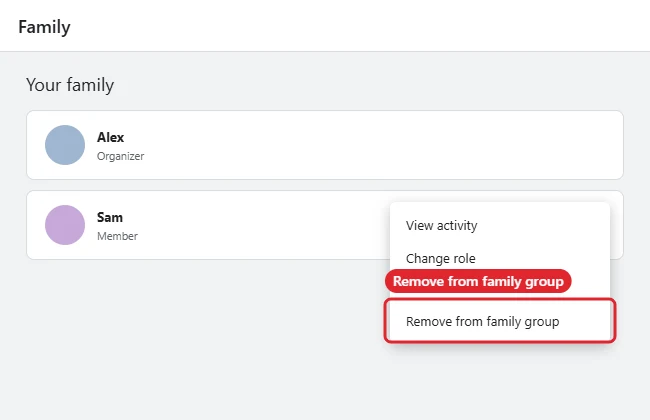
- Find the person and select the menu icon (three dots) next to their name.
- Choose Remove from family group.
- Select Remove to confirm.
Expected result: the person no longer appears in your family group, and their Family Safety settings stop applying. - Have them restart their Windows 11 PC and sign in again so the device picks up the change.
If you can’t remove a child account
If you gave parental consent for a child’s account, you may need to withdraw it first. Microsoft’s troubleshooting steps say to select the member, choose Remove consent, then return to the family group and choose Remove from family group. Only the parent who originally granted consent can remove it. Microsoft explains this on its Managing parental consent page.
A common reason to remove someone is that a child has grown up. Microsoft’s own advice is that if you or your grown-up child wants privacy, you can remove them from the family group.
Method 3: Leave or Delete the Family Group
Leave as an organizer
- Sign in at account.microsoft.com/family.
- Select the menu icon next to your own name and choose Leave family group.
- Select Remove to confirm.
Expected result: you’re no longer in the group. You also lose access to anything shared by other members, such as Microsoft 365 Family.
Microsoft’s support page notes that if you don’t see Leave family group, you aren’t an organizer. In that case, ask an organizer to remove you using Method 2.
Delete the whole family group
There’s no single delete button. Remove every other member and organizer first, then choose Leave family group for yourself. Microsoft also says family groups without an organizer and at least one other member are deleted automatically. The full steps are in How to leave a Microsoft family group.
Where Family Safety Appears in Windows 11
Windows 11 shows your family group, but the actual on/off switches live online. Two places link to them:
- Settings, then Accounts, then Family. This page lists your family group and links to the online family settings. The exact button names can vary by Windows 11 version, so look for an option to manage family settings online.
- Windows Security, then Family options. Select View family settings to open the Family Safety website.
Removing a user account from the PC is a different thing. Under Settings, then Accounts, then Other users, selecting Remove next to Account and data deletes that person’s sign-in and files from the device. It doesn’t delete their Microsoft account or take them out of the family group. For more on this, see how to remove a Microsoft account from Windows 11. Uninstalling the Family Safety app doesn’t turn off Family Safety either, because the settings belong to the account.
Which Option Should You Use?
| Your goal | Best option | Keeps shared Microsoft 365 Family? |
|---|---|---|
| Loosen one or two limits | Method 1: turn off that feature | Yes |
| Stop all controls for one person | Method 2: Remove from family group | No, for the removed person |
| Stop using Family Safety entirely | Method 3: remove everyone, then leave | No |
| You’re an adult member being restricted | Ask the organizer to use Method 1 or 2 | Depends on their choice |
| You’re not in any group but still see limits | Run the refresh task (Troubleshooting) | Not affected |
Troubleshooting
I’m an adult and Windows still asks for a parent’s permission
Microsoft says this can happen when a device was previously set up under a family group, or when an organizer has restrictions on their own account. First, sign in at account.microsoft.com/family to check whether you’re still in a group. If you aren’t, or you’re the organizer, Microsoft’s fix is:
- Open Microsoft’s Family Safety settings enforced on adults article and copy the schtasks command it lists. The command runs a built-in Windows task named FamilySafetyRefreshTask, which makes the PC re-check your current family settings.
- Press Windows key + R, type cmd and select OK.
- Paste the command into Command Prompt and press Enter.
Expected result: Command Prompt reports that the task was run. - Restart the computer.
- Repeat on each affected PC.
Copying the command from Microsoft’s page, rather than retyping it, avoids typos in the task path.
I’m an adult member and the organizer controls my settings
Right now, only the organizer can change a member’s safety settings. Ask them to turn off the features or remove you. Microsoft has said it’s working on an update that lets adult members opt in or out themselves.
My account thinks I’m a child
If your birth date on the Microsoft account is wrong, Microsoft says you need to update your account information. The process can feel like a child’s, because the account is still flagged as under age until it’s corrected.
Limits still apply after I removed someone
Have the person sign out and back in, restart the PC, and give it a little time to sync. If limits persist on a PC that’s no longer in a group, use the refresh task above.
Activity reports stopped on their own
Microsoft notes that in many regions, kids 13 and older can opt out of sharing usage data, which turns reporting off. The exact age varies by country.
Frequently Asked Questions
Can I turn off Family Safety from Windows 11 Settings alone?
Not fully. Windows Settings shows your family and links to the controls, but the switches that turn features off are at account.microsoft.com/family or in the Family Safety app.
Does removing someone delete their Microsoft account?
No. Their account, email and files stay. They simply leave the family group and lose shared family benefits.
What happens to Microsoft 365 Family when someone leaves?
Anyone who leaves or is removed loses access to shared subscriptions other members provide, including Microsoft 365 Family.
Can a child leave the family group?
A child member can’t remove themselves. An organizer has to remove them, and may need to remove parental consent first.
Does uninstalling the Family Safety app turn it off?
No. Settings are stored with the Microsoft account, so removing the app doesn’t change them. Use the website or the steps above.
Where did location sharing go?
Microsoft removed location sharing and drive safety from Family Safety on November 29, 2024, and now focuses on digital safety features.
Summary
- Family Safety is controlled online at account.microsoft.com/family, by an organizer.
- Turn off screen time, filters or activity reporting to relax controls but keep the group.
- Use Remove from family group to switch Family Safety off for one person.
- Use Leave family group after removing everyone to stop using it completely.
- Adults who are still restricted can run the FamilySafetyRefreshTask and restart.
Next step: sign in at account.microsoft.com/family with the organizer account and decide whether to turn off specific features or remove the member.

Kermit Matthews is a freelance writer based in Philadelphia, Pennsylvania with more than a decade of experience writing technology guides. He has a Bachelor’s and Master’s degree in Computer Science and has spent much of his professional career in IT management.
He specializes in writing content about iPhones, Android devices, Microsoft Office, and many other popular applications and devices.