How you stop McAfee pop-ups depends on where they come from. If you have McAfee installed, open the McAfee app, go to its settings, and turn off promotional messages and non-essential notifications, or uninstall McAfee in Settings > Apps if you don’t use it. If the “McAfee” alerts appear in your web browser, often claiming your subscription expired or your PC is infected, they’re usually fake notifications from a website. Block them in your browser’s notification settings. McAfee doesn’t warn you about viruses through random website pop-ups.
These steps work on Windows 10 and Windows 11.
Step 1: Figure out which kind of pop-up you’re seeing
| What you see | Where it’s from | Fix |
|---|---|---|
| Pop-up in the bottom-right corner that names your browser or a website, often with scary warnings | A website you allowed to send notifications | Step 2 |
| A McAfee window or notification about renewals, offers, or scans, and McAfee is in your apps list | The installed McAfee app | Step 3 or 4 |
| A full-page warning in your browser with a phone number to call | A scam website | Close the tab. Never call the number. |
Step 2: Stop fake McAfee pop-ups in your browser
Google Chrome
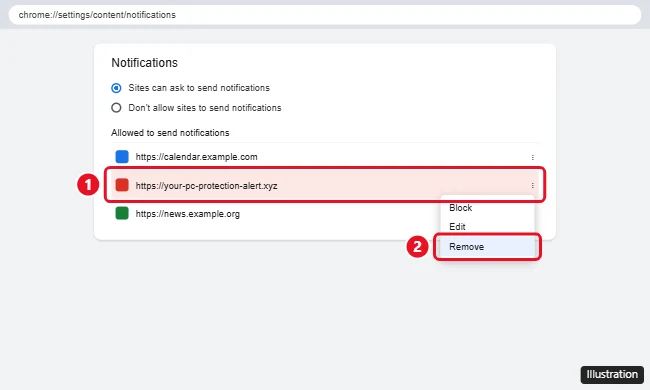
- Open Chrome and go to Settings > Privacy and security > Site settings > Notifications, or paste chrome://settings/content/notifications into the address bar.
- Under Allowed to send notifications, find any site you don’t recognize.
- Click the three-dot menu next to it and choose Remove or Block.
Microsoft Edge
- Go to Settings > Cookies and site permissions > Notifications, or paste edge://settings/content/notifications.
- Under Allow, click the three dots next to unfamiliar sites and choose Remove.
Firefox
- Go to Settings > Privacy & Security > Permissions > Notifications > Settings.
- Select unfamiliar sites, click Remove Website, and then Save Changes.
To avoid this in the future, click Block whenever a site you don’t trust asks to show notifications. Also remove browser extensions you don’t recognize.
Step 3: Turn off pop-ups from the McAfee app
- Open McAfee from the Start menu or the notification area.
- Open its settings (the gear icon or your account menu, depending on the version).
- Look for Notifications, Messages, or Alerts, and turn off promotional messages, special offers, and informational alerts.
- Keep security alerts turned on if you use McAfee as your antivirus.
You can also limit how often Windows shows McAfee notifications: go to Settings > System > Notifications, find McAfee, and turn it off or turn off banners.
Step 4: Uninstall McAfee if you don’t use it
Many PCs come with a McAfee trial. If you don’t plan to pay for it, uninstalling it stops the renewal reminders. Microsoft Defender Antivirus turns on automatically to keep you protected.
- Go to Settings > Apps > Apps & features (Windows 10) or Installed apps (Windows 11).
- Find each McAfee item, like McAfee, McAfee LiveSafe, or McAfee WebAdvisor, and click Uninstall.
- Restart your PC.
- Check Windows Security > Virus & threat protection to confirm Microsoft Defender is on.
If McAfee won’t uninstall normally, McAfee offers a removal tool on its support website. Download it only from mcafee.com.
Frequently asked questions
Are McAfee pop-ups a virus?
Pop-ups from the real McAfee app aren’t viruses. Browser pop-ups that claim McAfee found threats or that your subscription expired are usually scams trying to get you to click or pay.
Why do I get McAfee pop-ups if I never installed McAfee?
You likely clicked Allow on a website’s notification request. Remove that site from your browser’s notification settings.
Is it safe to uninstall McAfee?
Yes. Windows includes Microsoft Defender, which turns on automatically when no other antivirus is installed.
What if I called a number from a pop-up?
Don’t give anyone remote access or payment. If you already did, disconnect from the internet, run a full scan, change your passwords, and contact your bank.

Kermit Matthews is a freelance writer based in Philadelphia, Pennsylvania with more than a decade of experience writing technology guides. He has a Bachelor’s and Master’s degree in Computer Science and has spent much of his professional career in IT management.
He specializes in writing content about iPhones, Android devices, Microsoft Office, and many other popular applications and devices.