“Google Pay” covers several different things. In the US it now mostly means paying in stores and online with cards saved in Google Wallet. In India, Google Pay (GPay) is a UPI app for sending money. Google Play purchases are often billed through the same account. How you get money back depends on what kind of payment it was. This guide explains how to get a refund for each case: Google Play purchases, store and online purchases, failed UPI transactions, money sent to the wrong person, and unauthorized charges.
Quick Answer
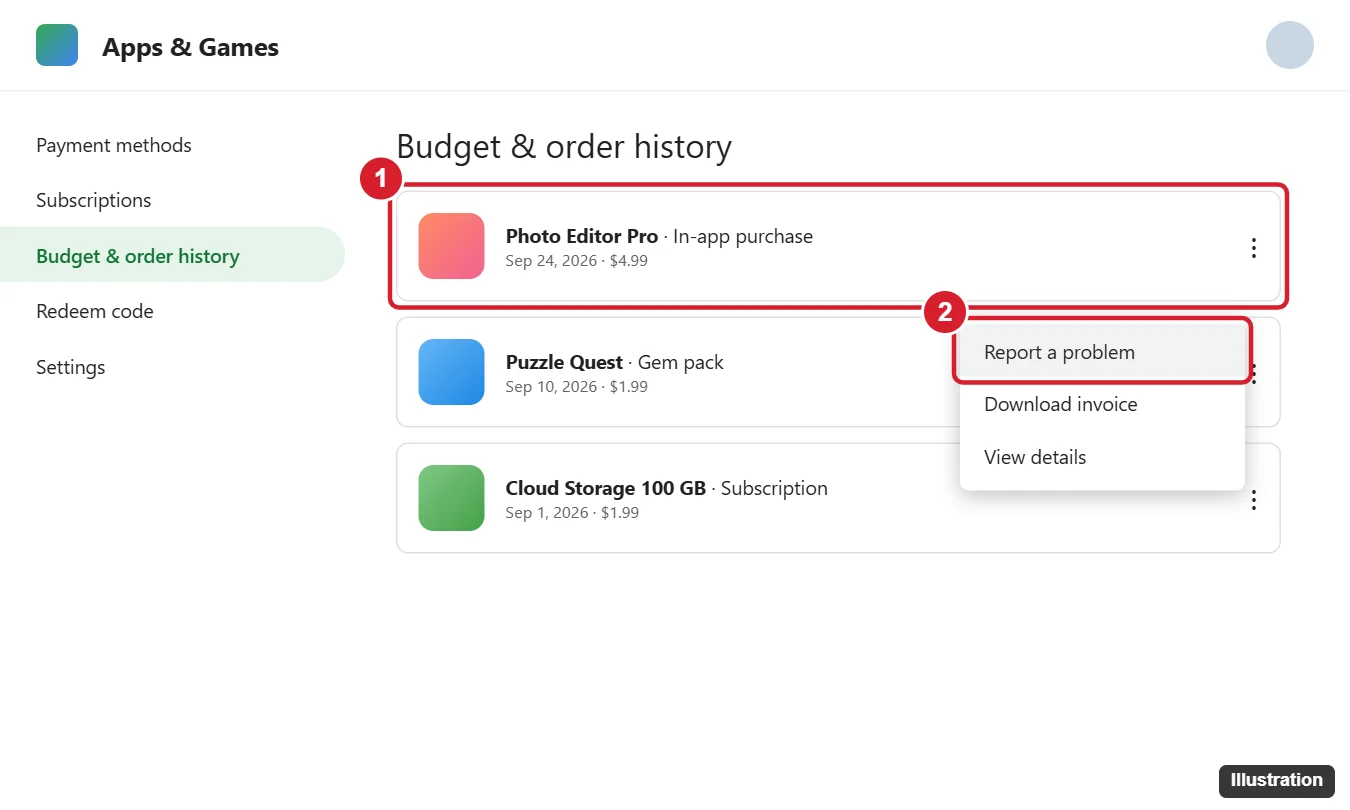
- Google Play app or in-app purchase: within 48 hours, go to play.google.com > profile > Payments & subscriptions > Budget & order history, click Report a problem, and request a refund. After 48 hours, contact the app’s developer.
- Store or online purchase paid with Google Pay/Wallet: ask the merchant for a refund. It goes back to the card you used.
- Failed UPI payment in GPay (India): money debited for a failed transaction is usually reversed automatically within a few business days. If not, raise a dispute on the transaction in the app.
Which Refund Path Applies to You?
| What you paid for | Who gives the refund | Where to start |
|---|---|---|
| Apps, games, in-app items, subscriptions on Google Play | Google (first 48 hours) or the developer | Google Play order history |
| A purchase in a store or on a website using Google Pay or Wallet | The merchant | The merchant’s returns process, or your card issuer |
| A UPI payment that failed but money was debited (GPay India) | Your bank, through UPI | The GPay transaction screen |
| Money sent to the wrong person | The recipient (voluntarily), with help from your bank | Contact the recipient and your bank |
| A charge you didn’t make | Your bank or card issuer | Report fraud immediately |
Refund a Google Play Purchase
Within 48 hours
- Go to play.google.com in a browser and sign in with the account you used.
- Click your profile picture and choose Payments & subscriptions > Budget & order history.
- Find the purchase and click Report a problem.
- Choose the option that fits, such as accidental purchase or not working as expected, and say that you want a refund.
- Click Submit.
Google usually decides within a day, but it can take up to four days. Sending more requests won’t speed it up.
After 48 hours
Contact the app’s developer. The developer’s email is listed on the app’s Play Store page under App support. Developers set their own refund rules within the law. Separate rules apply for unauthorized purchases made by a family member.
Subscriptions
Cancelling a subscription stops future charges but doesn’t refund the current period automatically. Cancel under Payments & subscriptions > Subscriptions, then request a refund as above if you’re eligible.
Refund a Store or Online Purchase Paid with Google Pay/Wallet
- Return the item or cancel the order with the merchant, following its return policy.
- The merchant refunds the card that was used. Google Pay only passes the card details, so Google can’t issue this refund.
- Refunds usually appear on your card statement within 3 to 10 business days, depending on the bank. They also show in Google Wallet’s transaction list for supported cards.
- If the merchant refuses a valid refund, contact your card issuer about a chargeback or dispute.
GPay (India): Failed or Pending UPI Payments
- Open the transaction in GPay and check its status.
- If it shows Failed but money left your account, wait. UPI transactions that fail are normally reversed automatically within a few business days.
- If the money hasn’t returned, open the transaction, tap Get help or Raise dispute, and follow the steps.
- If the problem still isn’t resolved, contact your bank with the UPI transaction ID. You can also escalate through the NPCI UPI complaint process.
Money Sent to the Wrong Person
- Payments to another person are generally final once completed. There’s no automatic “undo.”
- Contact the recipient politely and ask them to send it back.
- Contact your bank right away with the transaction details. For UPI, raise a complaint in GPay and with your bank, since banks can sometimes help contact the recipient’s bank.
- Always double-check the name shown before confirming a payment.
Unauthorized Charges
- Call your bank or card issuer immediately and report the charge as fraud. They can block the card and start a dispute.
- Change your Google account password and turn on 2-Step Verification.
- Check myaccount.google.com > Security for unknown devices and sign them out.
- For Google Play charges, report them through the Play order history.
Avoid Refund Scams
Scammers often pose as “Google Pay support” on social media or through fake phone numbers. They ask you to scan a QR code, enter your UPI PIN, or install a screen-sharing app “to receive a refund.” You never need to enter your PIN or scan a code to receive money. Only use help options inside the official app or on official Google and bank websites.
Frequently Asked Questions
How long does a Google Pay refund take?
Google Play refund decisions usually come within 1 to 4 days, and the money then returns to the original payment method. Merchant refunds to cards typically take 3 to 10 business days. Failed UPI reversals usually take a few business days.
Can I cancel a Google Pay payment after sending it?
Generally no, once it has completed. Contact the recipient or your bank.
Why was my Google Play refund denied?
Common reasons include requesting after 48 hours, many previous refunds on the account, or the purchase not being eligible. Contact the developer, or reply through Google Play Help with more details.
Summary
- Google Play: use Report a problem in order history within 48 hours, then contact the developer.
- Store or online purchases: ask the merchant, then your card issuer if needed.
- Failed UPI payments: wait for the automatic reversal, then raise a dispute.
- Wrong recipient or fraud: contact the recipient and your bank quickly.
- Never share your PIN or scan a code to “receive” a refund.

Kermit Matthews is a freelance writer based in Philadelphia, Pennsylvania with more than a decade of experience writing technology guides. He has a Bachelor’s and Master’s degree in Computer Science and has spent much of his professional career in IT management.
He specializes in writing content about iPhones, Android devices, Microsoft Office, and many other popular applications and devices.