“No IAL update found” is a line in the macOS installer log, not an error that stops the install on its own. It usually shows up as OSISDownloadOperation: No IAL update found while macOS is installing from Recovery or updating from an older version. If your install is stuck and this is the last line you see, the real cause is almost always the network connection, the Mac’s date and time, low storage, or a damaged download. To fix it, check those first, then reinstall from macOS Recovery or a bootable USB installer.
Apple doesn’t document what “IAL” stands for, and there’s no setting to change it. Treat the message as a clue that the installer is waiting on a download, and work through the fixes below in order.
Where you’ll see “No IAL update found”
Most people find this line after an install hangs on “About X minutes remaining” or loops back to the start. To see it yourself:
- While the macOS installer is running, open the Window menu at the top of the screen.
- Choose Installer Log.
- From the menu in the log window, choose Show All Logs, then scroll to the bottom.
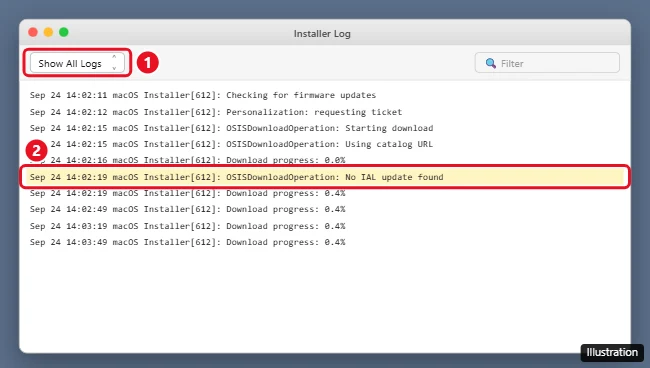
If the lines keep moving, the installer is still working. Give it at least an hour on a slow connection before you decide it’s stuck. If nothing new appears for a long time, try the fixes below.
Fix 1: Use a strong, direct internet connection
The installer needs to download macOS plus firmware and other files specific to your Mac model, so a weak or interrupted connection is the most common reason it stalls.
- Plug in an Ethernet cable if you can, or move closer to the Wi-Fi router.
- Avoid public, hotel, or school Wi-Fi that needs a sign-in page. Recovery can’t get past it.
- Turn off or uninstall any VPN, proxy, or firewall app before you update. These are a frequent cause of failed downloads.
- In Recovery, click the Wi-Fi icon in the top-right corner of the screen to confirm you’re connected.
Fix 2: Make sure the date and time are correct
If your Mac’s clock is wrong, it can’t make secure connections to Apple’s servers, and the download fails quietly. This happens often in Recovery after a Mac has been off for a long time or had its battery fully drained.
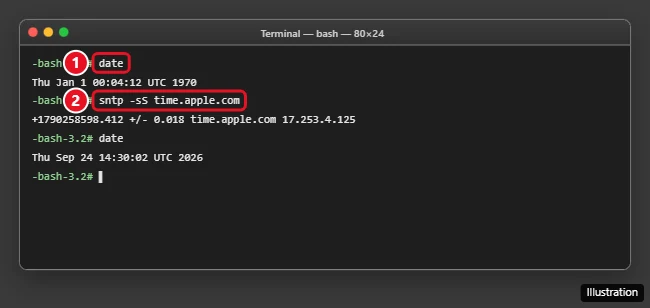
- In macOS Recovery, choose Utilities > Terminal from the menu bar.
- Type
dateand press Return to see the current date and time. - If it’s wrong and you’re online, type
sntp -sS time.apple.comand press Return to sync the clock. (If you’re doing this from a normal macOS session instead of Recovery, putsudoin front and enter your password.) - If that doesn’t work, set it manually in the format month, day, hour, minute, year. For example,
date 0924143026sets September 24, 2:30 PM, 2026. - Run
dateagain to confirm, then quit Terminal and restart the install.
Fix 3: Free up storage space
A macOS upgrade needs a lot of free space to download and unpack. If your Mac is nearly full, the install can hang without a clear warning.
- Check free space in System Settings > General > Storage. On older versions of macOS, use Apple menu > About This Mac > Storage.
- Aim to keep at least 15 to 20 percent of the drive free, or more than 35 GB, before a major upgrade.
- Empty the Trash, clear out the Downloads folder, and move large videos or old iPhone backups to an external drive.
Fix 4: Restart and try the install again
- If the installer is frozen, hold the power button for about 10 seconds until the Mac turns off.
- Wait a few seconds, then turn it back on.
- If your Mac starts up normally, try Software Update again. If it starts in Recovery or shows a folder with a question mark, go to Fix 5.
A forced shutdown during an install rarely damages anything, but back up your Mac with Time Machine first if it still starts up.
Fix 5: Reinstall macOS from Recovery
Installing from Recovery keeps other apps and startup items from getting in the way.
- Mac with Apple silicon: Shut down, then press and hold the power button until you see Loading startup options. Click Options, then Continue.
- Intel-based Mac: Turn it on and immediately press and hold Command + R until you see the Apple logo.
- If asked, select your user and enter its password.
- Before you reinstall, choose Disk Utility, select your startup disk (usually Macintosh HD), and click First Aid to repair it.
- Close Disk Utility, choose Reinstall macOS, and follow the prompts. Reinstalling doesn’t erase your files.
Fix 6: Use a bootable USB installer
If Recovery keeps stalling on the download, a bootable installer skips most of it. You’ll need a second Mac and a USB drive of at least 32 GB, which will be erased.
- On the working Mac, download the macOS installer from the App Store. It lands in your Applications folder.
- Connect the USB drive and name it MyVolume in Disk Utility.
- Open Terminal and run the command for your version. For macOS Tahoe, it’s:
sudo /Applications/Install\ macOS\ Tahoe.app/Contents/Resources/createinstallmedia --volume /Volumes/MyVolume
For macOS Sequoia, replaceTahoewithSequoia. - Enter your password, type Y to confirm, and wait for the copy to finish.
- Plug the drive into the problem Mac. On Apple silicon, hold the power button until startup options appear. On Intel, hold Option as it starts. Select the installer and follow the prompts.
Keep the problem Mac connected to the internet during this install. It still needs to fetch firmware for your model.
Fix 7: Revive or restore the Mac’s firmware
If none of the above works on a Mac with Apple silicon or a T2 Security Chip, the firmware may need to be revived or restored. This uses a second Mac running Apple Configurator and a USB-C cable. Reviving keeps your data. Restoring erases the Mac completely, so only do it if you have a backup. Apple’s guide, If an error occurs while updating or installing macOS, links to the steps for each.
If you still can’t get macOS to install, contact Apple Support or visit an Apple Store or Apple Authorized Service Provider.
Frequently asked questions
Is “No IAL update found” a virus or a sign of hardware failure?
No. It’s a normal log entry from Apple’s installer. It only matters when the install stops making progress, and even then the cause is usually the connection, clock, or storage.
Will I lose my files if I reinstall macOS from Recovery?
Reinstall macOS keeps your files and apps. Erasing the disk in Disk Utility or restoring the firmware deletes everything, so back up first if you can.
How long should a macOS install take?
Usually 30 minutes to an hour after the download finishes, but a big upgrade on a slow connection can take several hours. The time-remaining estimate isn’t reliable, so check the Installer Log to see whether it’s still moving.
Does this happen on iPhone or Windows?
No. The message comes from the macOS installer. If an iPhone won’t update, see how to update your iPhone.

Kermit Matthews is a freelance writer based in Philadelphia, Pennsylvania with more than a decade of experience writing technology guides. He has a Bachelor’s and Master’s degree in Computer Science and has spent much of his professional career in IT management.
He specializes in writing content about iPhones, Android devices, Microsoft Office, and many other popular applications and devices.