Losing access to Google Authenticator, because of a lost, broken, reset, or replaced phone, can lock you out of accounts protected by two-step verification. How easily you can recover your codes depends on how you set things up: whether you turned on cloud sync, exported accounts, or saved backup codes. This guide covers every recovery path for your own accounts, from restoring synced codes on a new phone to regaining access through each service's account recovery.
Quick Answer
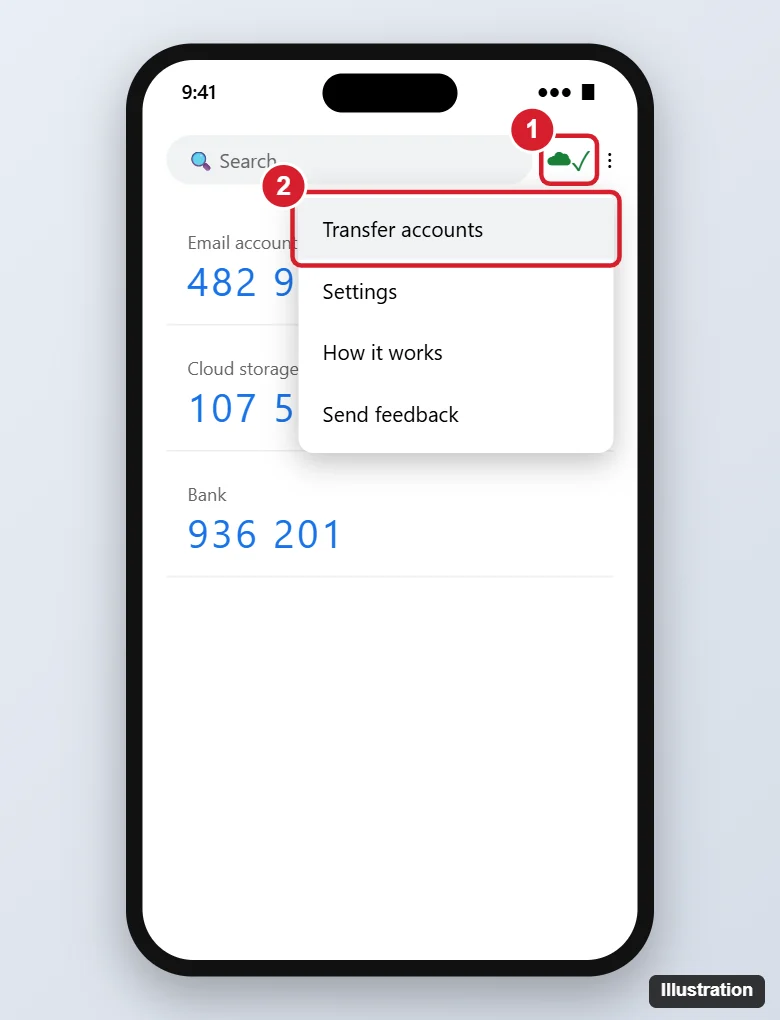
Install Google Authenticator on your new phone and sign in with the same Google Account. If you had cloud sync turned on, your codes restore automatically. If you still have your old phone, use Transfer accounts > Export accounts to move codes with a QR code. If you have neither, use each service's backup codes or account recovery process, then set up two-step verification again.
Which Recovery Option Applies to You?
| Your situation | What to do |
|---|---|
| Cloud sync was on | Sign in to Authenticator on the new phone with the same Google Account |
| You still have the old phone | Export accounts from the old phone via QR code |
| You saved backup codes | Sign in to each service with a backup code, then set up 2FA again |
| No sync, no old phone, no codes | Use each service's account recovery process |
Option 1: Restore From Cloud Sync
- Install Google Authenticator from the App Store or Google Play.
- Open it and sign in with the Google Account you used before.
- Your synced codes appear automatically.
Google added optional cloud sync to Authenticator in 2023. If you see a cloud icon with a check mark in the app, sync is on. If you are using Authenticator without signing in, your codes are stored only on that device.
Option 2: Transfer From Your Old Phone
- On the old phone, open Authenticator and tap the menu (three dots or lines).
- Tap Transfer accounts > Export accounts and verify your identity.
- Select the accounts and tap Next. A QR code appears.
- On the new phone, open Authenticator, tap + > Scan a QR code (or Import existing accounts), and scan it.
- Check that codes work on the new phone before removing them from the old one.
Option 3: Use Backup Codes
Most services give you one-time backup codes when you set up two-step verification. Use one to sign in, then:
- Go to the service's security settings.
- Remove the old authenticator entry.
- Set up a new authenticator on your current phone by scanning the new QR code.
- Generate and save a fresh set of backup codes.
For your Google Account itself, you can also verify with another signed-in device, a security key, or a phone number if you added one.
Option 4: Account Recovery for Each Service
If you have no other method, contact each service or use its account recovery page. Expect to verify your identity, for example through your recovery email, phone number, recent activity, or ID, depending on the service. This can take time, so start with your most important accounts, like email and banking.
Prevent Future Lockouts
- Turn on cloud sync in Authenticator, or keep a securely stored export.
- Save backup codes in a password manager or a safe place.
- Add more than one second factor where possible, such as a security key or a second device.
- Before resetting or trading in a phone, transfer your Authenticator accounts first.
Before you switch phones, get your Google backup codes as a safety net.
Related: Recover your Google account without your old phone.
Frequently Asked Questions
Can Google recover my Authenticator codes?
Only if you turned on cloud sync. Otherwise, codes are stored only on your phone and Google cannot restore them.
What happens if I delete the app?
Without sync, deleting Authenticator deletes its codes. Reinstalling does not bring them back.
Is cloud sync safe?
It protects against losing your phone, but it ties your codes to your Google Account. Secure that account with a strong password and its own second factor.
Summary
- Sign in to Authenticator on your new phone if cloud sync was on.
- Export accounts from your old phone with a QR code if you still have it.
- Use backup codes or each service's recovery process otherwise.
- Turn on sync and save backup codes to avoid future lockouts.

Kermit Matthews is a freelance writer based in Philadelphia, Pennsylvania with more than a decade of experience writing technology guides. He has a Bachelor’s and Master’s degree in Computer Science and has spent much of his professional career in IT management.
He specializes in writing content about iPhones, Android devices, Microsoft Office, and many other popular applications and devices.