Giving important folders their own icons makes them easy to spot at a glance: a star for your current project, a different color for school or work, a custom picture for a hobby folder. Windows 11 lets you change the icon of almost any folder with built-in tools, choose from hundreds of system icons, or use your own image. This guide covers all of it, including how to turn a picture into an icon and fix icons that won’t update.
Quick Answer
Right-click the folder and choose Properties. On the Customize tab, click Change Icon, pick an icon (or click Browse to choose your own .ico file), and click OK, then Apply.
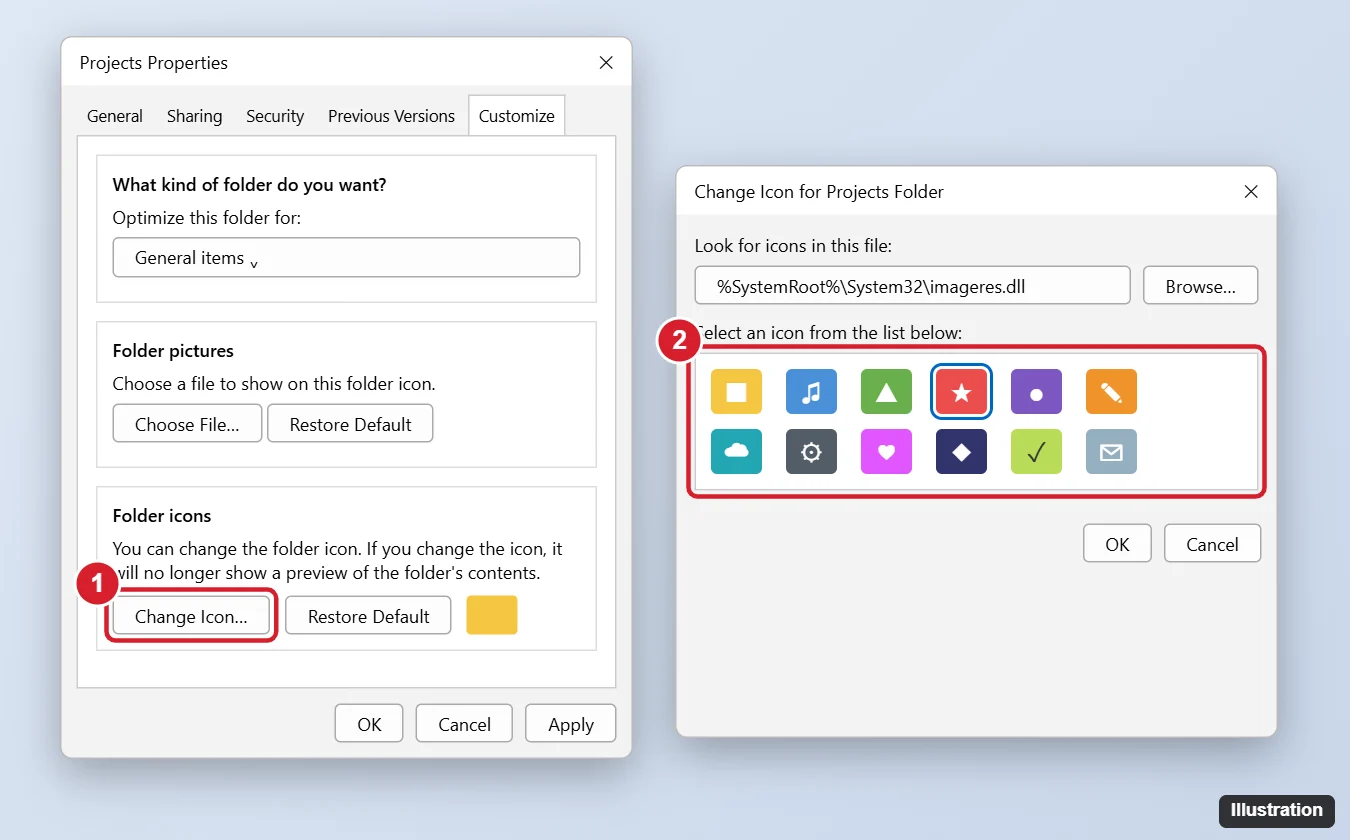
Change a Folder Icon in Windows 11
- In File Explorer or on the desktop, right-click the folder and choose Properties (or select it and press Alt + Enter).
- Click the Customize tab.
- Under Folder icons, click Change Icon.
- Choose an icon from the list, or click Browse to pick another icon file.
- Click OK, then Apply and OK.
The new icon appears right away in most views. If it doesn’t, see the troubleshooting section below.
Where to Find More Built-In Icons
In the Change Icon window, paste one of these into Look for icons in this file and press Enter:
| File | What’s inside |
|---|---|
| %SystemRoot%\System32\imageres.dll | The largest set: modern folders, drives, users, media, and more |
| %SystemRoot%\System32\shell32.dll | Classic Windows icons (default for Change Icon) |
| %SystemRoot%\System32\ddores.dll | Device icons such as phones, speakers, and printers |
| %SystemRoot%\System32\pifmgr.dll | Colorful retro icons |
Use Your Own Picture as a Folder Icon
Windows folder icons must be .ico files. A regular PNG or JPG won’t appear in the Browse window.
- Start with a square image, ideally 256 × 256 pixels. PNG with a transparent background looks best.
- Convert it to .ico with a reputable image editor or converter. For example, the free GIMP app can File > Export As and save with a .ico extension.
- Save the .ico file somewhere permanent, such as a Documents\Icons folder. If you move or delete it later, the folder goes back to a blank icon.
- Follow the steps above and use Browse to select it.
Many icon packs are available online; download them only from trusted sources, and never run an .exe that claims to be an icon pack.
Show a Picture Instead of Changing the Icon
On the same Customize tab, Choose File under Folder pictures sets an image from inside the folder as its thumbnail preview. In Windows 11, this preview appears only in some views (such as Large icons) and depends on your thumbnail settings, so a custom icon is more reliable.
Restore the Default Folder Icon
- Open the folder’s Properties > Customize.
- Click Change Icon, then Restore Defaults, and click OK and Apply.
Troubleshooting
- No Customize tab: libraries, drives, and some special folders don’t offer it. For a drive icon you’d need a registry change; for Quick access or Home, the icon follows the original folder.
- Icon didn’t change: press F5 to refresh. If it’s still wrong, restart File Explorer (Task Manager > Windows Explorer > Restart) or sign out and back in to refresh the icon cache.
- Icon reset after copying the folder: the icon setting lives in a hidden desktop.ini file inside the folder. Copying to a USB drive or cloud service may drop it, or the icon file path may not exist on the other PC.
- Cloud-synced folders: custom icons usually work on folders synced by OneDrive and similar services, but the icon may not show on other devices.
- Can’t change a folder on a work PC: your organization may restrict customization.
Frequently Asked Questions
Can I change the color of a folder in Windows 11?
Not directly. Windows has no folder color option, but choosing a differently colored icon (from imageres.dll or your own .ico) gives the same effect.
Can I change icons for many folders at once?
Not with built-in tools. You need to change each folder individually, or use a third-party folder customization app.
Does this work on Windows 10?
Yes. The steps are identical.
Summary
- Right-click the folder > Properties > Customize > Change Icon.
- Pick a built-in icon or browse to an .ico file.
- Click OK and Apply.
- Use Restore Defaults to undo, and restart Explorer if the icon doesn’t update.

Kermit Matthews is a freelance writer based in Philadelphia, Pennsylvania with more than a decade of experience writing technology guides. He has a Bachelor’s and Master’s degree in Computer Science and has spent much of his professional career in IT management.
He specializes in writing content about iPhones, Android devices, Microsoft Office, and many other popular applications and devices.