Windows 10 lets you swap any folder’s yellow icon for a different built-in icon, your own .ico file, or a picture, which makes important folders easier to spot. This guide covers changing a single folder’s icon, using a custom icon, setting a folder picture, restoring the default, changing desktop icons like This PC, and fixing icons that won’t update. The same steps work in Windows 11.
Quick Answer
Right-click the folder, choose Properties, open the Customize tab, click Change Icon, pick an icon, and click OK twice.
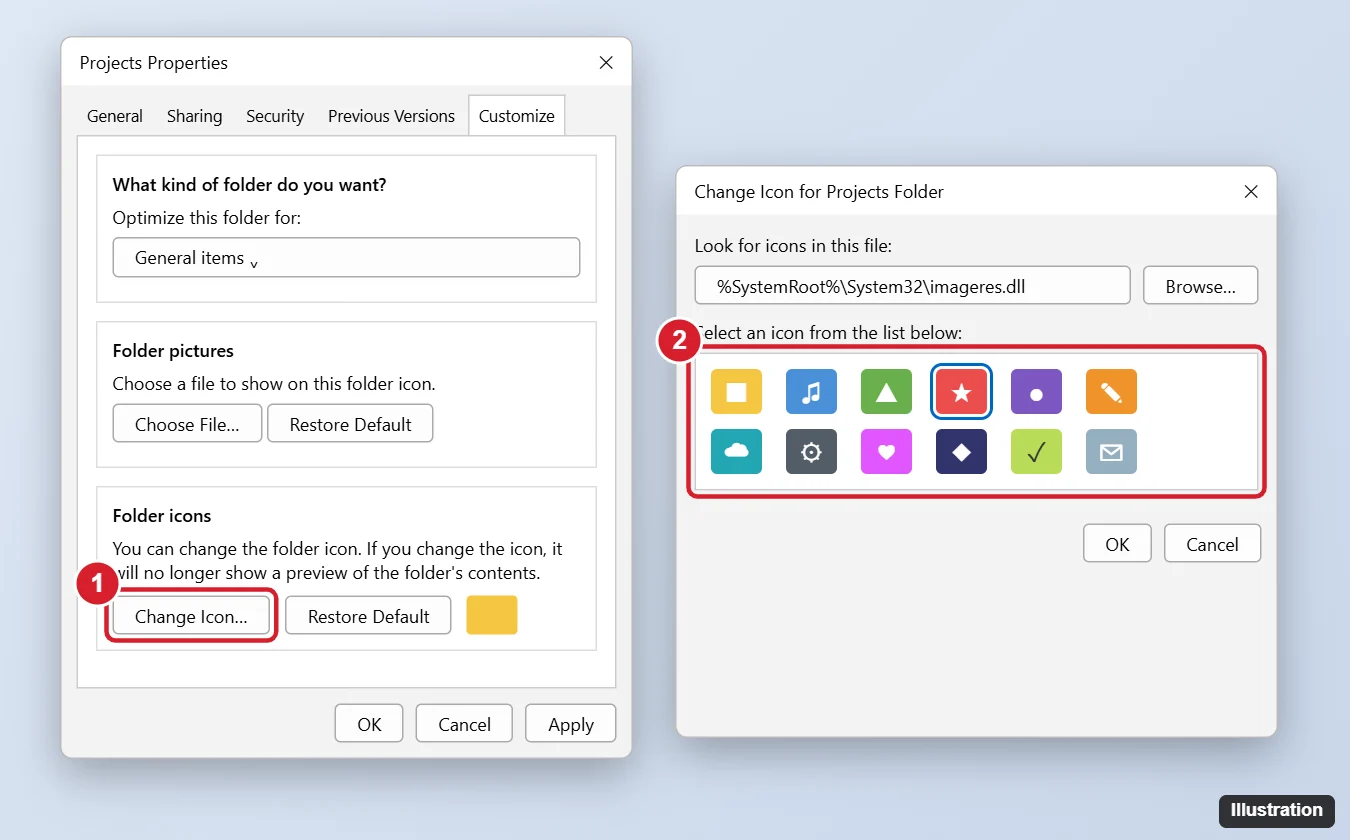
Change a Folder’s Icon
- Right-click the folder in File Explorer or on the desktop and choose Properties.
- Click the Customize tab.
- Under Folder icons, click Change Icon.
- Choose an icon from the list. The default list comes from %SystemRoot%\System32\SHELL32.dll. For more options, type %SystemRoot%\System32\imageres.dll in the box and press Enter.
- Click OK, then Apply and OK in Properties.
If the Customize tab is missing, the folder is a system folder, a library, or a drive root, which don’t support this option.
Use Your Own Custom Icon
- Get an icon in .ico format. You can create one from a PNG with an image editor or a free converter, ideally including 16, 32, 48 and 256 pixel sizes.
- Save the .ico file somewhere permanent, such as C:\Icons. If you move or delete it later, the folder goes back to a blank icon.
- In Change Icon, click Browse, select the .ico file, and click Open.
- Click OK and Apply.
Download icon packs only from reputable sites, and avoid any that come as an .exe installer.
Set a Folder Picture Instead
The Folder pictures section on the same tab sets an image that shows on the folder when File Explorer is in Medium, Large or Extra large icons view.
- Click Choose File and select a JPG, PNG or BMP image.
- Click Apply. The picture appears on the folder thumbnail rather than replacing the icon in list views.
Restore the Default Icon
- Open the folder’s Properties > Customize > Change Icon.
- Click Restore Defaults, then OK and Apply.
Change Desktop Icons (This PC, Recycle Bin, Network)
- Go to Settings > Personalization > Themes.
- Click Desktop icon settings under Related Settings.
- Select the icon, click Change Icon, pick a new one, and click OK.
How It Works Behind the Scenes
Windows stores the choice in a hidden desktop.ini file inside the folder and marks the folder as read-only so Windows reads that file. Don’t delete desktop.ini if you want to keep the icon. Copying the folder to another PC keeps the setting only if the icon path also exists there, which is another reason to use a common location for custom icons.
Change the Icon for All Folders
Windows has no setting to change every folder’s default icon at once. It’s possible through a registry edit or third-party customization tools, but the results can break after updates. For most people, changing icons on key folders is the safer choice.
Icon Won’t Change? Try These Fixes
- Refresh: press F5 in File Explorer or on the desktop.
- Restart File Explorer: open Task Manager, right-click Windows Explorer, and choose Restart.
- Rebuild the icon cache: run ie4uinit.exe -show from the Run box, or sign out and back in.
- Check the file: make sure the .ico file hasn’t been moved or renamed.
- Cloud-synced folders may show sync overlays or revert icons; set the icon on the folder’s local copy.
Frequently Asked Questions
Can I use a PNG as a folder icon?
Not directly. Convert it to .ico first, or use it as a folder picture.
Does changing the icon affect the files inside?
No. It only changes how the folder looks.
Does this work in Windows 11?
Yes, the steps are the same. Windows 10 reached end of support on October 14, 2025.
Summary
- Right-click the folder > Properties > Customize.
- Click Change Icon and choose a built-in or custom .ico icon.
- Use Choose File for a folder picture instead.
- Click Restore Defaults to undo.

Kermit Matthews is a freelance writer based in Philadelphia, Pennsylvania with more than a decade of experience writing technology guides. He has a Bachelor’s and Master’s degree in Computer Science and has spent much of his professional career in IT management.
He specializes in writing content about iPhones, Android devices, Microsoft Office, and many other popular applications and devices.