“Cannot Connect to App Store” on an iPhone, iPad, or Mac usually isn’t a problem with your device. It’s typically caused by a weak internet connection, the wrong date and time, a VPN, an account glitch, or, occasionally, an outage on Apple’s end. This guide walks through the fixes in order, from quickest to most thorough.
Quick Answer
Check Apple’s System Status page for an App Store outage, make sure you’re online (try Safari), turn off any VPN, and set Settings > General > Date & Time > Set Automatically to on. Then force-quit the App Store and reopen it. If it still fails, sign out of and back in to your Apple Account under Media & Purchases, and restart the device.
1. Check Apple’s System Status
Visit apple.com/support/systemstatus in a browser. If App Store shows a problem, wait; Apple usually fixes outages within hours.
2. Check Your Internet Connection
- Open a website in Safari. If it doesn’t load, fix Wi-Fi or cellular first.
- Toggle Airplane Mode on and off in Control Center.
- If you’re on cellular, check Settings > Cellular and make sure App Store is allowed to use cellular data.
- Public Wi-Fi (hotels, schools, offices) may block the App Store. Try another network.
3. Turn Off VPN, Proxy, or Content Filters
VPNs and ad-blocking or DNS apps can block Apple’s servers. Turn them off in Settings > VPN (or the app) and try again.
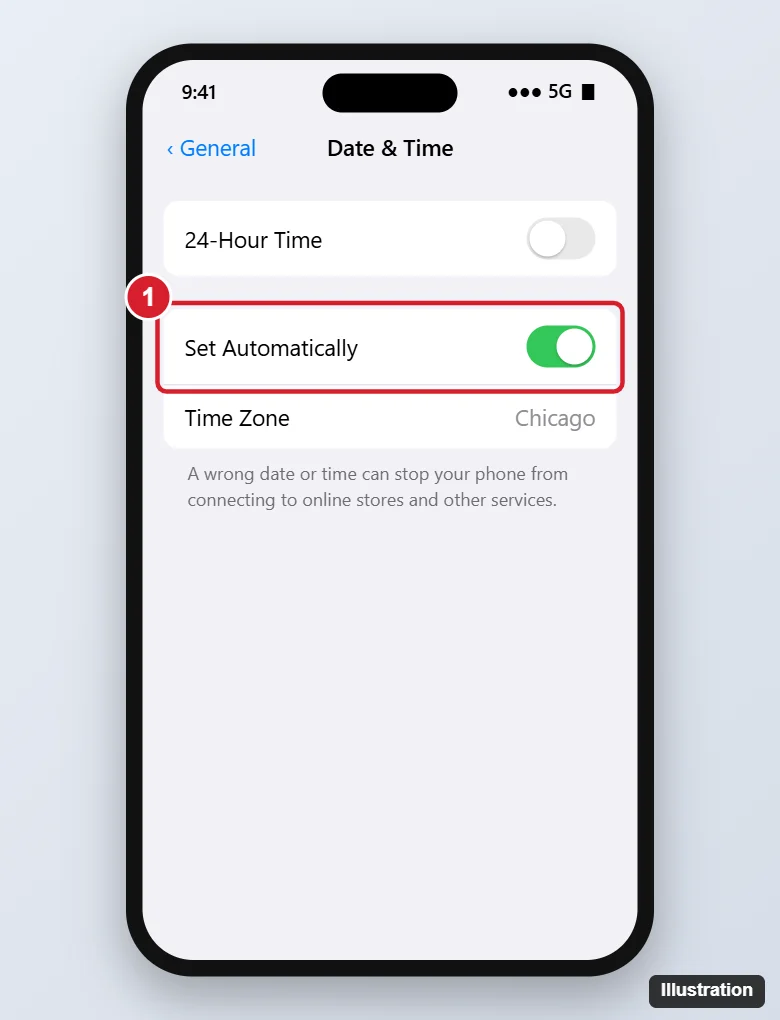
4. Set the Date and Time Automatically
Go to Settings > General > Date & Time and turn on Set Automatically. On a Mac, go to System Settings > General > Date & Time and turn on Set time and date automatically.
5. Force-Quit and Reopen the App Store
Swipe up from the bottom of the screen and pause (or double-click the Home button), swipe the App Store card up, then reopen it. On a Mac, press Command + Q in the App Store and reopen it.
6. Sign Out and Back In
- Go to Settings > [your name] > Media & Purchases.
- Tap Sign Out.
- Restart the device, then return to Media & Purchases and sign in.
On a Mac, open the App Store, choose Store > Sign Out, then sign in again.
7. Restart and Update
- Restart your iPhone, iPad, or Mac.
- Install updates in Settings > General > Software Update (Mac: System Settings > General > Software Update). Very old iOS versions may lose access to parts of the App Store.
8. Check Screen Time Restrictions
Go to Settings > Screen Time > Content & Privacy Restrictions > iTunes & App Store Purchases and make sure installing apps is allowed. Managed work or school devices may block the App Store entirely.
9. Reset Network Settings (Last Resort)
Go to Settings > General > Transfer or Reset iPhone > Reset > Reset Network Settings. This erases saved Wi-Fi passwords and VPN settings but not your data. Reconnect to Wi-Fi afterward.
Still Can’t Connect?
If none of these work and other devices on the same network can reach the App Store, contact Apple Support through the Apple Support app or website. They can check for account issues, such as a billing problem, that block the App Store.
If the App Store or the whole phone stops responding, a force restart usually helps. Here’s how to unfreeze an iPhone.
First, check Apple System Status for outages.
Summary
- Check Apple System Status and your internet connection.
- Turn off VPNs and set the date and time automatically.
- Force-quit the App Store and sign out and back in.
- Restart, update, and reset network settings if needed.

Kermit Matthews is a freelance writer based in Philadelphia, Pennsylvania with more than a decade of experience writing technology guides. He has a Bachelor’s and Master’s degree in Computer Science and has spent much of his professional career in IT management.
He specializes in writing content about iPhones, Android devices, Microsoft Office, and many other popular applications and devices.