Lock the PC with Windows logo key + L, then pick the other account from the list on the sign-in screen, usually in the lower-left corner: whatever was open in the first account keeps running in the background. To go back later, lock the PC again and choose the first account; its apps and files are where they were left.
This covers current versions of Windows 11 on a home or small-office PC where each person has their own account.
Switch from the lock screen in four steps
Start here if the PC is already showing the lock screen, whether someone locked it or it locked itself after a while.
- Wake the lock screen with a key press, a click or a tap. The sign-in screen appears.
- If the account shown isn’t yours, look for the list of accounts on the sign-in screen. On most PCs it sits in the lower-left corner.
- Select your account. Microsoft’s user account access page simply says to choose your account if prompted.
- Sign in with that account’s PIN, password or Windows Hello (face or fingerprint), whichever it is set up to use.
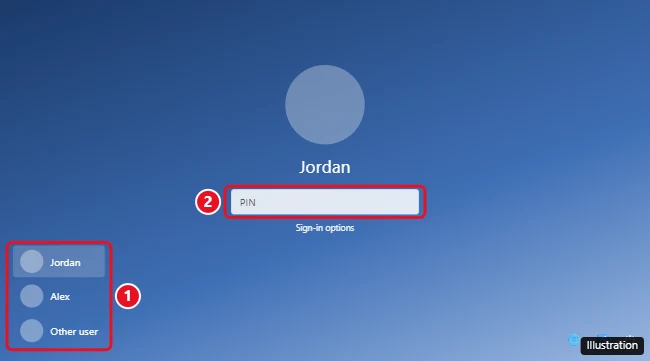
That’s the whole switch. The person who locked the PC is still signed in; you’ve simply opened a second session next to theirs. Your account opens to your own desktop, files and browser, not theirs.
The lock screen picture and any notifications it shows belong to the lock screen settings, not to the account list. To change the picture, see changing the lock screen on Windows 11, and to keep message previews off it on a shared PC, see turning off lock screen notifications.
What each person’s session looks like afterward
Windows offers three ways to leave the desk, and they treat open work differently. The wording below comes from Microsoft’s account access page.
| Action | What happens to the first account | Best when |
|---|---|---|
| Lock (Windows logo key + L) | Stays signed in, with apps and files open in the background | You’re stepping away and someone else may need the PC |
| Switch user | Stays signed in; Microsoft says you move between accounts “without closing any applications or ending the current session” | You’re at the desk and want to hand over directly |
| Sign out | Session ends; open apps close and unsaved work may be lost | You’re finished for the day |
Lock and Switch user leave your work exactly where it was. Sign out is the clean ending. If you’re done with the PC, signing out of Windows is the better choice, because it closes your apps and leaves nothing running for the next person.
Starting from a signed-in desktop instead
If you’re still at your own desktop and want to hand the PC over, use one of these routes. Each one ends at the same sign-in screen.
- Windows logo key + L. Microsoft’s keyboard shortcuts list describes it as “Lock your PC.” The next person then follows the four steps above.
- Ctrl + Alt + Delete. The same list says this opens the security screen, where you can lock the desktop, switch user or sign out. Choose Switch user.
- Start menu. Select Start, then your user picture or the Accounts icon, then the … (more) icon, and pick the account to switch to. Microsoft notes that PCs managed by an organization show an extra Switch user option there.
- Power icon. Select Start, the power icon, then Lock. Microsoft notes that earlier Windows 11 versions put Lock under the Accounts menu instead.
Save anything important first. Switching keeps your apps open, but you can’t control what happens to the PC while someone else is using it.
Getting back to the first account
Coming back works the same way in reverse. The second person locks the PC with Windows logo key + L (or uses Ctrl + Alt + Delete and Switch user), and the first person selects their account on the sign-in screen and signs in. Their open apps and documents reappear as they were.
When the account you want isn’t on the sign-in screen
- The account doesn’t exist yet. An administrator adds it in Settings > Accounts > Other user, then under Add other user selects Add account, as Microsoft’s manage user accounts page shows. The full walkthrough is in adding a user to Windows 11. For a short visit, a Visitor account for guests on Windows 11 is easier to remove afterward.
- Only a blank sign-in box appears. Some PCs are set to show a blank user name field rather than a list; type the account’s email address or user name and its password. The setting behind that screen is covered in the Other user option on the Windows 10 sign-in screen.
- It’s a work or school PC. Your organization may have turned off switching between accounts. Ask the IT department rather than changing system settings.
- Try a restart. If an account that should be there is missing after an update, restarting the PC is a reasonable first check.
An old account you no longer want on the list can be taken off by an administrator; see removing an account from Windows 11.
Before anyone shuts down or restarts
A locked or switched-away session is still open. Shutting down or restarting can close the apps in every account that’s still signed in, so ask the other person to save their work first.
Lock screen switching questions
Does locking the PC sign the first person out?
No. Microsoft describes locking as keeping your apps and files open in the background. The account stays signed in until its owner signs out or the PC shuts down.
Can I switch to someone’s account without their password?
No. Each account signs in with its own PIN, password or Windows Hello. If you’ve forgotten your own, use the “I forgot my password” or “I forgot my PIN” link Microsoft describes on the sign-in screen.
Why does the sign-in screen show only one account?
Usually because only one account exists on the PC, in which case Microsoft says that account is selected by default. Add the second person’s account first, then they’ll appear in the list.
Does the other account need to be signed in already?
No. You can choose any account listed on the sign-in screen, whether or not it has a session open.

Kermit Matthews runs Live2Tech from just outside Philadelphia. He is an IT specialist with over 20 years of experience, from a university help desk to small-business IT, IT management and his own consulting practice, and has written tech guides full time since 2020. Steps are checked against the current software on a real device or the maker’s official documentation. More about Kermit.