Character spacing, also called letter spacing or tracking, controls how close the letters in a word sit to each other. A little extra spacing makes all-caps headings look polished, and slightly condensed spacing can pull a stubborn last word back onto the previous line. Word keeps these controls on the Advanced tab of the Font dialog. This guide covers expanding and condensing spacing, scaling text width, kerning, and applying spacing to styles in Word for Windows and Mac.
Quick Answer
Select the text and press Ctrl + D (Cmd + D on Mac) to open the Font dialog. Click the Advanced tab. Set Spacing to Expanded or Condensed, enter an amount in points in the By box (for example, 1.5 pt), and click OK.
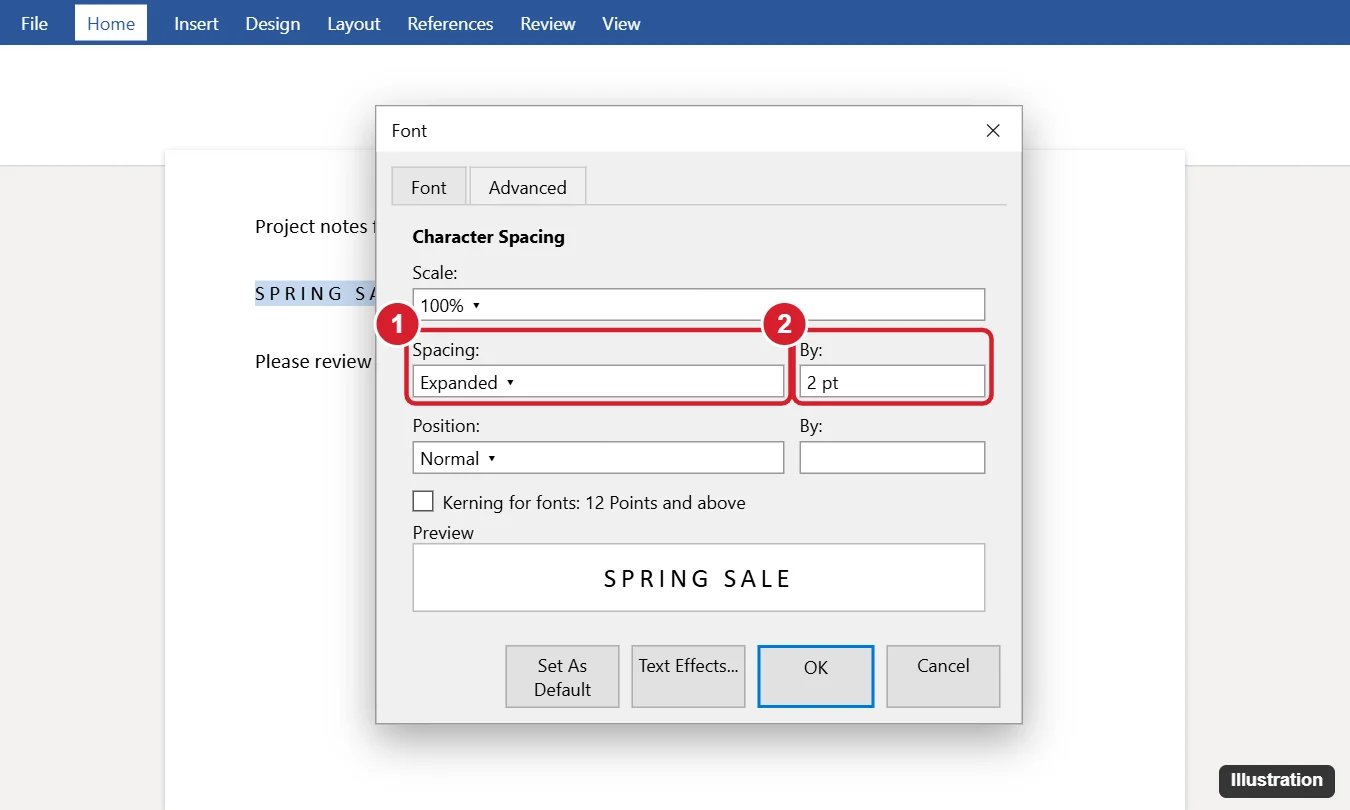
Change Character Spacing Step by Step
- Select the text you want to change.
- On the Home tab, click the small arrow in the corner of the Font group, or press Ctrl + D.
- Click the Advanced tab.
- Under Character Spacing, open Spacing and choose:
- Expanded to spread the letters apart.
- Condensed to pull the letters closer together.
- Enter the amount in the By box. Use the arrows or type a value, such as 0.5 pt or 2 pt.
- Check the Preview and click OK.
All Character Spacing Options
| Option | What it does | Typical use |
|---|---|---|
| Spacing: Expanded / Condensed | Adds or removes equal space between every letter | Headings, logos, fitting text on a line |
| Scale | Stretches or squeezes the letters themselves horizontally (for example, 90% or 150%) | Special effects. Use sparingly, as it distorts the font. |
| Position: Raised / Lowered | Moves text up or down from the baseline by a set amount | Fine-tuning symbols or custom superscripts |
| Kerning for fonts | Adjusts space between specific letter pairs, such as “AV” or “To” | Professional-looking headings |
Recommended Settings
- All-caps headings: Expanded by 1 to 2 pt.
- Body text: leave at Normal. Changes above about 0.5 pt reduce readability.
- Squeezing a paragraph: Condensed by 0.1 to 0.3 pt is usually invisible and can remove an orphaned word.
- Kerning: check Kerning for fonts and set it to the heading size, for example 14 points and above.
Apply Spacing to a Style
- On the Home tab, right-click a style (such as Title or Heading 1) and choose Modify.
- Click Format > Font, open the Advanced tab, and set the spacing.
- Click OK twice. Every paragraph with that style updates.
Word for Mac and the Web
- Mac: go to Format > Font (or press Cmd + D) and open the Advanced tab.
- Web: character spacing isn’t available in Word for the web. Open the document in the desktop app to change it. Existing spacing displays correctly online.
Reset Character Spacing
Select the text and press Ctrl + Spacebar to clear character formatting. Or open the Advanced tab and set Spacing to Normal and Scale to 100%.
For letter-pair spacing, read how to adjust kerning in Word.
Troubleshooting
The spacing didn’t change
Make sure text was selected before opening the dialog. Also check that the text isn’t in a text box or WordArt with its own settings.
Letters overlap
Condensed spacing is too large for the font size. Reduce the value or return to Normal.
Spacing looks uneven
You’re probably seeing kerning differences or justified alignment stretching words. Turn on kerning, or change the alignment to left.
Frequently Asked Questions
What’s the difference between character spacing and line spacing?
Character spacing is the horizontal space between letters. Line spacing is the vertical space between lines.
Is there a keyboard shortcut for letter spacing?
Not by default. Use Ctrl + D to open the Font dialog quickly, or add the command to the Quick Access Toolbar.
Summary
- Select text and press Ctrl + D (Cmd + D on Mac).
- Open the Advanced tab.
- Choose Expanded or Condensed and enter an amount.
- Use kerning and styles for professional, consistent headings.

Kermit Matthews is a freelance writer based in Philadelphia, Pennsylvania with more than a decade of experience writing technology guides. He has a Bachelor’s and Master’s degree in Computer Science and has spent much of his professional career in IT management.
He specializes in writing content about iPhones, Android devices, Microsoft Office, and many other popular applications and devices.