To turn up your microphone volume in Windows 10, open Settings > System > Sound, choose your microphone under Input, select Device properties, and drag the Volume slider up. If it’s still too quiet at 100, open the classic Sound Control Panel, go to Recording > Properties > Levels, and raise Microphone Boost.
Turn it up gradually and test as you go. Too much volume or boost adds hiss, background noise, and distortion.
Note: Windows 10 reached end of support on October 14, 2025. Consumer Extended Security Updates (ESU) now run until October 12, 2027.
Quick Answer
Settings > System > Sound > Input > Device properties, then raise Volume. For more, add Microphone Boost in the Levels tab of the Sound Control Panel.
Method 1: Raise the Volume in Settings
- Press Windows + I and select System, then Sound.
- Under Input, choose the microphone you use in Choose your input device.
- Select Device properties.
- Drag Volume to the right. Start around 80.
- Select Start test, speak normally, then select Stop test to see the peak level.
Method 2: Use Microphone Boost
- In Settings > System > Sound, select Sound Control Panel on the right (or search for “Change system sounds” and open the Recording tab).
- Open the Recording tab, select your microphone, and choose Properties.
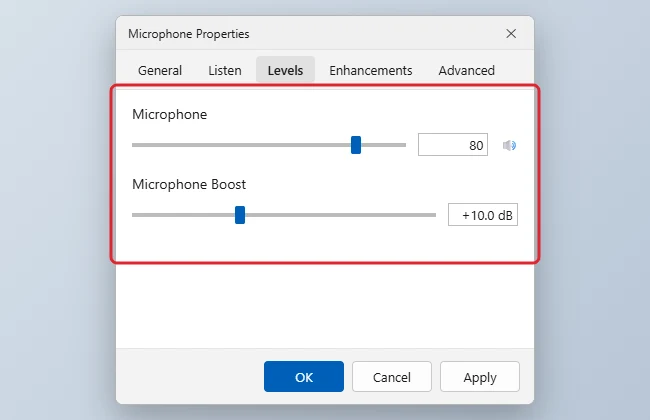
- Select the Levels tab.
- Set Microphone to 80 to 100.
- If you see Microphone Boost, raise it one step at a time (+10 dB is a good start).
- Select OK and test again.
Not every microphone has a Boost slider. USB and Bluetooth headsets often don’t.
Method 3: Check the App’s Own Setting
Video call and recording apps have their own input level. In the app’s audio settings, pick the same microphone and turn off Automatically adjust microphone volume if it keeps lowering your level.
Volume, Boost, and Sensitivity
| Setting | What it does | Watch out for |
|---|---|---|
| Volume (Level) | Main input level from 0 to 100 | Rarely causes problems |
| Microphone Boost | Adds extra gain in dB steps | Hiss and background noise |
| App auto-adjust | Lets the app change your level | Level drifting during calls |
“Mic sensitivity” usually means one of these same settings; there’s no separate sensitivity control in Windows 10.
Using a USB microphone that keeps chiming as it reconnects? See how to stop the USB connection sound and find the device causing it.
Troubleshooting
- The meter doesn’t move: Check Settings > Privacy > Microphone and make sure Allow apps to access your microphone is on.
- Wrong microphone: Pick the right one under Choose your input device. Here’s how to change your default microphone; the steps are similar on Windows 10.
- Still quiet at 100 with boost: Move the mic closer, check for a hardware mute switch or dial, or update the audio driver.
- Echo or noise after boosting: Lower the boost, and turn on noise suppression on the Enhancements tab if your driver offers it.
On Windows 11, the steps are a little different; see how to make your mic louder in Windows 11.
Frequently Asked Questions
Why does my mic volume keep changing by itself?
An app such as a chat or meeting app is adjusting it. Turn off its automatic mic volume option. Also check the Advanced tab and clear Allow applications to take exclusive control.
What level should I use?
Aim for your voice to peak around two-thirds of the meter when speaking normally.
Summary
- Raise Volume in Settings > Sound > Device properties.
- Add Microphone Boost in the Levels tab if needed.
- Test after each change.
- Check app settings and privacy permissions if it’s still quiet.

Kermit Matthews is a freelance writer based in Philadelphia, Pennsylvania with more than a decade of experience writing technology guides. He has a Bachelor’s and Master’s degree in Computer Science and has spent much of his professional career in IT management.
He specializes in writing content about iPhones, Android devices, Microsoft Office, and many other popular applications and devices.