Big gaps between words in a Word document usually come from one of four causes: justified alignment stretching lines to fill the margins, extra spaces typed or pasted in, expanded character spacing, or special characters like tabs and non-breaking spaces. Once you know which one you have, the fix takes seconds. This guide shows how to spot the cause and remove the extra space, in Word for Windows, Mac, and the web.
Quick Answer
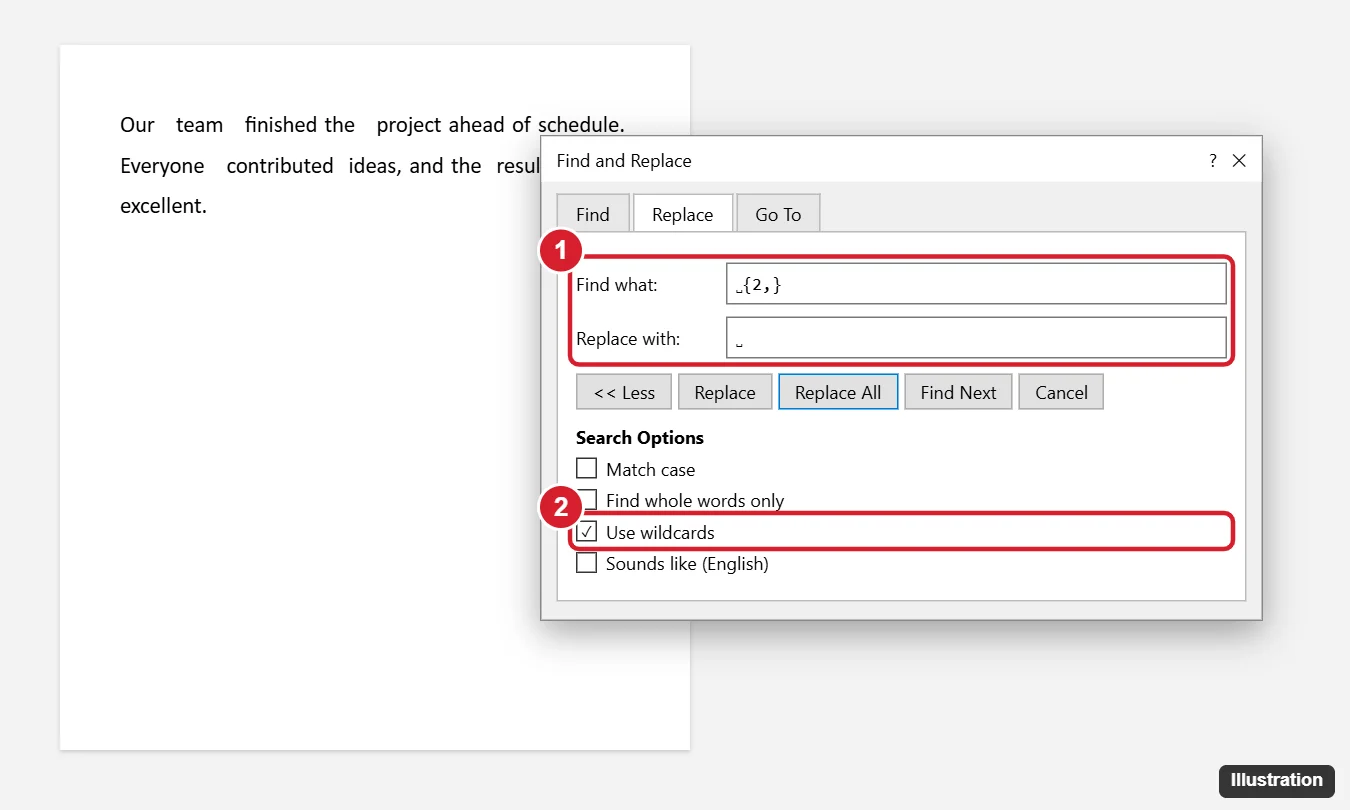
If the text is justified, select it and press Ctrl + L to align left. If there are double spaces, press Ctrl + H, click More, check Use wildcards, type a space followed by {2,} in Find what, type one space in Replace with, and click Replace All.
Step 1: Show Hidden Formatting to Find the Cause
Click the ¶ (Show/Hide) button on the Home tab or press Ctrl + Shift + 8. Now spaces appear as dots, tabs as arrows, and non-breaking spaces as small circles.
- One dot between words, but a wide gap: justified alignment or character spacing.
- Several dots: extra spaces.
- An arrow: a tab.
- A small degree-like circle: a non-breaking space.
Fix 1: Justified Text (Most Common)
Justified alignment spreads words so each line reaches both margins, which creates large gaps in short lines or narrow columns.
- Switch to left alignment: Select the text and press Ctrl + L (Mac: Command + L), or click Align Left on the Home tab.
- Keep justification but reduce gaps: Turn on hyphenation with Layout > Hyphenation > Automatic, so long words can break and lines fill more evenly.
- Last line of a paragraph stretched: That line probably ends with a manual line break (Shift + Enter). Replace it with a regular Enter, or go to File > Options > Advanced, expand Layout options at the bottom, and check Don’t expand character spaces on a line ending with SHIFT+RETURN.
Fix 2: Double or Extra Spaces
Text pasted from websites or PDFs, or typed with two spaces after periods, often has extra spaces.
Replace all multiple spaces at once
- Press Ctrl + H to open Find and Replace.
- Click More >> and check Use wildcards.
- In Find what, press the spacebar once and type {2,} (meaning “two or more spaces”).
- In Replace with, press the spacebar once.
- Click Replace All.
Without wildcards
Type two spaces in Find what and one in Replace with, then click Replace All repeatedly until Word reports 0 replacements.
Fix 3: Expanded Character Spacing
- Select the text.
- Press Ctrl + D to open the Font dialog, then open the Advanced tab.
- Set Spacing to Normal and Scale to 100%.
- Click OK.
Pressing Ctrl + Spacebar also clears character formatting from the selection.
Fix 4: Tabs and Non-Breaking Spaces
- Tabs: In Find and Replace (without wildcards), search for ^t and replace with a space.
- Non-breaking spaces: Search for ^s and replace with a regular space.
Other Causes
- Font substitution: If a document uses a font you don’t have, Word substitutes one, which can change spacing. Change the text to a standard font like Calibri or Aptos.
- Text boxes or columns: Narrow columns make justified gaps worse. Widen the column or use left alignment.
- Word for the web: Find and Replace works (Ctrl + H) but doesn’t support wildcards. Use the repeated two-spaces method.
Summary
- Turn on Show/Hide ¶ to see what’s in the gaps.
- Justified text: align left or turn on hyphenation.
- Extra spaces: Find and Replace with a space and {2,} using wildcards.
- Character spacing: set Spacing to Normal in the Font dialog.
- Tabs and non-breaking spaces: replace ^t and ^s.

Kermit Matthews is a freelance writer based in Philadelphia, Pennsylvania with more than a decade of experience writing technology guides. He has a Bachelor’s and Master’s degree in Computer Science and has spent much of his professional career in IT management.
He specializes in writing content about iPhones, Android devices, Microsoft Office, and many other popular applications and devices.