To remove an account from Windows 11, sign in as an administrator, open Settings > Accounts > Other users, click the account, and select Remove next to Account and data. Then confirm with Delete account and data. This deletes the user profile and everything saved in it, so back up that person’s files first.
If you only want to remove an email or work account from apps, or stop using a Microsoft account on your own profile, the steps are different and are covered below.
Quick Answer
Settings > Accounts > Other users > select the account > Remove > Delete account and data.
Remove Another User From the PC
- Sign in with an administrator account.
- Press Win + I and go to Accounts > Other users.
- Click the account you want to delete to expand it.
- Next to Account and data, click Remove.
- Click Delete account and data.
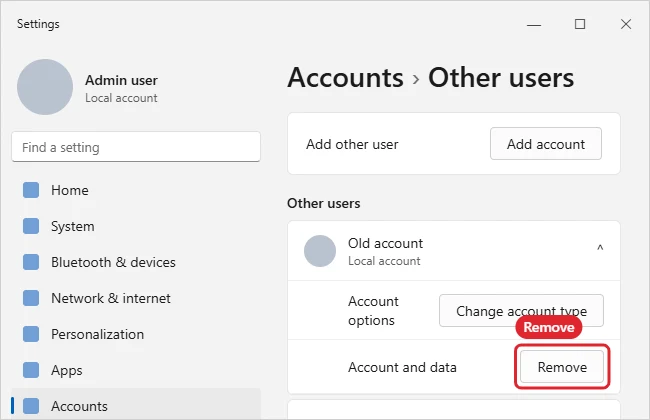
To keep that person’s files, copy their folders from C:\Users\[username] to another location before you remove the account.
Which Removal Do You Need?
| Goal | Where to go |
|---|---|
| Delete another person’s profile | Accounts > Other users > Remove |
| Remove a child or family member | Accounts > Family, then manage at the Microsoft family site |
| Remove an email account from Mail, Calendar, or other apps | Accounts > Email & accounts > select account > Remove |
| Disconnect a work or school account | Accounts > Access work or school > select > Disconnect |
| Stop using a Microsoft account on your own profile | Accounts > Your info > Sign in with a local account instead (if shown) |
Other Ways to Delete a User Account
- User Accounts dialog: Press Win + R, type netplwiz, select the user, and click Remove.
- Command line: Open Terminal (Admin) and run
net user username /delete. This removes the account but may leave the profile folder behind; delete it afterward from the Users folder. - Computer Management (Pro): Press Win + X > Computer Management > Local Users and Groups > Users, then right-click the user and choose Delete.
Need a second administrator first? See how to give an account administrator rights in Windows 11.
Need a replacement account first? See how to create a local account on Windows 11.
Troubleshooting
- There’s no Remove button: You’re not signed in as an administrator, or you’re trying to remove the account you’re signed in with. Sign in with a different admin account.
- You’re removing the only admin: Create or promote another administrator first so you don’t lock yourself out. See how to create a local account; the steps are similar in Windows 11.
- A work or school account can’t be removed from Email & accounts: Use Access work or school instead.
- The account still appears on the sign-in screen: Restart the PC. If it remains, check netplwiz for a leftover entry.
Frequently Asked Questions
Does removing a Microsoft account delete it from Microsoft?
No. It only removes it from this PC. The account, email, and OneDrive files online are untouched.
Can I remove the administrator account?
Yes, as long as another administrator account exists and you’re signed in with it.
How do I change which Microsoft account my PC uses?
See how to change the Microsoft account on Windows. The same Your info settings exist in Windows 11.
Summary
- Sign in as an administrator.
- Open Settings > Accounts > Other users.
- Expand the account and click Remove.
- Confirm Delete account and data.

Kermit Matthews is a freelance writer based in Philadelphia, Pennsylvania with more than a decade of experience writing technology guides. He has a Bachelor’s and Master’s degree in Computer Science and has spent much of his professional career in IT management.
He specializes in writing content about iPhones, Android devices, Microsoft Office, and many other popular applications and devices.