The fastest way to find your current desktop background image in Windows 10 is to open Registry Editor, go to HKEY_CURRENT_USER\Control Panel\Desktop, and look at the WallPaper value, which shows the full path of the picture you chose. Windows also keeps a copy of the current wallpaper named TranscodedWallpaper in %AppData%\Microsoft\Windows\Themes. If you use Windows Spotlight or a slideshow, the image is stored in a different place, covered below.
Method 1: Check Background settings
- Right-click the desktop and choose Personalize.
- On the Background page, look at the preview and the Choose your picture thumbnails. The first thumbnail is usually the current image.
This shows what the picture looks like, but not where the file is saved. For that, use one of the methods below.
Method 2: Find the file path in the Registry
- Press Windows + R, type regedit, and press Enter. Click Yes.
- Paste HKEY_CURRENT_USER\Control Panel\Desktop into the address bar at the top and press Enter.
- Find WallPaper in the right pane. The Data column shows the full path to the image.
- Double-click WallPaper, copy the path, and paste it into File Explorer’s address bar to open the file.
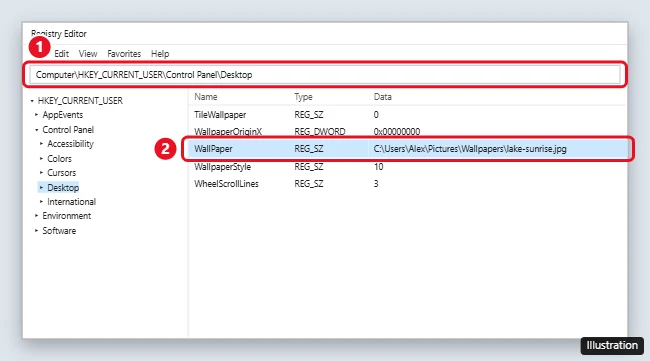
You’re only reading the value, so this doesn’t change anything. Close Registry Editor without editing.
Prefer a command? Open PowerShell and run:Get-ItemProperty 'HKCU:\Control Panel\Desktop' -Name WallPaper
If the path points to a file that no longer exists, you may have moved or deleted the original. Use Method 3 to get the copy Windows saved.
Method 3: Get Windows’ saved copy of the wallpaper
- Press Windows + R, paste %AppData%\Microsoft\Windows\Themes, and press Enter.
- Find the file named TranscodedWallpaper. It has no file extension.
- Copy it to another folder, such as your Desktop.
- Rename the copy to wallpaper.jpg. If you can’t see file extensions, turn them on in File Explorer under View > File name extensions.
Also check the CachedFiles folder inside Themes, which may contain a copy with its original name and resolution. The saved copy may be compressed or resized to fit your screen, so the original file gives the best quality.
Method 4: Find a Windows Spotlight image
If your background changes daily with photos from Microsoft, it’s using Windows Spotlight. (In Windows 10, Spotlight is mainly used on the lock screen.) The images are stored with random names and no extensions:
- Press Windows + R, paste %LocalAppData%\Packages\Microsoft.Windows.ContentDeliveryManager_cw5n1h2txyewy\LocalState\Assets, and press Enter.
- Copy all the files to a new folder.
- Rename them with a .jpg extension. You can do this all at once by opening Command Prompt in that folder and running
ren * *.jpg. - Look for the larger files, usually over 200 KB. Those are the full-size landscape and portrait images. The small ones are icons.
Method 5: Find the current image in a slideshow
When your background is a slideshow, the Registry shows only the folder or the last image set. To find the one on screen now, use the TranscodedWallpaper copy in Method 3, which always matches the current image. To find the original, open the slideshow folder listed in Settings > Personalization > Background and compare.
Where Windows keeps its built-in wallpapers
- C:\Windows\Web\Wallpaper for the default backgrounds.
- C:\Windows\Web\4K\Wallpaper\Windows for higher-resolution versions.
- C:\Windows\Web\Screen for lock screen images.
Frequently asked questions
Why doesn’t TranscodedWallpaper open?
It has no file extension. Copy it somewhere else and add .jpg to the end of its name.
Can I find where an online wallpaper came from?
Yes. Upload the image to a reverse image search, like Google Lens, to find the original source and a higher-resolution version.
Does this work on Windows 11?
Yes. The Registry value and the Themes folder are in the same places. Windows 11 also lets you use Spotlight for the desktop, with a Learn about this picture icon to see what the image shows.
Can I see the wallpaper path for another user?
Each user has their own wallpaper setting. Sign in as that user, or look in their AppData\Roaming\Microsoft\Windows\Themes folder with administrator access.

Kermit Matthews is a freelance writer based in Philadelphia, Pennsylvania with more than a decade of experience writing technology guides. He has a Bachelor’s and Master’s degree in Computer Science and has spent much of his professional career in IT management.
He specializes in writing content about iPhones, Android devices, Microsoft Office, and many other popular applications and devices.