Photos and videos are usually what fills up your 15 GB of free Google storage. Google Photos can compress them to use much less space with its Storage saver quality, both for new backups and, with Recover storage, for photos you’ve already uploaded. This guide explains how each works, what you give up in quality, and other ways to free space.
Quick Answer
To compress future uploads, open Google Photos, tap your profile picture > Photos settings > Backup > Backup quality, and choose Storage saver. To compress photos already in your account, go to photos.google.com/settings on a computer and click Recover storage. This can’t be undone.
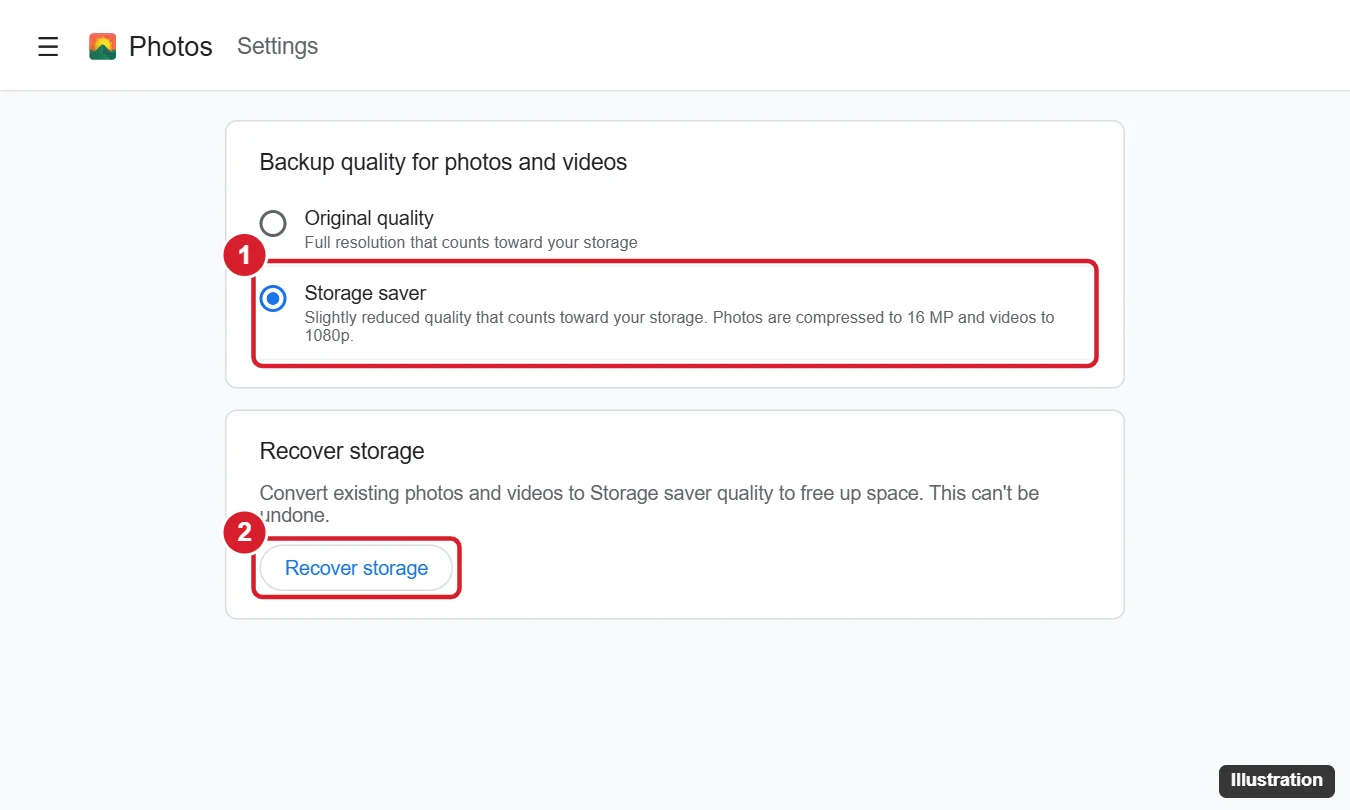
Original Quality vs. Storage Saver
| Original quality | Storage saver | |
|---|---|---|
| Photos | Full resolution | Compressed; photos larger than 16 MP are resized to 16 MP |
| Videos | Full resolution | Videos above 1080p are reduced to 1080p |
| Storage use | Counts fully | Counts, but files are much smaller |
| Best for | Professional photos, printing large | Everyday phone photos and videos |
Since June 2021, both options count toward your Google Account storage; Storage saver simply uses less of it. Some Pixel phones have had special storage benefits; check your device’s terms.
Compress New Backups (Phone)
- Open the Google Photos app.
- Tap your profile picture at the top right.
- Tap Photos settings > Backup.
- Tap Backup quality and choose Storage saver.
New photos and videos back up in compressed form. Photos already uploaded aren’t changed.
Compress Photos You Already Uploaded (Recover Storage)
- On a computer, go to photos.google.com/settings.
- Under Recover storage, click Recover storage (or Manage storage first, depending on your account).
- Read how much space you’ll recover and confirm.
Important: This permanently converts your existing Original quality photos and videos to Storage saver. Download full-quality copies first (for example, with Google Takeout) if you want to keep them. Some files, like videos over a certain length and photos in Google Drive, may not be converted.
Other Ways to Free Up Space
- Review and delete: In Google Photos, go to Library > Utilities (or Manage storage) to find blurry photos, screenshots, and large videos.
- Empty the trash: Deleted items stay in Trash for a limited time and still use space until they’re removed.
- Check Gmail and Drive: Storage is shared; large email attachments and Drive files count too. See one.google.com/storage.
- Compress a photo before sharing: Use your phone’s photo editor to resize or export at a lower resolution.
To remove cloud copies but keep phone copies, see how to delete from Google Photos without losing them on your phone.
Summary
- Choose Storage saver in Photos settings > Backup > Backup quality.
- Use Recover storage on photos.google.com to compress existing uploads (permanent).
- Delete large and unneeded files and empty the trash.

Kermit Matthews is a freelance writer based in Philadelphia, Pennsylvania with more than a decade of experience writing technology guides. He has a Bachelor’s and Master’s degree in Computer Science and has spent much of his professional career in IT management.
He specializes in writing content about iPhones, Android devices, Microsoft Office, and many other popular applications and devices.