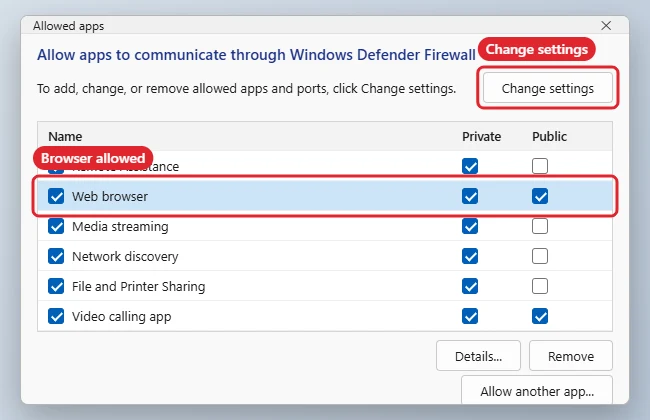
Windows Defender Firewall in Windows 11 doesn’t block or allow individual websites; it controls which apps can use the network. So to “allow a website through the firewall,” make sure your browser is allowed: open Windows Security > Firewall & network protection > Allow an app through firewall, click Change settings, and check your browser for Private and Public networks. If the browser is already allowed, something else is blocking the site, and the fixes below will find it.
On a work or school PC, website blocking is usually set by the organization. Ask IT to review the site rather than changing security settings yourself.
Quick Answer
Windows Security > Firewall & network protection > Allow an app through firewall > Change settings > check your browser > OK.
Allow Your Browser Through Windows Firewall
- Open Start, type Windows Security, and open it.
- Click Firewall & network protection.
- Click Allow an app through firewall.
- Click Change settings and approve the admin prompt.
- Find your browser in the list and check both Private and Public.
- If it isn’t listed, click Allow another app, browse to the browser’s .exe file, and add it.
- Click OK.
Find What’s Really Blocking the Site
| What you see | Likely cause | Where to look |
|---|---|---|
| A red warning page about an unsafe site | Microsoft Defender SmartScreen | Windows Security > App & browser control |
| A block page from your antivirus | Third-party security software web protection | That program’s web shield or exclusions settings |
| “This site can’t be reached” for one site only | A custom firewall rule, hosts file entry, or DNS problem | Firewall advanced settings; flush DNS |
| Blocked on every device on your Wi-Fi | Router parental controls or filtering | Router admin page |
| A family safety message | Microsoft Family Safety content filters | Your family organizer adjusts allowed sites |
| A school or company block page | Organization policy | Contact IT |
Check for a Custom Firewall Rule
- In Firewall & network protection, click Advanced settings.
- Select Outbound Rules and look for rules with a red block icon that you or an app created.
- Right-click an unwanted block rule and choose Disable Rule.
Only disable rules you recognize. If an app blocks a site on purpose, as described in how to block an app from the internet, remove that rule instead of weakening the firewall.
If SmartScreen Warns About a Site You Trust
SmartScreen warnings protect you from phishing and malware. If you’re sure a site is safe, you can report it as safe from the warning page’s More information link. Don’t turn SmartScreen off entirely just to reach one site.
Want to block sites on purpose? See how to block websites on Windows 10.
Troubleshooting
- Change settings is grayed out: You need an administrator account.
- The site works on phone data but not Wi-Fi: The block is on the network or router, not Windows.
- The site loads in one browser but not another: Check that browser’s extensions and its entry in the allowed apps list.
- Everything is blocked after changing settings: In Windows Security, click Restore firewalls to default.
Keeping your firewall on is part of hardening Windows 11. Also check your network type; see public vs. private networks in Windows 11.
Related: Turn off the firewall on Windows 11.
Frequently Asked Questions
Can Windows Firewall block a specific website?
Only by IP address through an advanced rule, which breaks when the site’s addresses change. Browser extensions, the hosts file, or router filters are better for that.
Should I turn off the firewall to reach a website?
No. It’s rarely the cause, and turning it off exposes your PC. Use the checks above instead.
Does allowing my browser make it less secure?
No. Browsers are normally allowed by default; the firewall still protects other apps and incoming connections.
Summary
- Open Windows Security > Firewall & network protection.
- Allow your browser through the firewall.
- Check SmartScreen, antivirus, router, and family filters.
- Ask IT on managed PCs.

Kermit Matthews is a freelance writer based in Philadelphia, Pennsylvania with more than a decade of experience writing technology guides. He has a Bachelor’s and Master’s degree in Computer Science and has spent much of his professional career in IT management.
He specializes in writing content about iPhones, Android devices, Microsoft Office, and many other popular applications and devices.