Windows can’t reveal the name (SSID) of a hidden Wi-Fi network you’ve never connected to. Hidden networks don’t broadcast their name, so Windows only shows them as Hidden Network. To find the SSID, check a place that already knows it: if your PC connected before, run netsh wlan show profiles in Command Prompt to list saved network names. If it’s your own network, sign in to your router’s settings page or check the router’s label. Otherwise, ask the network’s owner. Once you have the name and password, you can connect in Settings > Network & internet > Wi-Fi > Manage known networks > Add network.
Method 1: Find a saved hidden network’s name
If your PC has connected to the hidden network before, its name is stored in a Wi-Fi profile.
- Click Start, type cmd, and open Command Prompt.
- Run
netsh wlan show profiles. - Look through the User profiles list for the network name.
- For details about one network, run
netsh wlan show profile name="Network Name".
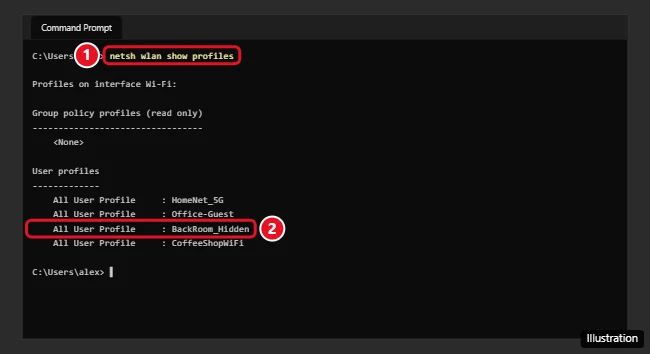
You can also see saved networks in Settings > Network & internet > Wi-Fi > Manage known networks.
Method 2: Check your router
- Connect to your router with an Ethernet cable or through another network it broadcasts.
- Open a browser and go to the router’s address, often 192.168.0.1, 192.168.1.1, or the address on the router’s label.
- Sign in with the admin username and password.
- Open the Wireless or Wi-Fi settings to see the network name. You can also turn off Hide SSID there if you want the network to show up normally.
Many routers also have a companion app, like those from Netgear, TP-Link, Eero, or your internet provider, that shows the network name.
Method 3: Ask the network owner
At work, school, or a friend’s place, ask the person who manages the network for the exact SSID, password, and security type. Hidden network names are case-sensitive and must be entered exactly.
How to connect to a hidden network in Windows 11 or 10
- Open Settings > Network & internet > Wi-Fi.
- Click Manage known networks, then Add network.
- Enter the Network name exactly, choose the Security type (usually WPA2-Personal AES or WPA3-Personal AES), and enter the Security key (password).
- Check Connect automatically and Connect even if this network is not broadcasting.
- Click Save.
You can also click the Wi-Fi icon on the taskbar, choose Hidden Network from the list, click Connect, and type the name and password when asked.
What about Wi-Fi scanner apps?
Commands like netsh wlan show networks mode=bssid show nearby hidden networks with a blank name and their MAC address (BSSID), signal, and channel, but not the SSID. Some specialized tools can capture a hidden name when another device connects, but that’s only appropriate on networks you own or have permission to test.
Related: Find your network name in Windows 10.
Frequently asked questions
Does hiding an SSID make Wi-Fi more secure?
Not really. The name is still sent when devices connect, and hidden networks can be less convenient. A strong WPA2 or WPA3 password matters much more.
Why does Windows show “Hidden Network”?
A nearby router is set to not broadcast its name. You need the exact name to connect.
How do I find the password for a saved network?
Run netsh wlan show profile name="Network Name" key=clear in Command Prompt as an administrator. The password appears next to Key Content. See how to find network credentials in Windows 11.

Matthew Burleigh is the head writer at solveyourtech.com, where he covers topics like the iPhone, Microsoft Office, and Google apps. He has a Bachelor’s and Master’s degree in Computer Science and has over 15 years of IT experience.
He has been writing online since 2008 and has published thousands of articles that have been read millions of times.