Copilot, Microsoft’s AI assistant, shows up in several places on Windows 11: as a standalone app, as a button or dedicated key on newer keyboards, in the Edge browser, and in Microsoft 365 apps such as Word and Excel. Each one is controlled separately, so turning Copilot “off” completely takes a few steps. This guide covers each location, from simply uninstalling the app to the Group Policy and registry setting Microsoft added in 2026. It also explains what you can and can’t remove on Windows 11 Home.
Quick Answer
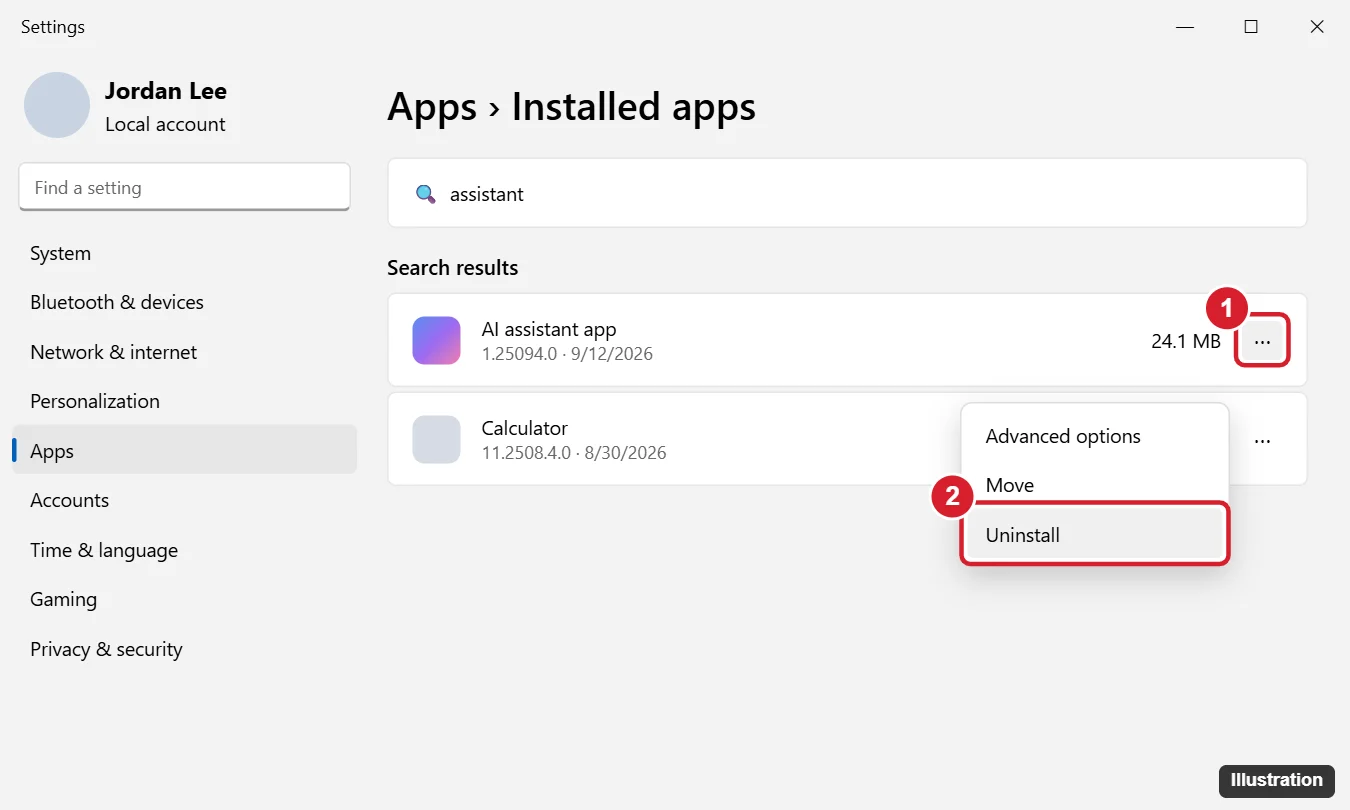
To remove the Copilot app, open Settings > Apps > Installed apps, find Copilot, click ⋯, and choose Uninstall. You can also right-click Copilot in the Start menu and choose Uninstall. To stop the Copilot key from opening it, go to Settings > Personalization > Text input and change what the key does. In Word, Excel, and PowerPoint, go to File > Options > Copilot and uncheck Enable Copilot.
Where Copilot Appears and How to Turn Each One Off
| Location | How to turn it off | Windows 11 Home? |
|---|---|---|
| Copilot app | Uninstall it in Settings or from Start | Yes |
| Copilot key on the keyboard | Settings > Personalization > Text input > Customize Copilot key | Yes |
| Taskbar button (older builds) | Settings > Personalization > Taskbar > turn off Copilot | Yes |
| Microsoft Edge | Edge Settings > Copilot and sidebar > turn off the Copilot button | Yes |
| Word, Excel, PowerPoint (Microsoft 365) | File > Options > Copilot > uncheck Enable Copilot | Yes |
| Keep it removed across updates | Group Policy “Remove Microsoft Copilot app” or its registry value | Registry only |
Step 1: Uninstall the Copilot App
- Open Settings (Windows key + I).
- Go to Apps > Installed apps.
- Type Copilot in the search box.
- Click ⋯ next to Copilot and choose Uninstall, then confirm.
If you also have the Microsoft 365 Copilot app (previously the Office app), it’s a separate app. Uninstall it the same way if you don’t want it. Windows updates or a new Microsoft 365 install may reinstall these apps, so see Step 5 if they return.
Uninstall with PowerShell
Open PowerShell and run Get-AppxPackage *Copilot* to list the installed Copilot packages. Then remove the one you want with Get-AppxPackage *Microsoft.Copilot* | Remove-AppxPackage.
Step 2: Change What the Copilot Key Does
Many new laptops have a dedicated Copilot key. Once the app is removed, the key may do nothing or open a web page. To choose what it does:
- Go to Settings > Personalization > Text input.
- Find Customize Copilot key on keyboard.
- Choose Search, or Custom to pick another app. The Custom list only shows certain packaged apps.
Step 3: Remove the Copilot Button from the Taskbar
Earlier Windows 11 versions had a Copilot button next to Search. If you see one, right-click the taskbar, choose Taskbar settings, and turn off Copilot. On current builds, Copilot appears as a pinned app instead. Right-click it and choose Unpin from taskbar.
Step 4: Turn Off Copilot in Edge and Microsoft 365 Apps
Microsoft Edge
- Open Edge and go to Settings (⋯ > Settings).
- Open Copilot and sidebar (the name varies by version).
- Click Copilot and turn off Show Copilot button on the toolbar and related options.
Word, Excel, PowerPoint, and OneNote
- Open the app and go to File > Options > Copilot. On a Mac, go to the app menu > Preferences > Authoring and Proofing Tools > Copilot.
- Uncheck Enable Copilot and click OK.
- Restart the app. Repeat in each app, since the setting is per app.
Microsoft 365 Personal and Family subscribers can also switch to a “Classic” plan without Copilot at renewal, where it’s offered. Check your subscription page for current options and prices.
Step 5: Keep Copilot From Coming Back
Microsoft added a policy in 2026 called Remove Microsoft Copilot app.
Windows 11 Pro, Enterprise, and Education (Group Policy)
- Press Windows key + R, type
gpedit.msc, and press Enter. - Go to User Configuration > Administrative Templates > Windows Components > Windows AI.
- Double-click Remove Microsoft Copilot app, choose Enabled, and click OK.
Windows 11 Home (Registry)
- Press Windows key + R, type
regedit, and press Enter. - Go to
HKEY_CURRENT_USER\Software\Policies\Microsoft\Windows. - Create a key named
WindowsAIif it doesn’t exist. - Inside it, create a DWORD (32-bit) Value named
RemoveMicrosoftCopilotAppand set it to1. - Sign out and back in, or restart.
According to Microsoft’s documentation, this policy removes the app automatically only under certain conditions. For example, the app must have been preinstalled rather than installed by you, and unused for about 28 days. It may also require your build to have the latest updates. Manual uninstalling (Step 1) still works right away.
Older guides mention a Turn off Windows Copilot policy (TurnOffWindowsCopilot). It controlled the original sidebar version and doesn’t affect the current Copilot app.
Troubleshooting
There is no Uninstall option
Update Windows and try again. In some regions and builds, Copilot is a system component that can only be hidden, not removed. Use Steps 2 through 4 to keep it out of the way.
Copilot came back after an update
Uninstall it again and set the policy or registry value in Step 5.
The Copilot key opens a browser page
Remap the key in Text input settings (Step 2). Choosing Search makes it act like a search key.
Frequently Asked Questions
Is it safe to uninstall Copilot?
Yes. Removing the Copilot app doesn’t affect other Windows features. You can reinstall it from the Microsoft Store anytime.
Does removing Copilot turn off Recall or other AI features?
No. Recall (on Copilot+ PCs) and features like Click to Do have their own settings under Settings > Privacy & security.
How do I disable Copilot on Windows 10?
See our guide to disabling Copilot in Windows 10. The Settings uninstall steps are similar.
Summary
- Uninstall the Copilot app in Settings > Apps > Installed apps.
- Remap the Copilot key in Personalization > Text input.
- Unpin it from the taskbar and turn it off in Edge.
- Uncheck Enable Copilot in each Microsoft 365 app.
- Use the Remove Microsoft Copilot app policy or
RemoveMicrosoftCopilotAppregistry value to keep it away.

Kermit Matthews is a freelance writer based in Philadelphia, Pennsylvania with more than a decade of experience writing technology guides. He has a Bachelor’s and Master’s degree in Computer Science and has spent much of his professional career in IT management.
He specializes in writing content about iPhones, Android devices, Microsoft Office, and many other popular applications and devices.