When you mail merge from an Excel spreadsheet, dates often come through in the wrong format: a nicely formatted “October 15, 2026” in Excel turns into “10/15/2026” or even “2026-10-15 00:00:00” in your Word letters. The same thing happens with currency and percentages. The fix is a small format switch added to the merge field in Word. This guide shows how to add it, with ready-to-use date and number formats.
Quick Answer
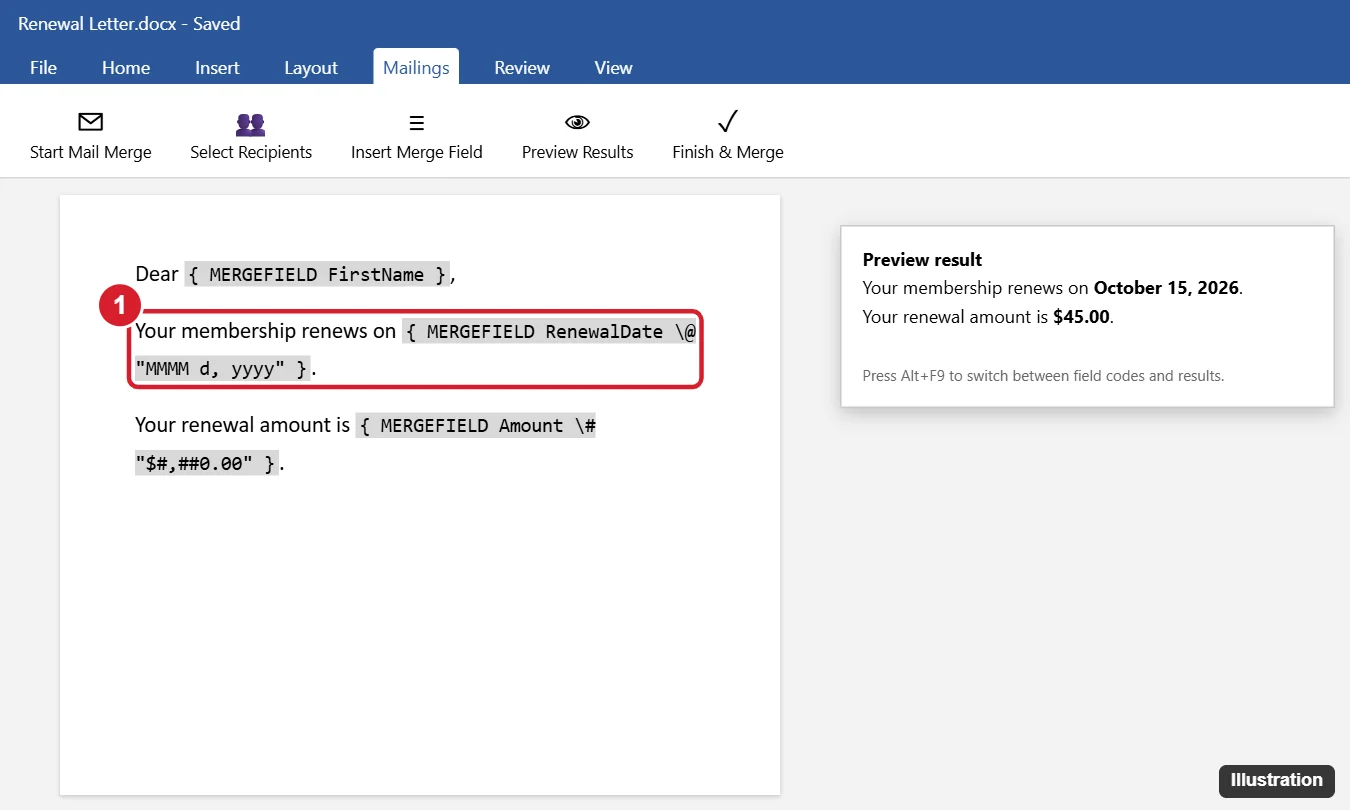
In your merge document, press Alt + F9 to show field codes. Click inside the date field and add a date switch before the closing brace, like this: { MERGEFIELD RenewalDate \@ “MMMM d, yyyy” }. Press Alt + F9 again, then F9 to update, and click Preview Results to check.
Why Dates Change Format
Word reads the underlying value from Excel, not the formatting you applied in Excel. Excel stores dates as numbers and shows them in whatever format you pick, but Word receives the raw date and uses a default format. A format switch tells Word how to display it.
Add a Date Format Switch
- Open your mail merge document in Word.
- Press Alt + F9 (on Mac, Option + F9) to show field codes. Merge fields look like { MERGEFIELD RenewalDate }.
- Click just before the closing brace } of the date field.
- Type a space and a switch, for example: \@ “MMMM d, yyyy”. Use straight quotation marks.
- Press Alt + F9 to hide field codes.
- Select the field and press F9 to update it, or go to Mailings > Preview Results.
Don’t type the braces yourself. They’re special field characters. If you need to create a new field manually, press Ctrl + F9 to insert a pair of braces.
Common Date Formats
| Switch | Result |
|---|---|
| \@ “MMMM d, yyyy” | October 15, 2026 |
| \@ “MM/dd/yyyy” | 10/15/2026 |
| \@ “dd/MM/yyyy” | 15/10/2026 |
| \@ “d MMMM yyyy” | 15 October 2026 |
| \@ “dddd, MMMM d” | Thursday, October 15 |
| \@ “MMM d, yyyy” | Oct 15, 2026 |
| \@ “h:mm am/pm” | 2:30 PM |
Codes are case-sensitive: MM means month and mm means minutes.
Format Currency, Numbers, and Percentages
| Switch | Result |
|---|---|
| \# “$#,##0.00” | $1,250.00 |
| \# “#,##0” | 1,250 |
| \# “0.0” | 12.5 |
For percentages stored as decimals (0.15), use { = { MERGEFIELD Rate } * 100 \# “0%” } to show 15%.
Alternative: Format the Data in Excel
Add a helper column in Excel that converts the date to text, such as =TEXT(B2,”mmmm d, yyyy”), and merge that column instead. The text comes through exactly as shown. This is handy if several people prepare merges from the same spreadsheet.
Troubleshooting
- Switch has no effect: Make sure you pressed F9 to update, the quotes are straight (not curly), and there’s a space before the backslash.
- Date shows as a number like 46310: The Excel column may be formatted as General or text. Format it as a date in Excel, or use the TEXT helper column.
- Day and month swapped: Your data or regional settings may differ. Use an explicit switch like \@ “MMMM d, yyyy” so the month is spelled out.
- Field codes show in the final letters: Press Alt + F9 to toggle back to results before finishing the merge.
Summary
- Press Alt + F9 to show field codes.
- Add \@ “MMMM d, yyyy” (or another format) inside the date field.
- Press Alt + F9, then F9, and preview.
- Use \# switches for currency and numbers.

Kermit Matthews is a freelance writer based in Philadelphia, Pennsylvania with more than a decade of experience writing technology guides. He has a Bachelor’s and Master’s degree in Computer Science and has spent much of his professional career in IT management.
He specializes in writing content about iPhones, Android devices, Microsoft Office, and many other popular applications and devices.