Keeping NVIDIA graphics drivers current improves game performance and fixes bugs. On Windows 11 the easiest way is the NVIDIA app, which replaced GeForce Experience in late 2024. You can also download drivers manually or use Windows Update.
Quick Answer
Open the NVIDIA app, go to Drivers, click Download, then choose Express Installation. Or download the driver for your card from nvidia.com.
How to Update NVIDIA Drivers on Windows 11
- Install the NVIDIA app from nvidia.com if you do not have it.
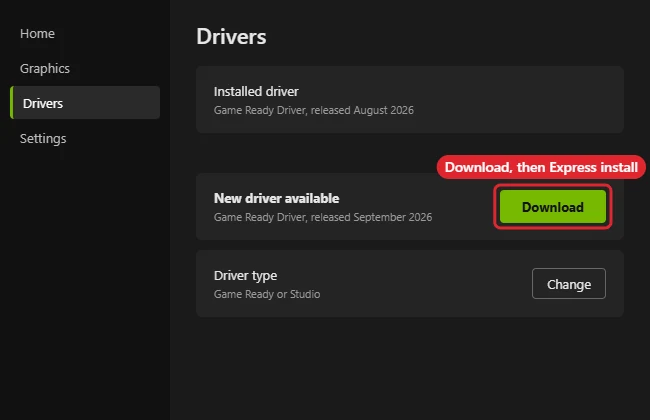
- Open it and click Drivers.
- Choose Game Ready (for games) or Studio (for creative apps).
- Click Download when a new driver appears.
- Click Express Installation, or Custom to perform a clean install.
- Restart if prompted.
Update Methods
| Method | Notes |
|---|---|
| NVIDIA app | Automatic notifications; easiest |
| Manual download from nvidia.com | Choose your exact GPU and Windows version |
| Windows Update, optional updates | May be older, but tested by Microsoft |
| Device Manager | Often reports the best driver is installed even when newer exists |
See also how to update drivers in Windows.
Troubleshooting
- Install fails: close games and overlays, then try Custom with Perform a clean installation.
- New driver causes problems: roll back in Device Manager.
- Laptop with two GPUs: some laptop makers recommend their own driver packages.
- Related: rolling back NVIDIA drivers and updating all drivers in Windows 11.
Frequently Asked Questions
Do I need an account?
Not for the NVIDIA app’s driver updates.
Game Ready or Studio?
Game Ready for new games; Studio for stability in creative apps.
How do I find my GPU model?
Task Manager, Performance, GPU.
Should I update every time?
Update when a release fixes something you need or supports a new game.
Summary
- Open the NVIDIA app.
- Go to Drivers.
- Download the update.
- Choose Express Installation.
- Restart if needed.

Kermit Matthews is a freelance writer based in Philadelphia, Pennsylvania with more than a decade of experience writing technology guides. He has a Bachelor’s and Master’s degree in Computer Science and has spent much of his professional career in IT management.
He specializes in writing content about iPhones, Android devices, Microsoft Office, and many other popular applications and devices.