Google Maps shows coordinates as latitude first, then longitude, in decimal degrees (for example 41.40338, 2.17403), and you can type or paste numbers in that same format straight into the search box to jump to the spot. On a computer, the numbers appear at the top of the pop-up when you right-click the map; on a phone, they appear after you touch and hold to drop a red pin.
The steps below follow Google’s own help for computers, Android, and iPhone or iPad.
What the two numbers mean
Knowing what each number does makes typing mistakes easier to spot:
- Latitude comes first. It measures north or south of the equator. Positive numbers are north, negative numbers are south.
- Longitude comes second. It measures east or west of the Prime Meridian. Positive numbers are east, negative numbers are west (so all of the Americas are negative).
- Google Maps displays decimal degrees. The more digits after the decimal point, the more precisely the pair points to one spot, which is why it’s better to copy the numbers than to round them.
Get coordinates on a computer
- Open Google Maps in a web browser.
- Zoom in on the exact spot you want.
- Right-click the place or area. A pop-up appears.
- At the top of the pop-up, you’ll find the latitude and longitude in decimal format. Click them to copy them to your clipboard.
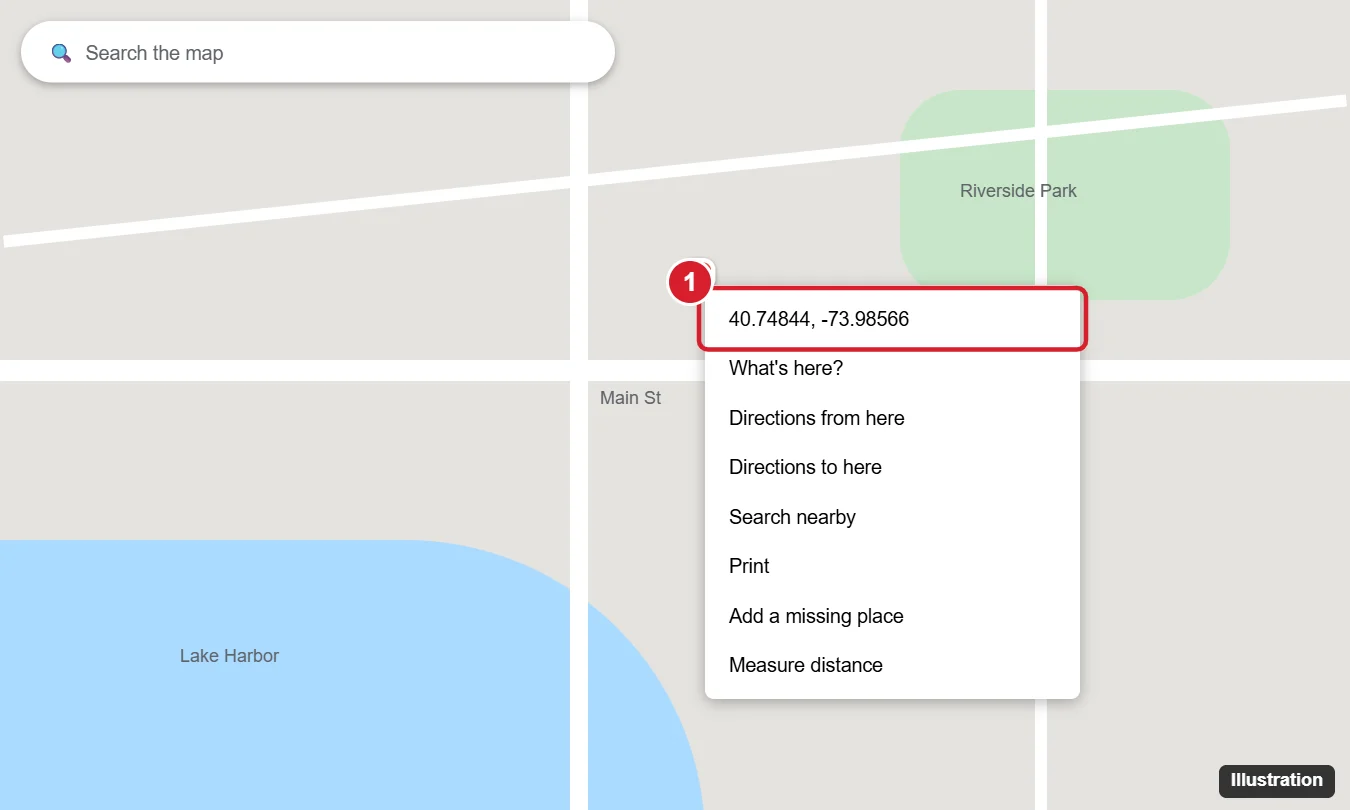
If the pop-up doesn’t start with the numbers, right-click a nearby empty part of the map and check again.
Get coordinates in the Google Maps app
The app works the same way on Android and on iPhone or iPad; only where the numbers appear differs.
- Open the Google Maps app and zoom in on the spot.
- Touch and hold an area of the map that isn’t labeled. A red pin drops.
- Read the coordinates:
- Android: they appear in the search box at the top of the screen.
- iPhone or iPad: they appear in the place sheet, the panel that slides up from the bottom for the pin. Swipe it up if you only see part of it.
- Copy or note the numbers. Google’s help doesn’t describe a copy step for phones; if tapping the numbers doesn’t offer to copy them, write them down exactly as shown.
If you tapped a shop, a park name or another label, the app opens that place instead of dropping a pin. Move a little to a blank part of the map and touch and hold again. Once you’re done, you can clear the marker as described in deleting a dropped pin on Google Maps.
Find the coordinates of where you are now
Google’s documented route for your current position goes through the blue dot that marks your location:
- In the app, make sure location is turned on for Google Maps and the blue dot is on the map.
- Tap the blue dot. The Your Location panel appears.
- Swipe up from the bottom of the screen to see the details, including a Plus Code you can copy.
If you need latitude and longitude rather than a Plus Code, zoom in close and touch and hold right beside the blue dot to drop a red pin; the coordinates appear as described above. The position is only as good as your phone’s location fix, which is usually best outdoors with a clear view of the sky.
Type coordinates into Google Maps
- Click or tap the search box at the top of Google Maps (computer or app).
- Type or paste the coordinates, latitude first.
- Press Enter on a computer, or tap the search key on your phone’s keyboard. A pin appears at that point.
From that pin you can get directions as you would to any other place; see Google’s help on getting directions in Google Maps.
Formats Google Maps accepts
Google’s help page on searching by latitude and longitude in Google Maps lists three formats, all describing the same spot in Barcelona:
| Format | Example |
|---|---|
| Decimal degrees (DD) | 41.40338, 2.17403 |
| Degrees, minutes, seconds (DMS) | 41°24’12.2″N 2°10’26.5″E |
| Degrees and decimal minutes (DMM) | 41 24.2028, 2 10.4418 |
Rules that stop most typing errors
- Use a period for decimals. Google gives 41.40338, 2.17403 as correct and 41,40338, 2,17403 as incorrect. If your region writes decimals with a comma, change them to periods before you search.
- Put latitude before longitude. Swapping them sends the pin somewhere else entirely.
- Keep the numbers in range. Latitude must be between -90 and 90, longitude between -180 and 180. A latitude of 122 means the numbers are reversed.
- Keep the sign or the letter. In decimal degrees, a minus sign means south (latitude) or west (longitude); in DMS, the N, S, E or W letters do that job. Leave them out and the pin can land far from the place you meant.
- Copy DMS exactly. Follow Google’s example, 41°24’12.2″N 2°10’26.5″E, including the symbols; if a DMS search doesn’t work, use decimal degrees instead.
Copying and pasting is safer than retyping.
Use a Plus Code instead
A Plus Code is Google’s short code for a location, such as JJXX+HR8, Seattle. It’s easier to read aloud than two long numbers. Google’s help on finding and sharing a location with Plus Codes gives these steps:
- Computer: click the location, then click the coordinates in the info box at the bottom. In the left panel, click the Plus Code to copy it.
- Android: touch and hold to drop a pin, tap the panel that appears at the bottom, then tap the Plus Code.
- iPhone or iPad: tap the screen at the location to drop a pin, then tap the Plus Code in the panel.
To search with one, type it into the search box. If the place is in another town, add the town or city after the code, as in the Seattle example; inside your own town, the short code on its own is usually enough.
Send the numbers to someone
Copied coordinates are plain text you can paste into a message, an email or a form, which suits a campsite or a back entrance; the other person pastes them into their own Maps search box. If they’d rather tap a link that opens Maps at the spot, follow the steps to share a pin on Google Maps. For a list of many spots, pinning multiple locations on Google Maps keeps them together.
When the pin lands in the wrong place
| What happens | Likely cause | Fix |
|---|---|---|
| No coordinates in the right-click pop-up | The click landed on a map label or icon | Right-click an empty part of the map |
| The pin is in another country or the ocean | Missing minus sign or N/S/E/W letter, or the numbers are swapped | Check the sign and put latitude first |
| Maps shows the wrong place or no result | Commas used as decimal points, or a number out of range | Use periods for decimals; keep latitude between -90 and 90 and longitude between -180 and 180 |
| The DMS search fails | The text doesn’t match Google’s DMS example | Paste the original text, or convert to decimal degrees |
| Coordinates don’t appear in the app | A tap instead of a touch and hold, or an outdated app | Touch and hold until the red pin drops; update Google Maps |
Map coordinates answers
Why does tapping a restaurant show an address but no coordinates?
Named places open their own details card. Coordinates appear for a dropped pin on an unlabeled spot, so touch and hold a blank area beside the building instead.
Which format should I give to someone else?
Decimal degrees, copied straight from Google Maps. It’s the format Maps shows, it has no special symbols to mistype, and they can paste it straight into the Google Maps search box.
More things to do with a spot on the map
Once you have a location pinned down, you can find its elevation on Google Maps or draw a radius around it on Google Maps. Coordinates also work in Google Earth, where the historical imagery timeline in Google Earth shows how that exact spot changed over the years. For easier reading of the map itself, see how to rotate Google Maps on a phone or computer and turn on dark mode in Google Maps, and if you’re tracking a highway location, finding mile markers on Google Maps shows how to use coordinates when a marker isn’t labeled.

Kermit Matthews runs Live2Tech from just outside Philadelphia. He is an IT specialist with over 20 years of experience, from a university help desk to small-business IT, IT management and his own consulting practice, and has written tech guides full time since 2020. Steps are checked against the current software on a real device or the maker’s official documentation. More about Kermit.