Whether you can plug a controller into Minecraft on a Windows 10 PC depends on which version you have. Minecraft: Bedrock Edition (the version from the Microsoft Store or Xbox app) supports controllers out of the box. Minecraft: Java Edition doesn’t, but a free mod or Steam can add full controller support. This guide covers both, including Xbox, PlayStation, and other controllers.
Quick Answer
Bedrock Edition: Connect your controller by USB or Bluetooth before launching Minecraft, then just press a button. It works automatically. Java Edition: Install a controller mod such as Controlify (for Fabric or NeoForge), or add Minecraft to Steam and use Steam Input to map the controller to keyboard and mouse.
Which Minecraft Do I Have?
- Bedrock Edition (also called “Minecraft for Windows”): the launcher labels it Bedrock, and it supports cross-play with consoles and phones.
- Java Edition: the original PC version, labeled Java in the Minecraft Launcher, known for mods.
If you bought Minecraft for PC recently, you likely own both. They’re sold together as “Minecraft: Java & Bedrock Edition for PC.”
Step 1: Connect Your Controller to Windows 10
- Xbox controller (USB): Plug it in with a USB cable. Windows installs the driver automatically.
- Xbox controller (Bluetooth): Hold the Pair button on top of the controller until the Xbox button flashes, then go to Settings > Devices > Bluetooth & other devices > Add Bluetooth or other device > Bluetooth and select it. Older Xbox One controllers without Bluetooth need the Xbox Wireless Adapter.
- PlayStation DualShock 4 or DualSense: Hold Share (or Create) + PS until the light bar flashes, then pair it in Bluetooth settings, or connect with USB.
- Other controllers: Look for an “XInput” or “X-input” mode switch on the controller for the best compatibility.
To confirm Windows sees it, press Windows + R, type joy.cpl, and press Enter. Your controller should appear in the list.
Step 2A: Use a Controller in Bedrock Edition
- Connect the controller before opening the game.
- Launch Minecraft (Bedrock) and press any button on the controller. The game switches to controller mode.
- To customize, go to Settings > Controls > Controller. You can remap buttons, change look sensitivity, invert the Y-axis, and set sneak or sprint to toggle.
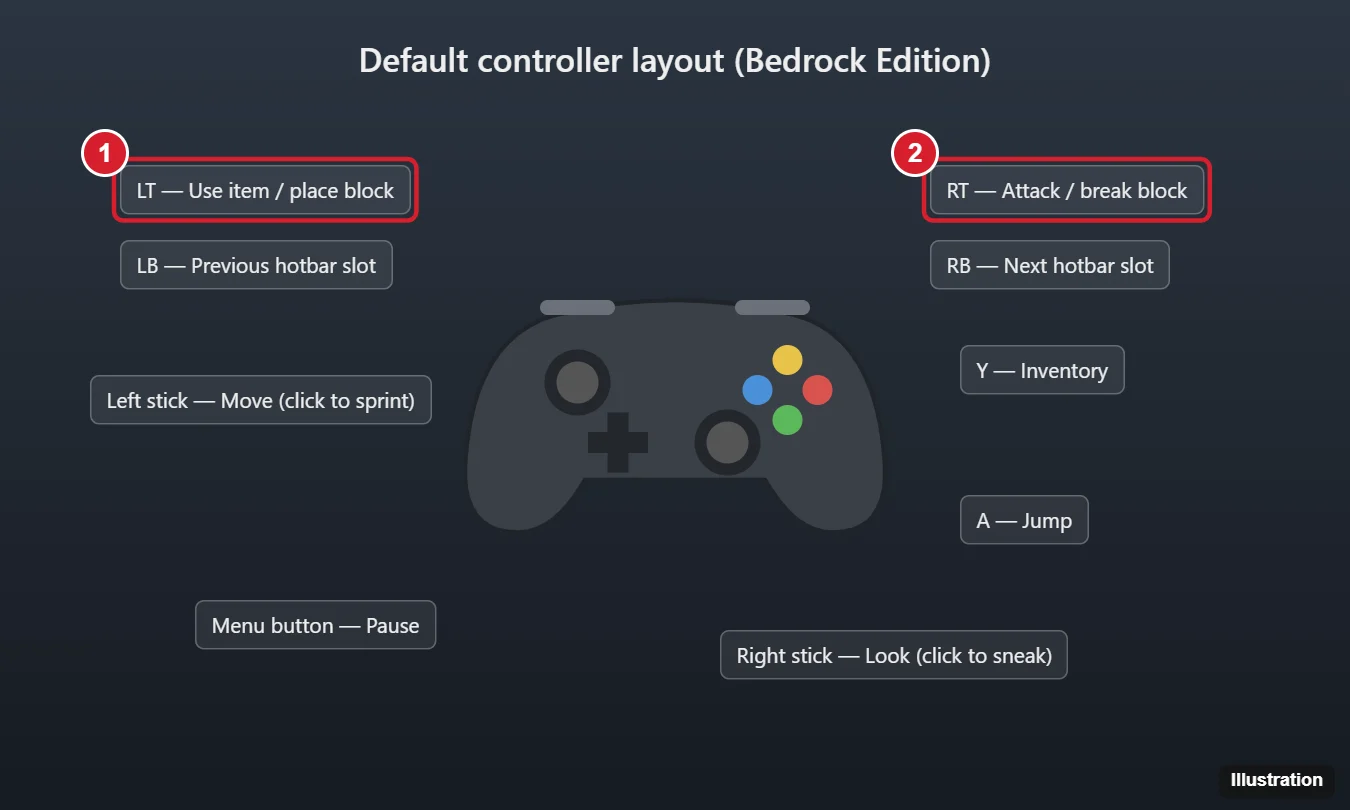
Core Bedrock controls
| Button | Action |
|---|---|
| Left stick | Move (press to sprint) |
| Right stick | Look around (press to sneak) |
| RT (R2) | Attack / break block |
| LT (L2) | Use item / place block |
| LB / RB (L1 / R1) | Switch hotbar slot |
| A (Cross) | Jump / swim up / fly |
| Y (Triangle) | Open inventory |
| Menu (Options) | Pause |
Button names differ on PlayStation controllers, but positions are the same. Xbox controllers have the best support in Bedrock. If a PlayStation controller doesn’t respond, try USB instead of Bluetooth, update Windows, or use Steam (Step 2C).
Step 2B: Use a Controller in Java Edition With a Mod
Java Edition has no built-in controller support, so a mod is the most complete option. Controlify is a popular free mod that adds native controller support, on-screen button prompts, a virtual keyboard, and vibration, and it supports Xbox, PlayStation, Switch Pro, and many other controllers.
- Install a mod loader that matches your Minecraft version: Fabric (fabricmc.net) or NeoForge, depending on which the mod supports for your version.
- Download Controlify (and any required library mods listed on its page) from Modrinth or CurseForge, choosing the file for your Minecraft version and loader.
- Press Windows + R, type %appdata%\.minecraft\mods, and put the downloaded .jar files there (create the folder if needed).
- Open the Minecraft Launcher, select the Fabric or NeoForge profile, and click Play.
- Press a button on the controller. Controlify detects it and walks you through setup.
Only download mods from Modrinth, CurseForge, or the developer’s official page. Mods from random sites can contain malware.
Step 2C: Use Steam Input (Java or Bedrock, No Mods)
- Install Steam and sign in.
- Click Games > Add a Non-Steam Game to My Library and add the Minecraft Launcher.
- Right-click it in your library, choose Properties > Controller, and enable Steam Input.
- Open the controller layout, search community layouts for Minecraft, and apply one, or map buttons to keys yourself (for example, RT to left mouse button, LT to right mouse button, right stick to mouse movement).
- Launch Minecraft from Steam so the mapping stays active.
Apps like reWASD (paid) or JoyToKey can do similar mapping without Steam.
Troubleshooting
- Controller works in Windows but not in the game: Close the game, reconnect the controller, and relaunch. In Bedrock, check that no second controller or steering wheel is connected.
- Camera drifts: Increase the stick dead zone in Controls settings (Bedrock or Controlify), or calibrate in joy.cpl > Properties.
- Double input with Steam and a mod: Don’t use Steam Input and Controlify together. Turn off Steam Input for Minecraft if you use the mod.
- PlayStation controller not detected: Use Steam Input, which supports DualShock and DualSense well, or connect by USB.
Frequently Asked Questions
Does Minecraft Java Edition support controllers natively?
No. You need a mod like Controlify or a mapping tool like Steam Input.
Can I use a controller on Windows 11 the same way?
Yes. The steps are the same, though Bluetooth settings are under Settings > Bluetooth & devices.
Can I switch between controller and keyboard?
Yes. In Bedrock, using the mouse or keyboard switches back automatically, and pressing a controller button switches to controller mode.
Summary
- Connect your controller by USB or Bluetooth and check it in joy.cpl.
- Bedrock Edition: just press a button; customize in Settings > Controls > Controller.
- Java Edition: install Controlify with Fabric or NeoForge.
- Or use Steam Input to map the controller for either edition.

Matthew Burleigh is the head writer at solveyourtech.com, where he covers topics like the iPhone, Microsoft Office, and Google apps. He has a Bachelor’s and Master’s degree in Computer Science and has over 15 years of IT experience.
He has been writing online since 2008 and has published thousands of articles that have been read millions of times.